

Archaeologists from the Wisconsin Historical Society announced on November 19, 2025 that they mapped 16 ancient dugout canoes in Lake Mendota.
They believe the site follows old Indigenous trails and suggest people placed the canoes there for shared use, like a bike-share dock.
Age and Significance of the Finds
- Radiocarbon dating shows a wide age range. The oldest canoe is about 5,200 years old, while the newest is around 700 years old.
- The oldest canoe predates the construction of the Great Pyramid of Giza.
- Researchers note that several canoes are the oldest in the Great Lakes region and among the oldest in eastern North America.
What This Reveals About Indigenous Watercraft Culture
Archaeologists describe the canoes as dugouts carved from single logs, often red or white oak. This method appears across many societies and spans thousands of years.
Additionally, WHS archaeologists, working with local Indigenous groups such as the Ho-Chunk Nation and the Bad River Band of the Lake Superior Chippewa, suggest the canoes served as communal property.
Furthermore, communities likely stored the canoes at a lakeshore “dock” and left them for shared use. This system supported travel, trade, and access to nearby sacred sites.
Preservation Status & Future Research
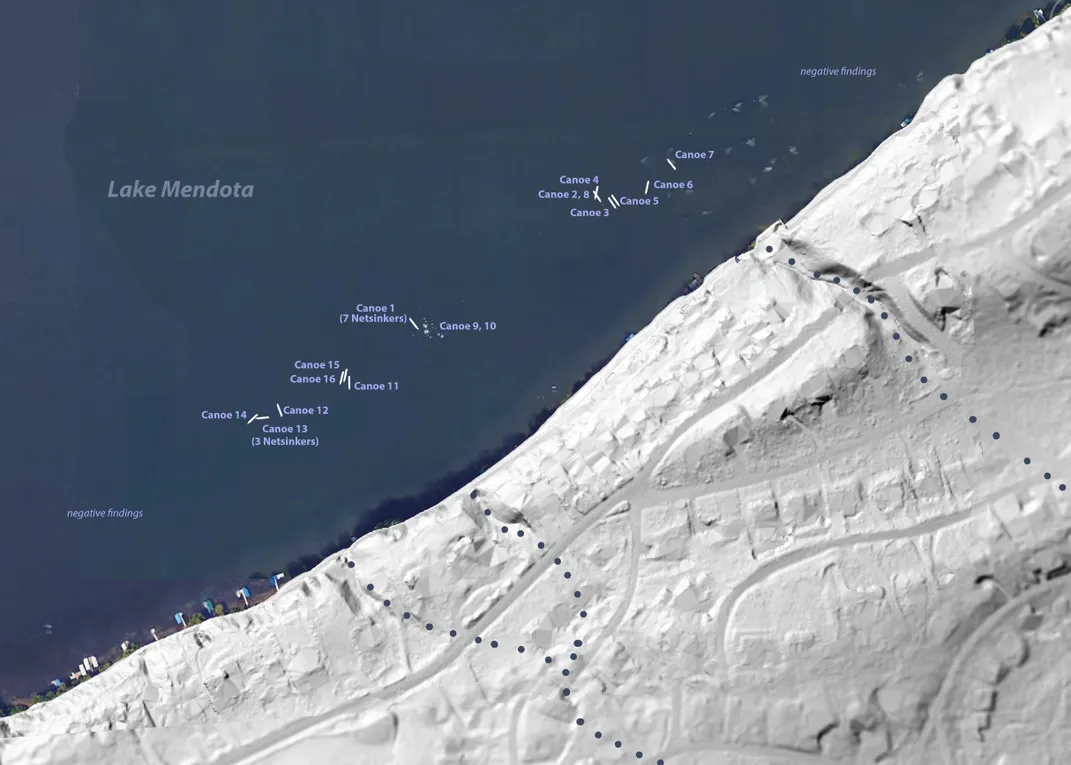
- Two of the 16 canoes have already been retrieved (in 2021 and 2022) and are undergoing a multi-year preservation process; one is slated for public display at the future museum of the Wisconsin History Center.
- The remaining 14 canoes remain submerged to preserve their integrity. Archaeologists continue to map and document the lakebed site, hoping to better understand the patterns of canoe placement and usage over millennia.
Expanding Our Understanding of Prehistoric Mobility
This discovery reshapes our understanding of prehistoric mobility in the Great Lakes region. It provides concrete evidence that Indigenous communities maintained a systematic network of watercraft — shared and maintained — enabling travel, trade and access across water and land over thousands of years.
As a result, these findings open a new chapter in underwater archaeology, Indigenous history, and cultural heritage. They may also inspire new research into ancient transport systems and community practices far older than previously documented.
