
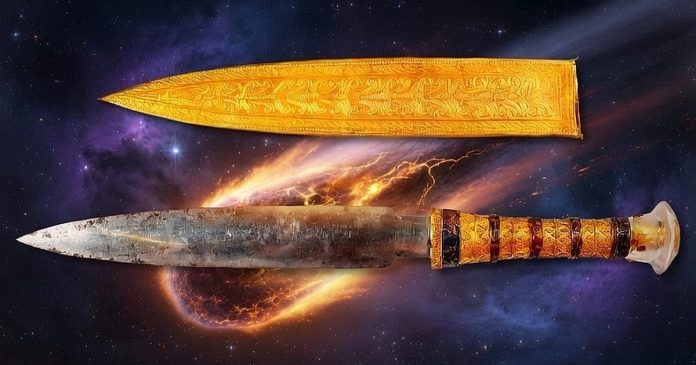
Howard Carter discovered Tutankhamen’s meteoritic iron dagger in the boy king’s opulent tomb in Egypt’s Valley of the Kings in 1922. For centuries, this artifact has puzzled historians and scientists. It dates to around 1352 B.C. during the Late Bronze Age. Therefore, it predates the widespread use of iron smelting by centuries. In that era, people often viewed iron as a divine gift. After all, it typically came from meteorites falling from the sky. A study published in Meteoritics & Planetary Science in 2022 reveals how artisans forged this extraterrestrial iron into a weapon. Additionally, it explores the dagger’s likely origins. In doing so, the research combines advanced science with ancient diplomacy.
A Dagger from the Stars
The Iron Age started around 1200 B.C. During this period, societies mastered smelting iron from ore. However, iron artifacts were rare in the earlier Bronze Age. They usually came from meteorites rich in iron and nickel. For example, an iron dagger from Alaca Hoyuk in Turkey dates to 2300 B.C. Similarly, beads from Egyptian tombs trace back to around 3200 B.C. Tutankhamen’s dagger stands out because of its excellent preservation. As a result, it allows for in-depth study.
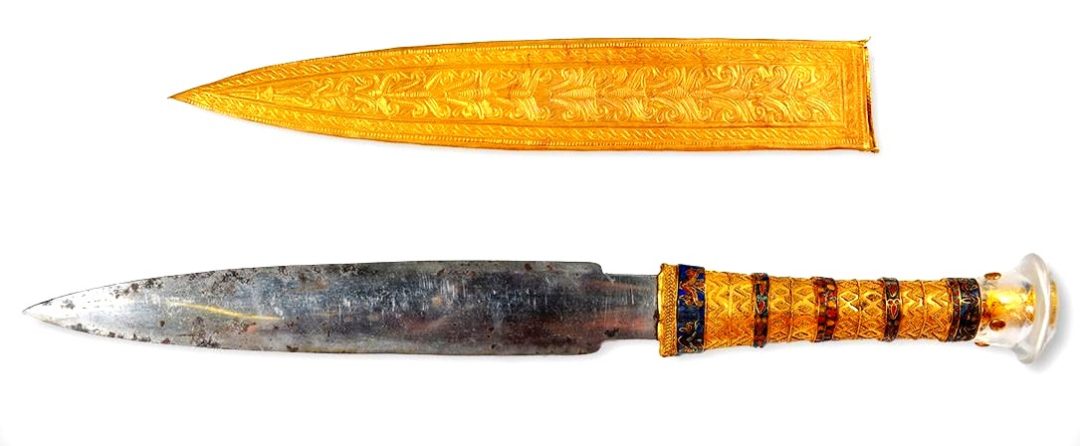
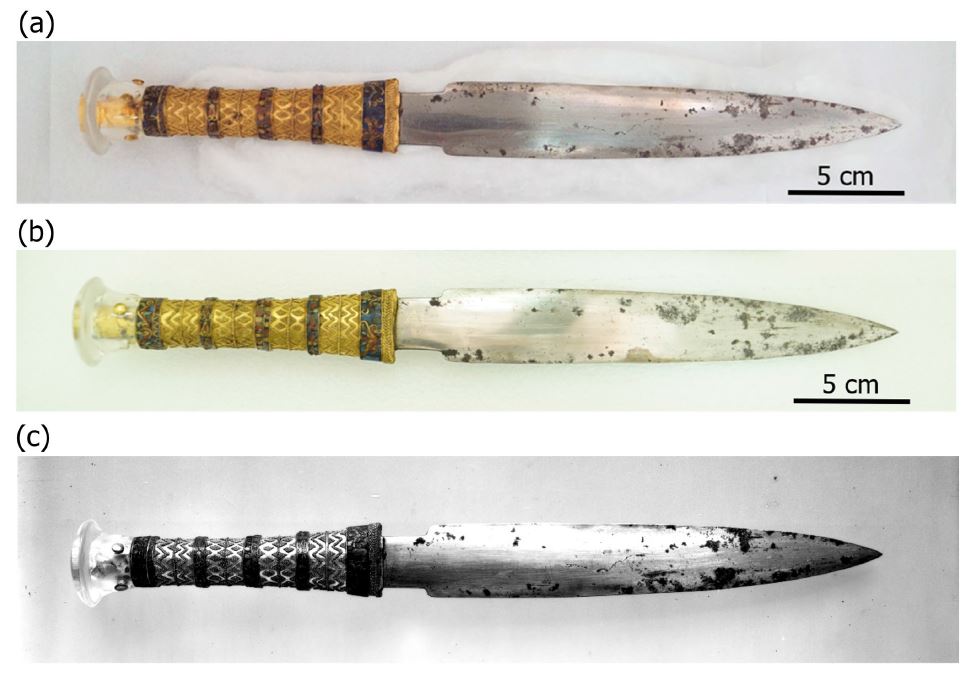
The dagger features a 21.8 cm blade attached to a 13.4 cm gold hilt. Precious stones like lapis lazuli, carnelian, and malachite adorn the hilt. Intricate gold grain patterns enhance it further. The blade shows fine polishing scratches, a prominent crack, and black spots. Nevertheless, no major corrosion has appeared since its discovery. Research from 2016 confirmed its meteoritic origin. It noted a high nickel content of about 11 wt%, typical for iron meteorites. Still, questions remained about its creation. For instance, did Egyptians forge meteoritic iron themselves? Or did they import the dagger?
Peering into the Past Without a Scratch
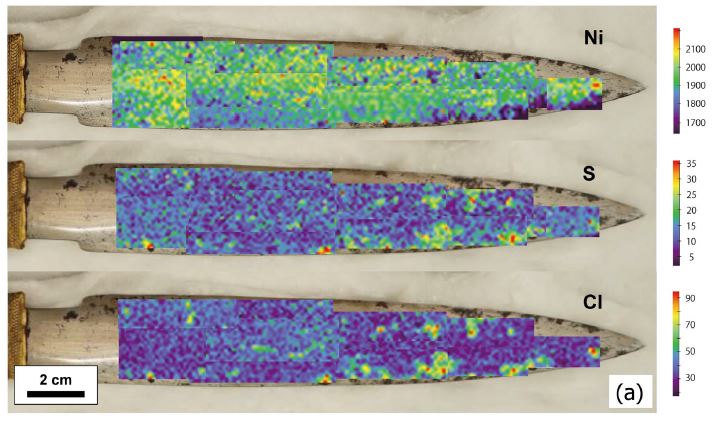
XRF Image Source: https://doi.org/10.1111/maps.13787 CC BY-NC-ND 4.0
To resolve these questions, Takafumi Matsui’s team from Japan’s Chiba Institute of Technology conducted nondestructive analyses. They did this at the Egyptian Museum in Cairo in February 2020. Using a portable X-ray fluorescence spectrometer, they mapped elements like nickel, sulfur, and chlorine on the surface. Importantly, they made no physical contact. For comparison, they analyzed Japan’s Shirahagi iron meteorite, source of the historical sword Ryuseito. This step validated their results on Tutankhamen’s dagger.
Forged in Low Heat
XRF mapping uncovered a hidden pattern on the blade. It showed discontinuous nickel bands about 1 mm wide. These arranged in cubic symmetry in some areas. This matches the Widmanstätten pattern, formed as meteorites cool slowly in space over millions of years. Specifically, it includes interlocking plates of nickel-poor kamacite and nickel-rich taenite.
Therefore, the blade came from an octahedrite meteorite. This type has 5 to 18 wt% nickel and band widths of 0.5 to 1.3 mm. Artisans forged it at low temperatures below 950°C. In this way, they shaped the metal while keeping its cosmic structure. Otherwise, high heat would melt and erase the pattern.
Evidence from Black Spots
The black spots and crack provided more clues. These bubbly features are rich in sulfur and chlorine. They originate from troilite (FeS) inclusions common in iron meteorites. During forging in Earth’s atmosphere, heating caused oxidation and sulfur loss. As a result, troilite became porous iron oxides.
The reaction is 2FeS + 3/2O₂ → Fe₂O₃ + 2S (gas). Experiments with modern meteorites like Gibeon replicate this. Low-heat forging preserves the Widmanstätten pattern. At the same time, it creates cracks and spots from troilite. Moreover, the dagger’s low phosphorus and sulfur (below 0.1 wt%) prevented excessive cracking during forging.
A Golden Hilt with a Foreign Accent
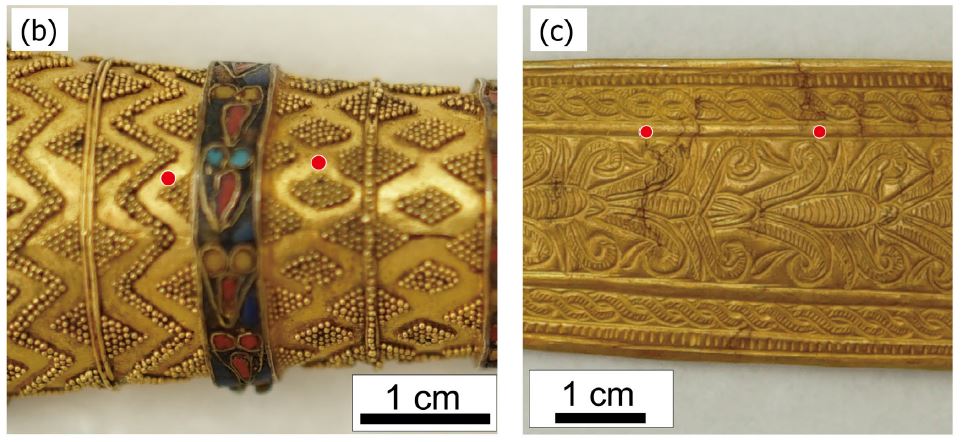
The hilt and sheath consist of gold at 93 to 96 wt% Au, with silver and copper traces. Semiquantitative XRF found 1.7 to 3.3 wt% calcium on the hilt. This is higher than usual for ancient gold. However, no sulfur was detected. The calcium probably comes from adhesive for the stones and gold grains.
In ancient Egypt, adhesives included organic glues from animals or plants. Plasters were also common. Gypsum plaster (CaSO₄-based) contains sulfur. In contrast, lime plaster (from CaO or Ca(OH)₂) does not. Thus, the data points to lime plaster. Yet, lime production requires 900 to 950°C heat. Egyptians adopted it widely only in the Ptolemaic period (305 to 30 B.C.), after Tutankhamen.
This timing mismatch suggests a foreign origin. The Amarna letters support this idea. They record gifts from Mitanni’s king Tushratta to Amenhotep III, Tutankhamen’s grandfather. One describes an iron dagger with a gold hilt, possibly this one. “I send to my brother a dagger of iron, its sheath of gold, fashioned as a gift of friendship.” Notably, Mitanni and Hittites advanced in ironworking earlier. They also used lime plaster before Egyptians.
Echoes from the Bronze Age
This study depicts the dagger as a Bronze Age masterpiece. Artisans forged it from octahedrite meteorite at low heat. Consequently, they preserved its stellar traits. It may have been a diplomatic gift symbolizing alliance. The research highlights Anatolia as an early iron tech hub. There, meteoritic iron working began by 2300 B.C. To ancients, such blades were divine, from the heavens. Today, the dagger connects archaeology, materials science, and cosmology. Ultimately, it shows humanity’s age-old reach for the stars.
For more ancient Egyptian relic tales check out: Lost at Sea: Sarcophagi of Menkaure Saga
