
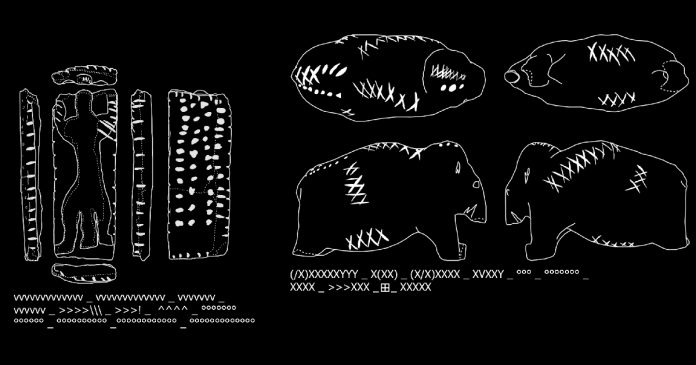
Aurignacians were using geometric markings on artifacts in a deliberate and systematic way. A groundbreaking study was published in the Proceedings of the National Academy of Sciences. Researchers Christian Bentz Et al have uncovered evidence that early modern humans, in Europe, developed a sophisticated system of conventional signs as far back as 40,000 years ago. This discovery pushes back our understanding of human symbolic communication by tens of thousands of years. Comparable in complexity to the earliest known proto-writing systems from ancient Mesopotamia.
The Aurignacian Culture: Pioneers of European Prehistory
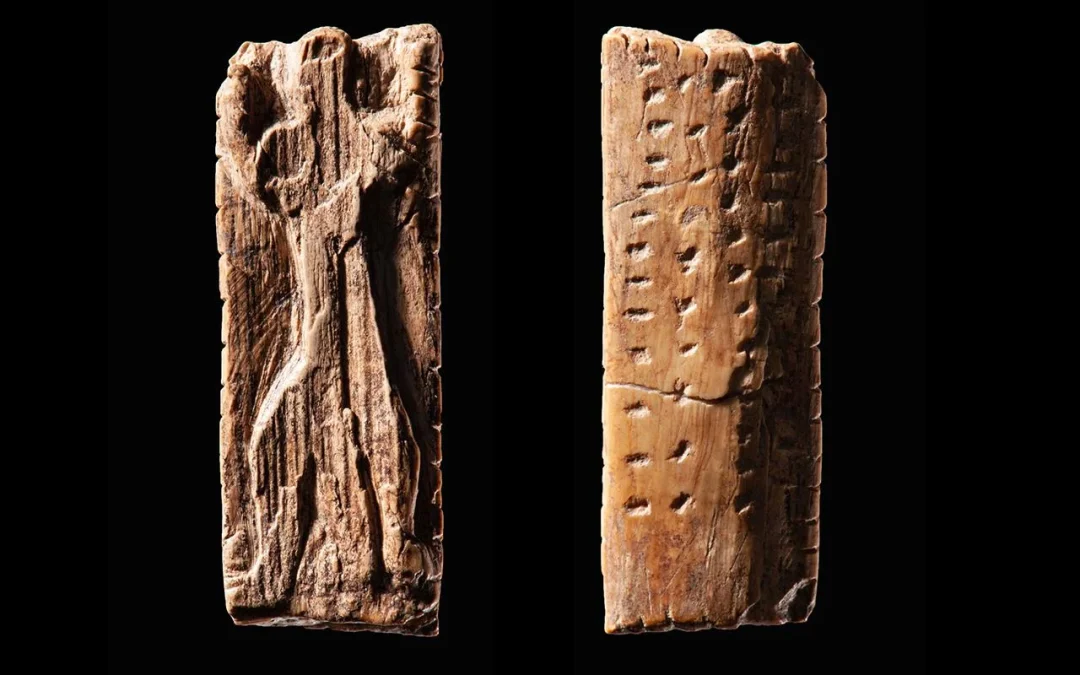
The Aurignacian period, spanning roughly 43,000 to 34,000 years ago. It marks the arrival of anatomically modern humans (Homo sapiens) in Central Europe. These early settlers coexisted briefly with Neanderthals. They inhabited cave systems in the Swabian Jura region of southwestern Germany, including sites like Vogelherd, Hohle Fels, and Geissenklösterle. Crafting a rich array of mobile artifacts from materials like mammoth ivory, bone, and antlers. Including tools, musical instruments (such as flutes), personal ornaments, and intricate figurines. Some depicting animals like woolly mammoths, cave lions, and horses, as well as anthropomorphic and hybrid human-animal forms.
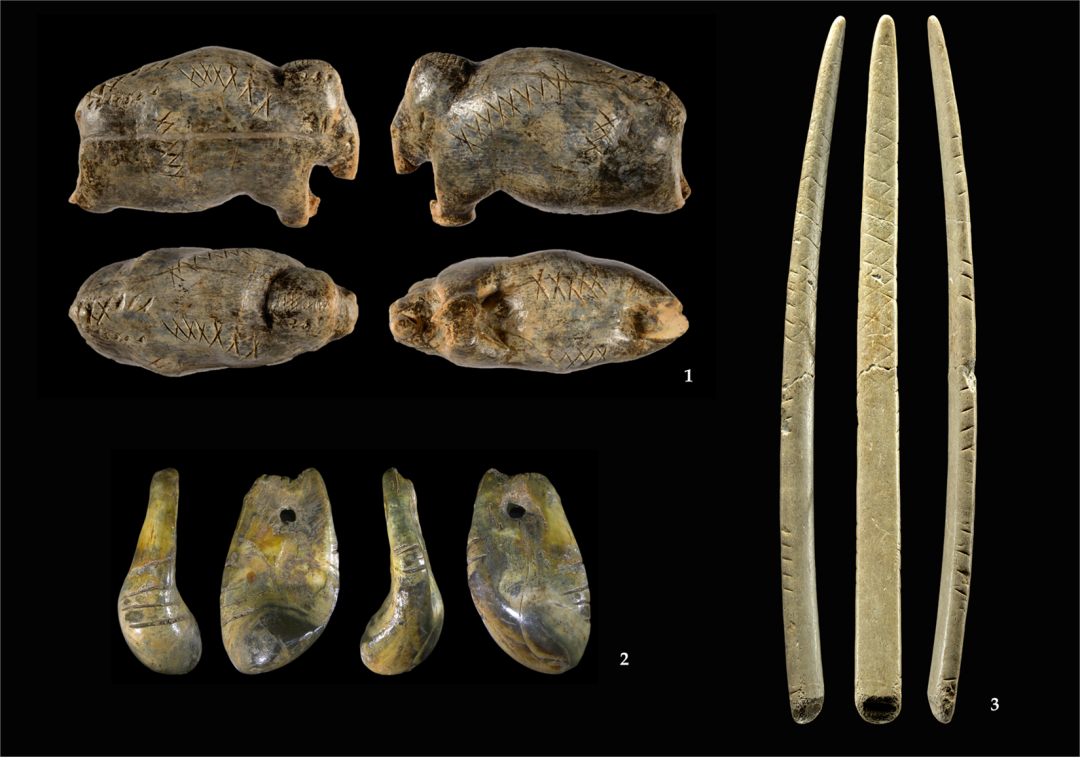
What sets these artifacts apart are the thousands of geometric signs engraved on their surfaces, lines, dots, crosses, zigzags, stars, and grids. Previous theories have speculated on their purpose, ranging from decorative elements to early numerical notations or even artificial memory systems. However, Bentz and Dutkiewicz’s study is the first to quantitatively analyze these signs using tools from linguistics and information theory, treating them as “sign sequences” to reveal their underlying structure.
A Quantitative Dive into Ancient Signs
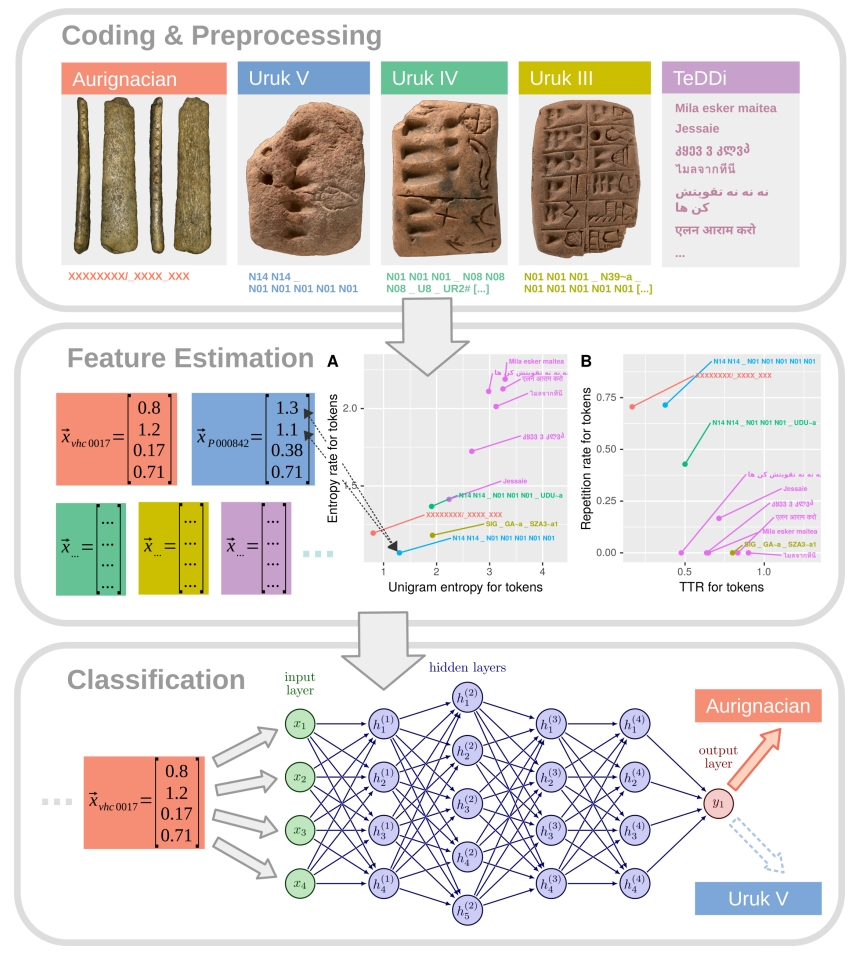
The researchers compiled a corpus of over 260 artifacts (213 after preprocessing), extracting more than 3,000 sign sequences. They applied statistical models from quantitative linguistics, including type-token ratios (measuring diversity of signs), unigram entropies (assessing unpredictability of individual signs), entropy rates (evaluating sequential patterns), and repetition rates (tracking how often signs repeat adjacently).
These features were compared to two benchmarks:
- Protocuneiform tablets from Uruk in ancient Mesopotamia (modern-day Iraq), dating from 3500–3000 BCE. These are among the earliest known precursors to true writing, starting as simple numeric records (Uruk V) and evolving into more complex numero-ideographic systems (Uruk IV and III).
- Modern writing systems from 89 languages across 16 scripts, sampled from the Text Data Diversity (TeDDi) database.
Results of Analysis
The results were striking: Aurignacian sign sequences share a “statistical fingerprint” with the earliest Uruk V protocuneiform—low entropies paired with high repetition rates and short lengths (median 8 signs). This suggests similar levels of complexity, potentially encoding numero-ideographic information like counts or basic concepts. However, they diverge from later Uruk periods, which show increasing entropy as the system complexified toward full writing. Modern scripts, in contrast, exhibit high entropies and low repetitions, reflecting the avoidance of adjacent repeats common in human languages.
Classification algorithms (K-Nearest Neighbors and Multi-Layer Perceptrons) confirmed this: Aurignacian sequences are indistinguishable from Uruk V (accuracy not above baseline), but clearly separable from modern writing (nearly 100% accuracy).
Furthermore, regression models revealed that signs weren’t applied randomly. Ivory figurines (anthropomorphic and zoomorphic) carried sequences with ~15% higher information density than tools, independent of factors like object size, preservation, or age. This selectivity (e.g., crosses on horses and tools, dots on humans and felines) indicates deliberate conventions passed down over generations.
Not Writing, But a Step Toward It
The study emphasizes that these signs don’t qualify as “writing” in the strict sense. Becasue they lack the phonetic link to spoken language seen in modern scripts. Instead, they represent a “system of intentional and conventional signs,”. Signs with design features like linear arrangement and a finite inventory. But, without full combinatoriality or the rebus principle (using signs for sounds).
This challenges the timeline of symbolic evolution. While true writing emerged independently in Mesopotamia, Egypt, China, and Mesoamerica around 5,000–3,000 years ago, the Aurignacian system predates it by ~35,000 years. Unlike protocuneiform, which evolved amid economic pressures into Sumerian script within 1,000 years, the Aurignacian signs remained stable for 10,000 years before vanishing.
The findings align with theories of “expanded information capacity” in human cognition, suggesting early Homo sapiens had the mental tools for complex sign systems. They also open doors to “Evolutionary Semiotics,” bridging archaeology, linguistics, and cognitive science.
Broader Implications for Human History
This research not only rewrites the story of prehistoric Europe but also highlights how quantitative methods can decode ancient mysteries. As Bentz notes in the paper, these signs prove that “the first hunter-gatherers arriving in Europe already applied sign sequences of comparable complexity in a deliberate, systematic, and conventional manner, several ten thousand years before the advent of genuine writing.”
Summarizing
In essence, the Aurignacian signs appear to represent an early step in human symbolic recording. Potentially a practical tool for noting quantities and ideas in everyday life. Think of it as our ancestors’ version of a basic ledger. Tallying up hunts, marking the passage of moons, or keeping tabs on animal movements to better navigate their Ice Age world. While we can’t decode exact meanings, the deliberate patterns suggest these hunter-gatherers were already harnessing symbols in clever, conventional ways to share knowledge and survive.
