
Abstract
The Ploutonion (Ploutonion/Plutonium) of Hierapolis in the southwest area of Anatolia (now Pamukkale, Denizli) is an particularly obvious case in which a persistent geophysical phenomenon influenced architectural form, ritual choreography, and the production of religious authority. Engineers erected the sanctuary over a natural vent that releases carbon dioxide (CO₂), a colorless asphyxiant denser than air, so it pools at low elevations in calm conditions. Recent measurements recorded CO₂ concentrations up to 91% inside the grotto and lethal levels at the entrance; readings outside also rise and fall with height above ground and time of day. This article integrates the study “Deadly CO₂ gases in the Plutonium of Hierapolis (Denizli, Türkiye)” and positions its results in the archaeological, historical and hazard-management context of the UNESCO World Heritage site Hierapolis-Pamukkale.
Introduction: An Active Gas Vent based Sanctuary
Hierapolis-Pamukkale is internationally recognized for its travertine terraces formed by mineral-rich thermal waters and for the nearby ruins of the ancient city. UNESCO’s World Heritage description highlights the calcite-laden springs cascading down the cliff and the archaeological remains of Hierapolis. And in that wider terrain of geothermal activity, the Ploutonion provides a particular, and often beloved niche: an invented religious complex built at the mouth of a natural cavern that liberated deadly gases. In Greco-Roman texts, regions where “mephitic” exhalations would come out of the earth became far from simple environmental quirks; they were instead imagined to have thresholds between worlds. The Hierapolis Ploutonion became a typical “Gate to the underworld,” alluded to again and again in ancient myth and later in travel writing. What sets Hierapolis apart, however, is the capacity to measure the underlying physical mechanism now and relate it directly to the ancient accounts. The scientific study as employed in this work is both methodological and interpretive. It doesn’t invoke the Ploutonion as a metaphor or as a folkloric remnant; it just records a gas regime with modern instrumentation, and from this data it uses ancient testimonies about animal deaths and priestly performances to assess the ancient one.
Historical and Archaeological Background: Ritual, Spectatorship, and Authority
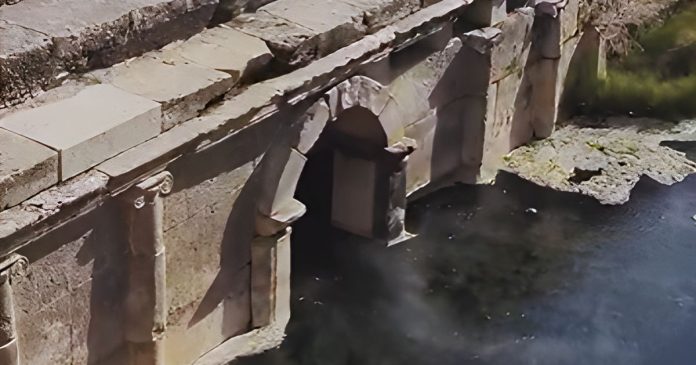
The sanctuary served more than a cult function; its designers also created a space for controlled visibility. Archaeologists have identified seating oriented toward the area in front of the subterranean grotto, a layout that enabled spectators to watch ritual performances. It is an important spatial arrangement. It suggests the site’s social purpose lay in constant demonstration of danger and mastery: a crowd observes, a victim (usually an animal) has died, and a specialist survives. The ancient authors referred to the place as deadly, describing the selective lethality of the space: certain bodies (mostly animals near the bottom) died quickly, while priests could rush in, enter or stay close under specific circumstances. The new research presents the findings straightaway, claiming that ancient authors like Strabo and Pliny reported on a real phenomenon “very exactly” with no exaggeration of the evidence. Two implications follow. First, the Ploutonion was a place where environmental knowledge — empirical, embodied, and probably guarded — metamorphosed into religious charisma. Second, the ritual system never strayed from micro-topography, where a cm of vertical space would distinguish lethal exposure from survivable when CO₂ becomes stratified near the ground.
Geological Setting: Fault-Controlled Degassing in the Pamukkale thermal province.
It contextualises the CO₂ emissions in an active tectonic world. Hierapolis is within a larger system of extensional tectonics in western Anatolia including many of the faults and grabens. The Ploutonion CO₂ is geogenic, and in line with an active seismic structure passing through the ancient city, which, in the authors’ interpretation, lies in the area of the Babadağ fracture zone. This matters for two reasons: Ongoing and predictable: Fault-controlled degassing may happen for the long timescales to integrate this effect into urban and sacred planning. Multiparameter gas signatures—Modern techniques indicate geogenic CO₂ degassing with mantle components and relatively high helium and radon concentrations (Wang and Hao 2006). In practice, Hierapolis is not an isolated “strange.” It is the linchpin of a geothermal landscape of which thermal waters, carbonate deposition, seismic fracturing and gas release together were the conditions under which settlement, tourism and cult took place.
Methods: In Situ Measurement of a Lethal Micro-Environment.
One of the main contributions of this discussed publication is the field approach. The authors describe the application of a portable gas analyzer to determine CO₂ concentrations within and nearby the Ploutonion. Significantly, they consider it to be a vertical structure of the site. Measurements were conducted at a range of heights above ground in front of the grotto over a 24-hour period: 15 cm, 40 cm, and 100 cm. This sampling approach addresses CO₂’s basic physical response in low-wind, near-ground conditions; CO₂ is denser than air, producing a “gas lake” that is shallow but deadly. The study also reports field constraints typical of wet geothermal settings. Water flowing through the grotto flooded the base area, so the team could not measure CO₂ at the “proper ground level” there. These constraints matter analytically because they show how difficult it can be to sample the lowest, most lethal layer directly even when its effects remain visible.
Results: Concentrations of lethal CO₂, Height Dependence and Diurnal Cycles
5.1. Inside the grotto. The most commonly cited result is the reported CO₂ concentration in the grotto: up to 91% CO₂ (a concentration that kills you quickly from oxygen displacement).
5.2. Exterior Concentrations and their influence upon the height. According to the study, CO₂ leaving from the grotto mouth into the air remains very high, and depends on the height above ground — 4 to 53% depending on your measurement height. DOI+1 This height dependence provides a direct explanatory bridge between (a) ancient tales of animal deaths and (b) the possibility that human specialists could survive by maintaining their breathing zone above the densest layer.
5.3. Time-of-day effects and the “gas lake” The authors describe dramatic diurnal dynamics: concentrations could peak at night periods that “would easily kill even a human being within a minute.” And they note an ongoing near-ground “gas lake” effect, and note biological evidence showing continued lethality to small fauna. They describe insect deaths associated with high-CO₂ phases and state that even in daytime a very thin gas layer (reported to go up to 5 cm in height) can persist. The measurement design specifically addresses these dynamics by measuring CO₂ across 24 h at 15, 40 and 100 cm above ground. The interpretive implication is simple: danger at the Ploutonion is not constant in space or time. It consists of microclimates (wind and temperature), topography, and the daily cycle.
Discussion: From a Physical Stratification Perspective to Ritual Choreography
6.1. Why sacrifices “worked” as public evidence The sacrificial demonstration at the Ploutonion would have been convincing through pictorial appeal, reproducible and visible from all angles. Animals, especially those kept close to the ground or that naturally breathe near it, encounter the highest CO₂ concentrations. Upright humans can reduce risk by keeping their breathing zone above the densest layer, avoiding low spots, and timing their movements to minimize exposure.The authors claim, clearly, that the measured concentrations shed light on ancient tales of killed bulls, rams and birds in ceremonies.
6.2. Priestly survival as expert regulation The “miracle” is not that some bodies survived while others perished. The miracle is that the conditions of survival could be navigated without modern theory, via observation and tradition: with knowledge of where to stand, when to approach, and how long to remain. The paper’s focus on the gradients of height and variation in time of day enables a way to make authority: priests are privileged in their practical knowledge about the unseen danger.
6.3. Ancient testimony and modern measurement But the study’s grander historiographical assertion is a telling one: for at least Hierapolis, ancient authors were correct to characterize a “mystic phenomenon” accurately. This is a useful antidote to simplistic binaries that represent ancient accounts as literal “superstition,” or in their pure fiction. Rather, the Ploutonon becomes a case of both religious interpretation and careful empirical noticing.
Cultural Heritage Management and Safety
7.1. The Ploutonion as a living hazard site Because degassing is still taking place, the Ploutonion is more than a simple archaeological monument; it is a dangerous operating environment inside a tourism area. The researchers say lethal concentrations remain in the environment and can kill animals today.
7.2. Use quantitative thresholds to communicate risk It can be useful to convert the Ploutonion’s CO₂ emissions to contemporary occupational safety language to read the scale. OSHA’s permissible exposure limit (PEL) for CO₂ is 5,000 ppm as an 8-hour time-weighted average (0.5% by volume), whereas short-term limits are far below multi-percent concentrations reported at the Ploutonion entrance and well below the up to 91% level inside the grotto. That does not mean that an ancient sanctuary could be organized as an industrial workplace. Instead modern thresholds offer an interpretive yardstick: the Ploutonion’s measured concentrations are not marginally dangerous; they sit in an extreme range that can generate rapid incapacitation in enclosed or low-lying zones.
7.3. UNESCO context: preserving a living geothermal landscape UNESCO presents Hierapolis-Pamukkale as a coupled cultural-natural site with its travertine and the waters at the heart of its value. The Ploutonion extends this coupling to gases and faults. Conservation is therefore not only of stone and stratigraphy, but rather of active earth processes, and the process and the site in a manner that will protect not only its occupants and visitors, but also the phenomenon by which the site has been historically important.
Conclusion
The Ploutonion of Hierapolis is best conceived of as a geoarchaeological interface: an architectural and ritual complex to exploit the natural emission regime. Recent monitoring has shown that the levels of CO₂ inside the grotto can become lethal (up to 91%), and the concentrations outside are dangerously high, fluctuating widely with height above ground and time of day. Such gradients are what illustrate how ancient ritual could kill sacrificial beings as a matter of course in the presence of onlookers and be approached by skilled human specialists, at the same time being controlled. This study also suggests that ancient text was surprisingly precise in showing the site’s fatal nature. So Hierapolis’s “Gate to Hell” should not be simply described as a sensationalized anecdote. It is an extreme case study of how ancient societies recognized, monumentalized and ritualized phenomena in the earth, transforming invisible geochemistry into visible evidence, social order and ritualized spiritual significance. Simultaneously, its ongoing emissions mean it must work with modern risk communication and site management in a large World Heritage tourism landscape.
References (core sources used)
- Pfanz, H., Yüce, G., Gulbay, A. H., & Gokgoz, A. “Deadly CO₂ gases in the Plutonium of Hierapolis (Denizli, Turkey).” Archaeological and Anthropological Sciences (published online 12 Feb 2018; vol. 11, pp. 1359–1371, 2019).
- UNESCO World Heritage Centre. “Hierapolis-Pamukkale.” UNESCO World Heritage Centre
- Occupational Safety and Health Administration (OSHA). “Carbon Dioxide: Exposure Limits.”
