
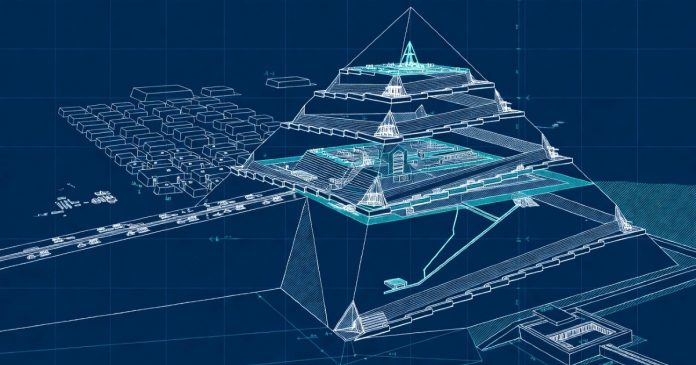
Latest Published Pyramid Construction Hypothesis Examined. The Great Pyramid of Giza remains one of history’s greatest puzzles. Built around 2560 BCE for Pharaoh Khufu, it soars 146 meters tall over a 230-meter square base. Millions of limestone blocks form its core, each averaging several tons. For centuries, experts have puzzled over how ancient Egyptians achieved this feat without modern machinery. Vicente Luis Rosel Roig’s 2026 paper in npj Heritage Science offers a bold new take. He introduces the Integrated Edge-Ramp (IER) model, backed by sophisticated simulations. Yet, as we explore further, questions about its practicality and supporting evidence emerge.
This examination contrasts Roig’s ideas with Jean-Pierre Houdin’s internal ramp theory. Drawing from historical records, engineering critiques, and scan data, I highlight key differences. Through careful examination, we’ll see how these models overlap and clash. In essence, Roig brings innovation, but Houdin’s empirical foundations still hold strong.
The Edge Ramp Concept
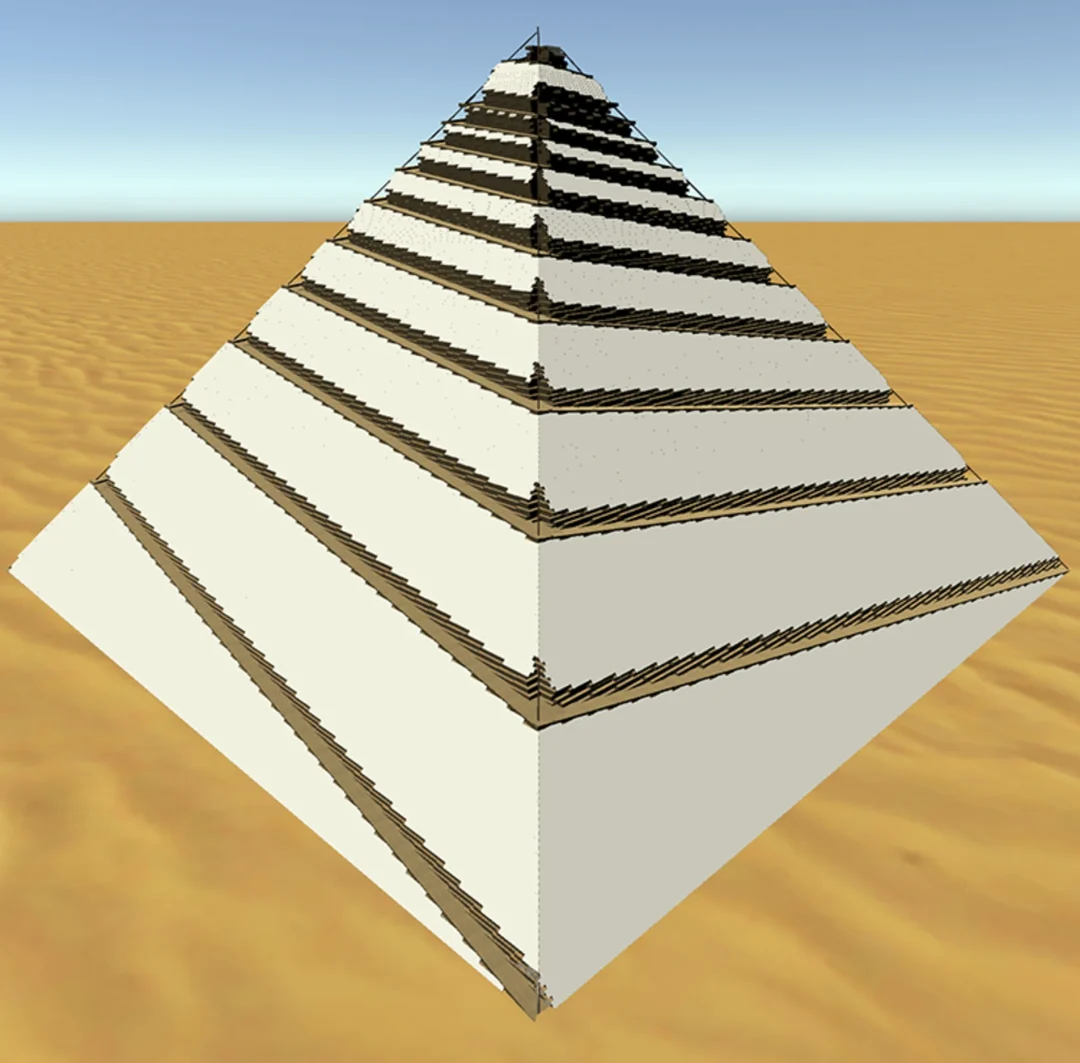
Roig’s IER model weaves ramps into the pyramid’s edges. Workers skipped certain perimeter blocks to create open-air helical paths. These lanes measure 3.8 meters wide and 4.26 meters high, with a standard 7-degree slope. Simple materials like adobe or planking leveled the floors, and sand reduced friction for sleds. The internal chambers Granite blocks pose unique challenges. Roig suggests placing them early and raising them via short 3- to 4-degree inclines on terraces.
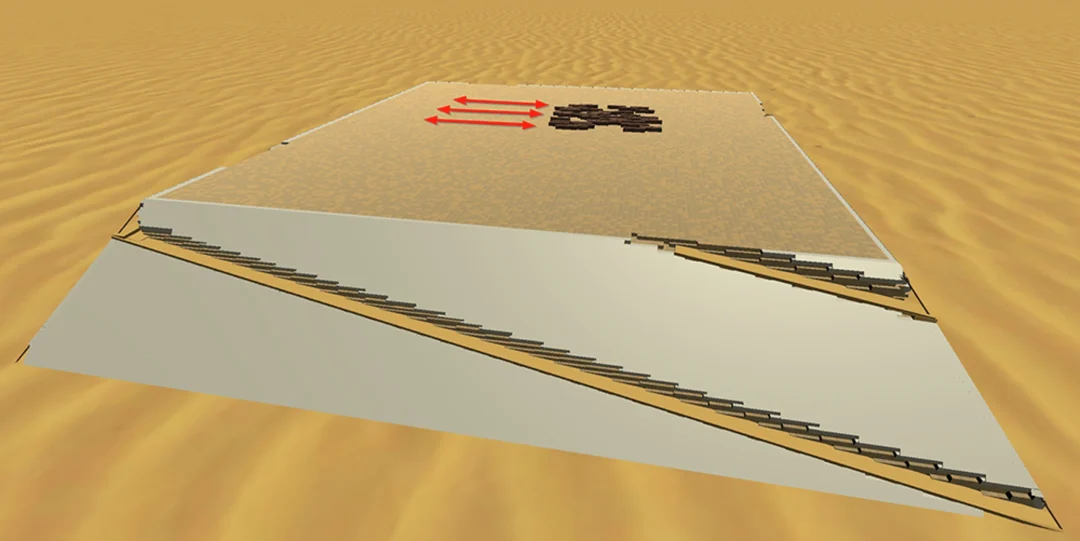
The system adapts as the pyramid grows. Lower levels use 16 ramps for rapid progress on broad bases. As space tightens, it scales down to 8, then 4, 2, and finally 1 ramp. Computer runs show blocks moving every 4 to 6 minutes. This pace leads to 13.8 to 20.6 years on-site. Add in stone extraction, river hauls, and flood-season breaks, and the full project spans 20 to 27 years.
Reliance on the Merer Papyri
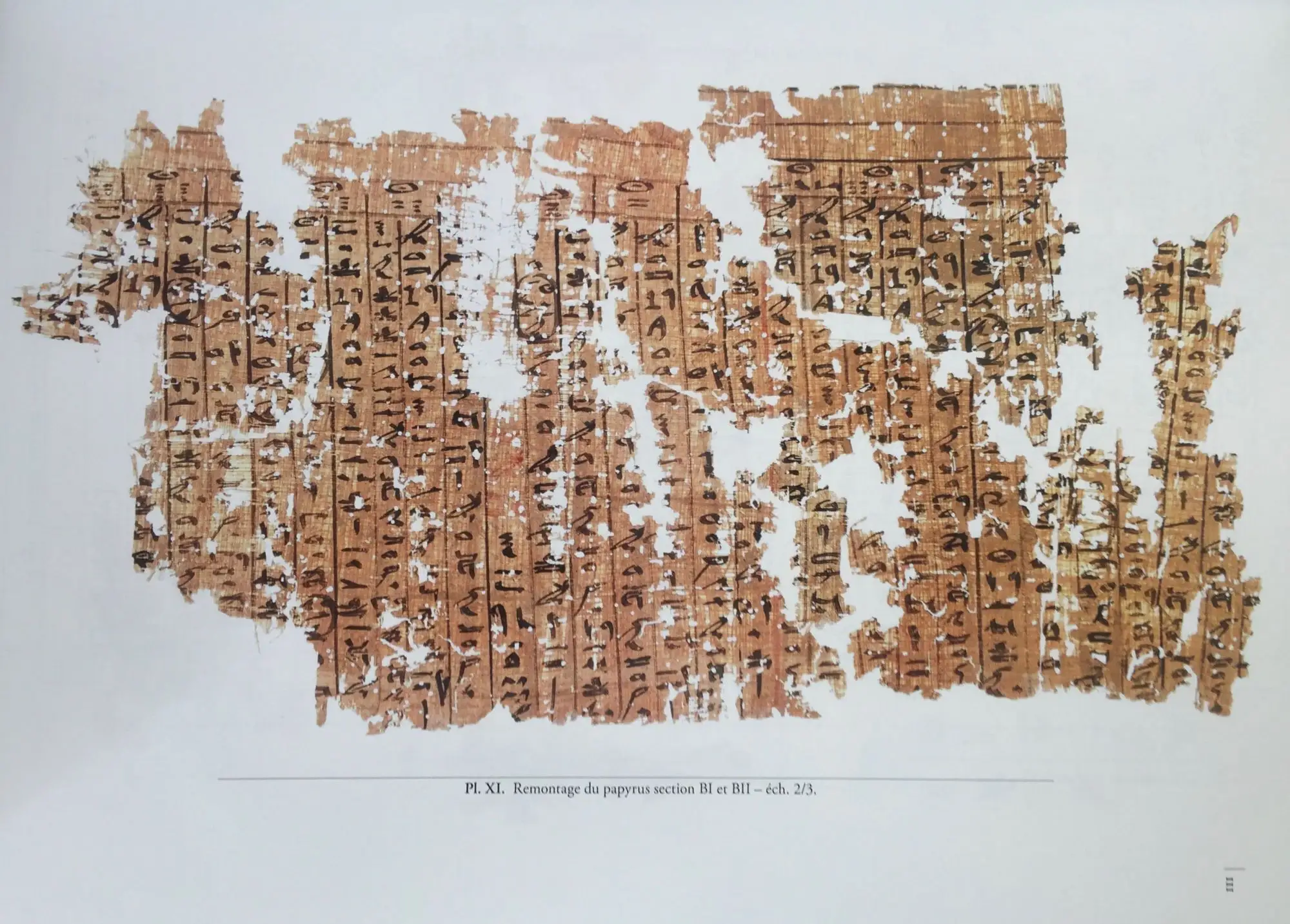
Roig anchors much of his 20-to-27-year construction window in the famous Wadi al-Jarf papyri. These fragile papyrus rolls, discovered in 2013 at an ancient Red Sea harbor south of Suez, are genuine Old Kingdom documents written during the final years of Khufu’s reign. The most complete roll is the diary of Inspector Merer, an official who oversaw teams of roughly 200 sailors and laborers. Merer’s daily entries describe loading fine white Tura limestone casing blocks onto boats, sailing north along the Nile and its man-made canals, and delivering the stones to the pyramid site known as “Akhet Khufu.” Trips took two to four days each way, and crews worked in tidy 10-day cycles with time for rest and rotation. The papyri also mention high-level oversight by Vizier Ankhhaf, Khufu’s half-brother, and they record the careful rationing of bread, beer, and grain—classic evidence of a well-organized, non-slave workforce.
That logistical detail is impressive and real. Yet when you read Pierre Tallet’s complete translations, the documents feel surprisingly quiet about the actual building process. Nowhere do they describe ramps, levers, sled paths, or how stones were lifted once they reached Giza. There is not a single line that tallies how many blocks were carried on any given boat or month. Phrases such as “loaded with stone” appear repeatedly, but no quantities follow. Modern scholars sometimes estimate “about 30 blocks per 10-day cycle” or “roughly 200 blocks a month,” but those numbers are educated guesses built from boat size, typical stone weight, and the pyramid’s overall scale—not from anything Merer actually wrote down.
Roig takes those inferences and stretches them further. He uses the papyri to support his minute-scale throughput claim (one block placed every three minutes on average) and then folds the 20-to-27-year reign window into his simulation results. The scrolls do confirm that Nile transport was vital and that the project was still active in Khufu’s 27th year, but they focus almost exclusively on late-stage casing work, not the core pyramid body. Merer was delivering the polished outer stones, not the millions of rough blocks that form the bulk of the structure. In addition, large sections of the papyri deal with separate Sinai mining expeditions for copper tools, not pyramid assembly at all.
Houdin’s internal-ramp theory sidesteps this problem entirely. It fits comfortably inside the same historical window without needing to lean so heavily on Merer’s logs for minute-by-minute proof. The papyri remain valuable, they humanize the workforce and prove sophisticated supply chains existed, but they simply do not contain the construction details Roig’s model asks them to carry. When a source is asked to do more heavy lifting than its own words allow, the argument starts to feel tenuous. That is the core weakness here: Roig treats indirect context as concrete support, while the papyri themselves stay stubbornly silent on the very mechanics his edge-ramp hypothesis needs to prove.
Comparison with Jean-Pierre Houdin’s Internal Ramp Theory
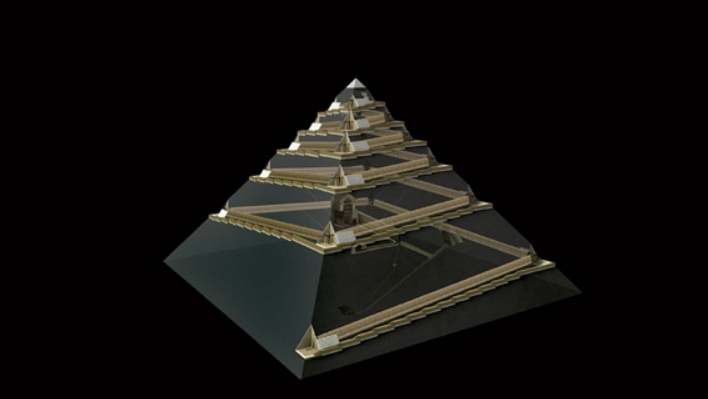
Jean-Pierre Houdin first laid out his dual-phase ramp theory in 2006 and refined it further in 2008. The idea is straightforward yet elegant. Builders started with a straight external ramp to raise the lower third of the pyramid; roughly the first 43 meters. Once that stage was complete, they switched to an internal spiral ramp that wound upward inside the structure at gentler 4-to-5-degree slopes. This kept the external footprint small and avoided the massive earthworks that other ramp theories require.
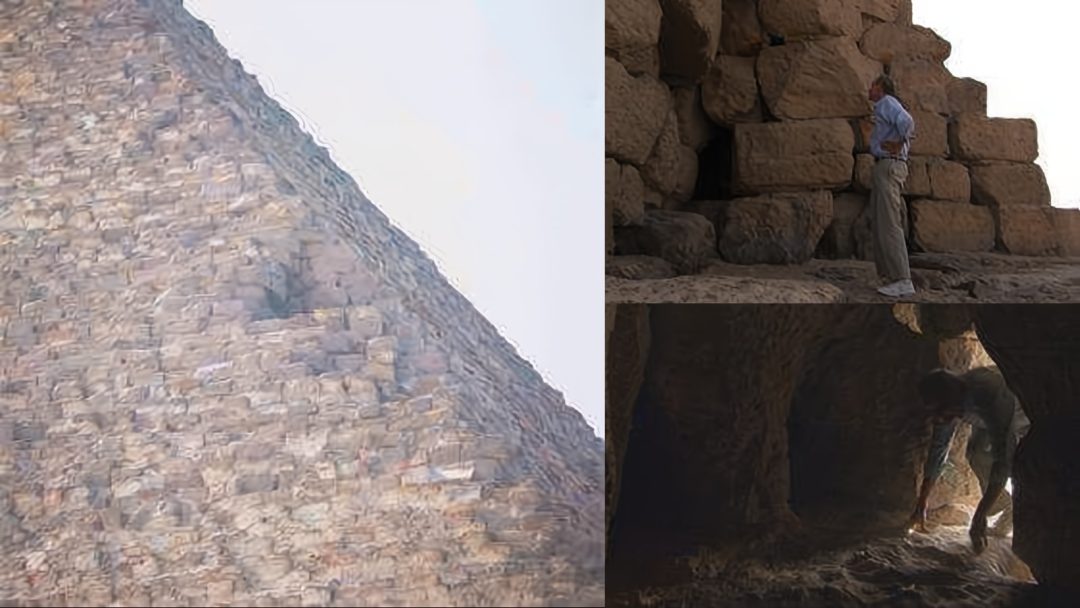
What makes Houdin’s model stand out is how he solved the turning problem that plagues most spiral designs. At every 90-degree corner, he placed open-air niches; temporary platforms cut into the face of the pyramid. These were not hidden tunnels; they were exposed workspaces where crews could pivot heavy blocks safely using levers and hoists. The most famous example is the northeast notch that Egyptologist Bob Brier climbed into and explored in 2008. Locals and researchers still call it “Bob’s Room.” It is roughly five meters deep, with clear signs of internal passages that continue inward. Brier’s firsthand inspection showed exactly the kind of maneuvering space Houdin had predicted decades earlier. These niches eliminate bottlenecks entirely. Teams could turn blocks without jamming traffic or forcing tight, dangerous maneuvers inside narrow corridors.
Houdin did not stop at sketches and guesses. He partnered with the French engineering giant Dassault Systèmes. Over two full years, a team of 14 professional engineers built a complete 3D digital simulation of the entire construction sequence. They tested every phase logistics, forces on the stone, worker movements, even the structural loads on the temporary niches. Much of that modeling work goes far beyond what has been published in books or papers. It exists in proprietary Dassault files that Houdin has referenced in interviews and presentations. The simulation confirmed that the internal spiral could handle the pyramid’s weight and the daily flow of blocks without collapse or gridlock.
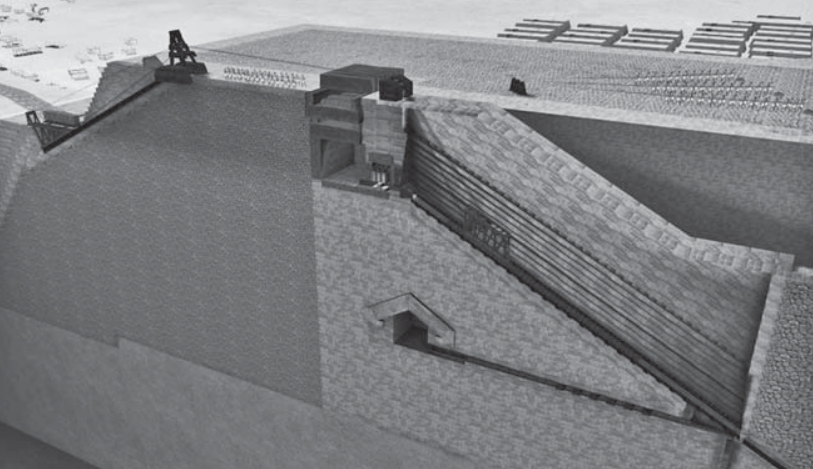
Roig, by contrast, critiques Houdin heavily for relying on “undocumented internal corridors.” He argues that a hidden spiral would block survey lines and clash with the latest muon scans. Roig’s IER keeps everything on the open edges so surveyors could always see the arrises and maintain perfect alignment. His helical paths supposedly match the discrete voids found by ScanPyramids (the Big Void and North Face Corridor) as backfilled omissions rather than long tunnels.
Yet Houdin’s design actually feels safer and more practical in several key ways. His gentler 4-to-5-degree slopes reduce the pulling force crews needed, making the work less exhausting than Roig’s steeper 7-degree lanes. The open-air corner niches remove the very bottlenecks Roig tries to solve with adaptive ramp counts and stochastic delay modeling. Houdin’s enclosed spiral also distributes loads through corbel-vaulted ceilings—stepped arches that ancient Egyptians already used in other tombs. Roig’s temporary edge omissions rely solely on the surrounding masonry for support, which feels riskier during the build.
Empirical clues tilt further toward Houdin. Bob Brier’s “Bob’s Room” is physical, climbable evidence that turning platforms existed exactly where Houdin said they would. The 1986 French-Japanese microgravimetric survey detected spiral zones of 5-to-10 percent lower density inside the pyramid; precisely the signature of an internal ramp path. Roig’s paper never mentions this gravimetry data at all, even though it is one of the earliest non-invasive scans that supported Houdin’s idea. Instead, Roig focuses only on muon tomography and claims his backfilled edges fit the same voids.
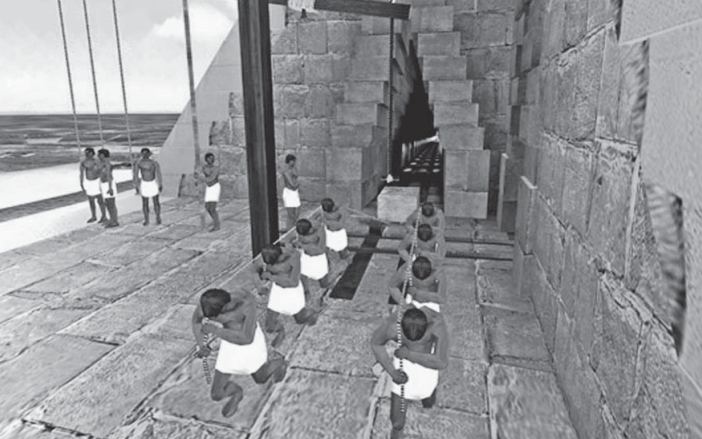
Both men say their ramps align with the muon results. Houdin predicted the Big Void decades before it was found and sees it as a natural leftover of his ramp. Roig interprets the same void as a series of backfilled omissions. Backfill could mask either system, but Houdin’s fully enclosed design with vaulted ceilings simply feels more stable under the pyramid’s enormous self-weight. Roig’s open-air edges, even if temporary, expose the structure to greater risk during the long years of construction.
In short, Houdin’s theory is not the bottleneck-plagued tunnel Roig sometimes portrays. The open corner niches, the real-world notch Brier explored, the Dassault modeling, and the 1986 gravity scan give it a stronger empirical foundation than Roig acknowledges. Houdin’s gentler slopes and protected internals make the work safer and the flow smoother, while Roig’s steeper, more aggressive edge ramps trade simplicity for speed at the cost of added risk. That contrast is one of the clearest places where Roig’s computational elegance meets Houdin’s hands-on, evidence-backed practicality.
What Modern Scans Really Tell Us
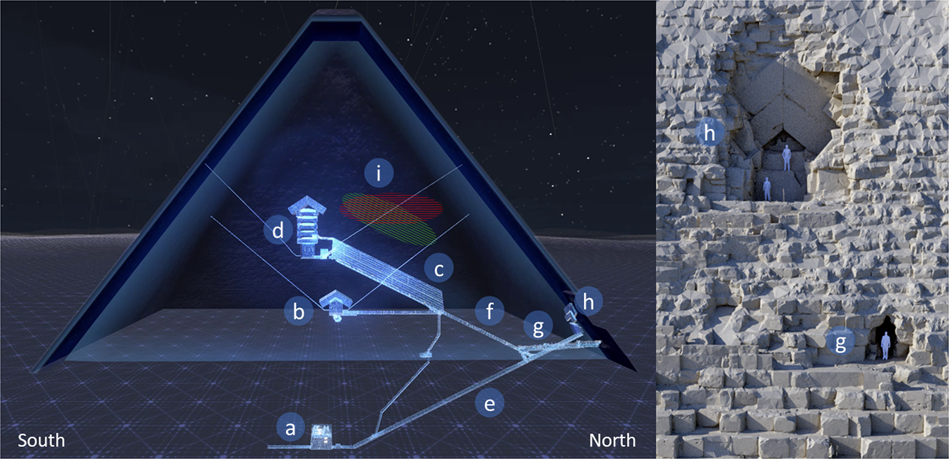
Scientists have used high-tech scans to peek inside the pyramid without drilling. The ScanPyramids project since 2015 uses muons, cosmic particles that pass through stone differently based on density. They’ve found the Big Void (a 100-foot space above the Grand Gallery) and the North Face Corridor (a chevron-shaped tunnel) which Houdins perdictive modelling said would be there almost a decade earlier.
Roig says his backfilled edges match these as localized spots, not long tunnels. Houdin claims the Big Void is part of his ramp. But muon detectors were placed in specific spots, like inside chambers or outside the entrance. They cover focused areas, not the whole pyramid—maybe 10-20% at best. A spiral ramp could easily dodge the beams. If filled with rubble, it might not show as a clear void.
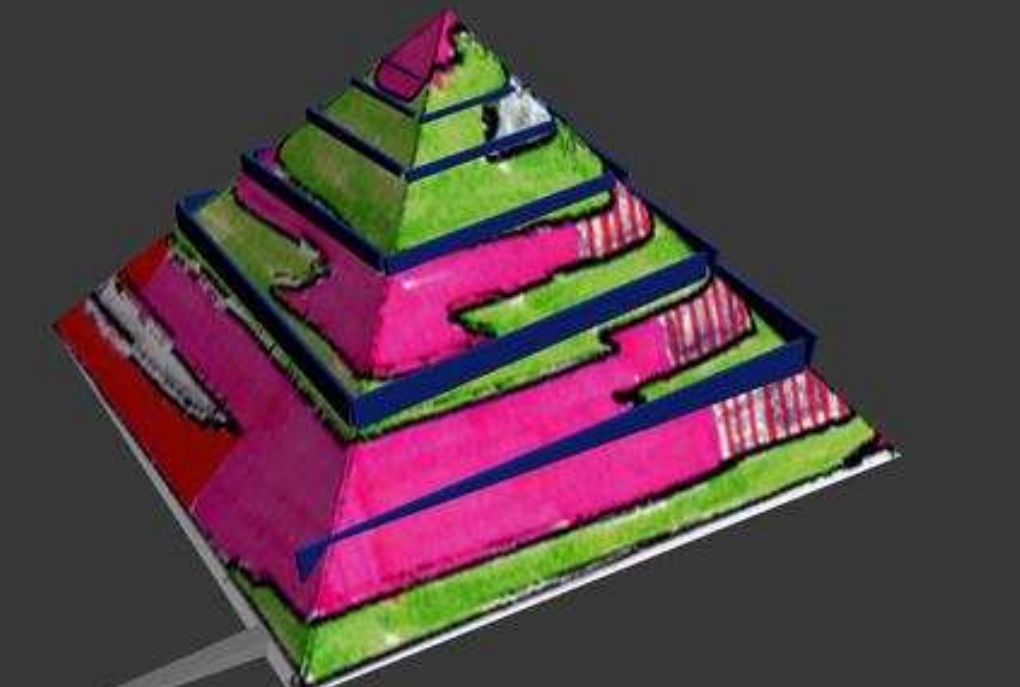
In 1986 gravity scan used measurements from thousands of points to map density. It showed spiral patterns with 5-10% less mass, fitting Houdin’s internals. Roig doesn’t mention it, sticking to muons.
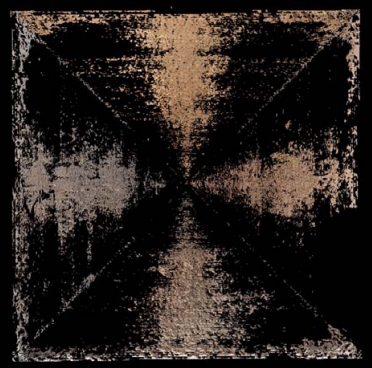
Then there’s the 2004 laser scans by RIEGL, processed with RiSCAN PRO software. These map the outside with laser points, creating 3D models. Top-down views show bulges, depressions, and color variations, darker spots from rougher stone or erosion. These discolorations although external might hint Houdin’s internal ramp due to slight settlement of the outer stones atop the backfilled internal ramp voids. These support Houdin loosely if anomalies link to underlying structures.
No scan proves or disproves the theories. Muons miss areas, gravity has low resolution, lasers stay external. We need combined methods or drills to know for sure.
Testing the Theories: What Comes Next?
Roig built his entire IER model to be testable, and he says so openly. He predicts specific archaeological signatures that future digs or scans could confirm or destroy. Look for narrow bands of slightly lower density along all four edges where the temporary haul lanes were backfilled with rubble and mortar.
Houdin makes equally clear predictions. He expects sealed internal corridors with corbel-vaulted ceilings and open-air niches at every corner turn. The northeast notch that Bob Brier climbed into in 2008 “Bob’s Room” is the first real-world example. If endoscopy or small cameras ever enter the North Face Corridor and find similar turning platforms or ramp remnants, Houdin’s model gains huge ground
