
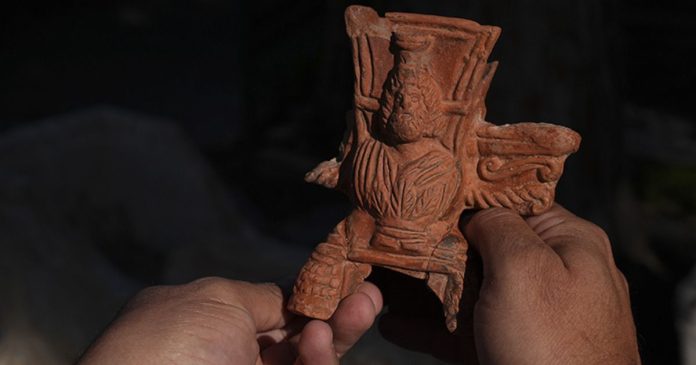
Archaeological teams working in the ancient city of Ephesus have uncovered a remarkable artefact: a terracotta incense burner decorated with a relief of the Egyptian-Hellenistic deity Serapis. The find emerged during excavations at the city’s Harbour Bath complex (Liman Hamamı), under the ongoing heritage project Endless Ephesus: Heritage for the Future, supported by the Turkish Ministry of Culture and Tourism.
Excavation Context: Harbour Bath and Harbour Street
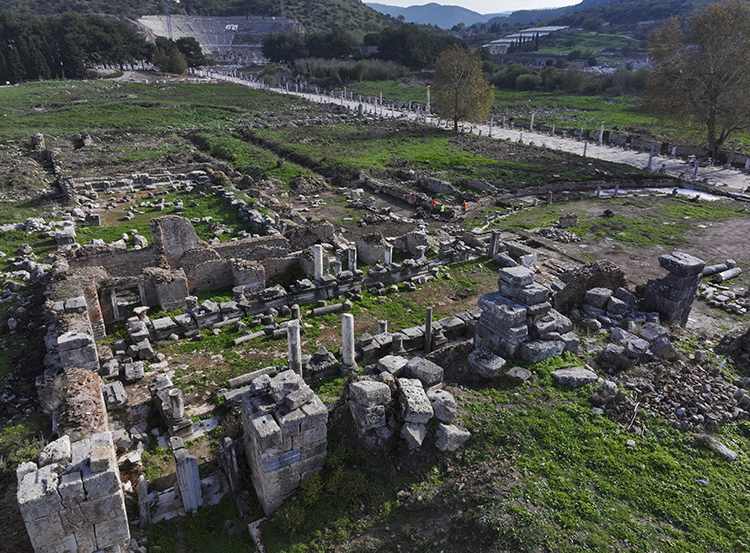
Archaeologists discovered the incense burner along the 570-meter-long ancient Harbour Street (Liman Caddesi), which once connected the center of Ephesus to its main port, the city’s maritime gateway.The Harbour Bath complex lies along this route, occupying a substantial footprint: approximately 70,000 m², making it one of the largest Roman-era bath complexes in Anatolia.
Archaeological efforts focus on unearthing the bath’s public and service spaces — including the oval hall, courtyards, pools, and latrine zones — to better understand the experience of travelers and merchants arriving by sea. Over the years, excavations at this site have yielded marble decorative elements, bronze statues, and architectural fragments, attesting to the structure’s former grandeur and the cosmopolitan character of the city.
The Incense Burner: Description and Iconography
The newly found object is a terracotta incense burner featuring a bowl-shaped chamber on top, with a relief bust of Serapis on its front. The figure is rendered with traits distinctive to Serapis iconography: full beard and hair, a tall modius-style headdress, and a spool-shaped base beneath the bust. Scholars note that the depiction echoes a famous statue traditionally attributed to the ancient sculptor Bryaxis, suggesting that the artisan who crafted the burner was intentionally referencing a widely recognized model.
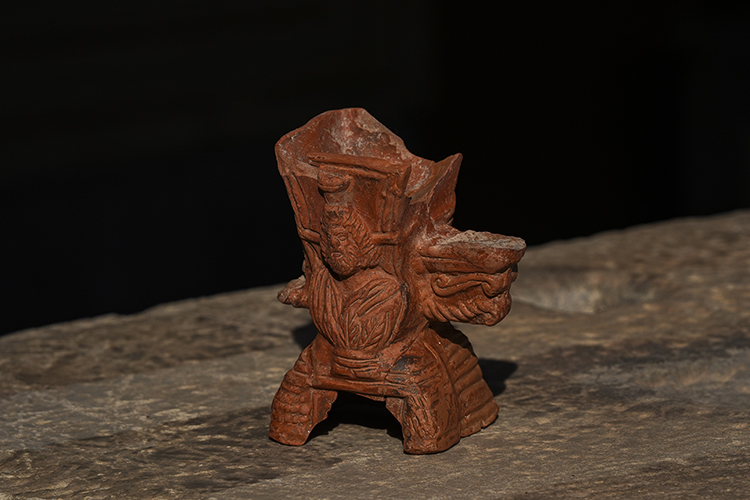
The clarity of the relief allowed for immediate identification of the deity: the combination of beard, high crown, and stylistic bust form were sufficient to link the image to Serapis without ambiguity.
Inscription and Implications for Trade & Workshop Networks
A particularly significant detail is an inscription on the reverse side of the burner. Thanks to this inscription, archaeologists were able to match the object with a similar incense burner previously found in the so-called Terrace Houses (Yamaç Evler) area of Ephesus. This connection strongly suggests the existence of a local workshop producing such cult objects, or at least a pattern of regular trade in religious items within the city.
The recurrence of near-identical incense burners across different quarters of Ephesus — from elite residential villas to public bath complexes — indicates both production standardization and a distribution network that made these religious objects accessible to diverse segments of the urban population.
Serapis in Ephesus: Religious and Cultural Significance
Serapis was a syncretic deity — combining Egyptian religious traditions with Hellenistic and later Roman interpretative frameworks. His worship spread widely across the Roman Empire, and in Ephesus his cult left a particularly strong legacy. The city hosted a substantial temple dedicated to Serapis, thought to have been sponsored by Egyptian merchants in the 2nd century CE.
Finds of inscriptions, graffiti, and small-scale religious artefacts associated with Serapis across Ephesus testify to the deep integration of his cult into everyday urban life. The new incense burner reinforces this picture: it reflects how imported religious practices — carried by trade and migration — became woven into the daily rituals of Ephesus’ inhabitants, from public baths to private dwellings.
Conclusion
The discovery of the Serapis-relief incense burner in Ephesus’ Harbour Bath is more than an archaeological novelty. It is a material testament to how trade, migration, and religious exchange shaped one of the Mediterranean world’s great cities. This find enriches our understanding of Ephesus — not just as a center of monumental architecture and commerce — but as a living, breathing urban environment where beliefs and daily life merged across cultural boundaries.
For more discoveries like this check out : Prusias ad Hypium: Unearthing the Forgotten Treasure of Düzce
