
The recent discovery of a remarkably preserved 1,400‑year‑old Zapotec tomb in the municipality of San Pablo Huitzo, Oaxaca, has quickly become one of the most celebrated archaeological revelations in modern Mexican history. President Claudia Sheinbaum Pardo announced the discovery publicly, underscoring its national significance. Researchers consider it the most notable Zapotec revelation in at least a decade. Its preservation is exceptional, and the tomb offers a rare amount of cultural, artistic, and ritual detail from one of Mesoamerica’s most sophisticated civilizations.
Tomb Discovery and Its Context
The tomb came to light after authorities followed up on an anonymous report of looting in 2025. This is a common threat to archaeological heritage in Oaxaca, where many ancient sites remain vulnerable. Upon investigation, archaeologists from Mexico’s National Institute of Anthropology and History (INAH) uncovered a funerary complex dating to around A.D. 600. A time during the height of Zapotec cultural development. The Zapotecs, sometimes referred to as the “Cloud People,” flourished in the region for more than a millennium. They established monumental centers such as Monte Albán and developing intricate writing, calendrical, and artistic traditions.
What distinguishes the Huitzo tomb from many others is its completeness. Rather than a scattered assemblage of damaged fragments, the structure emerged as a coherent ritual space, with its architecture, murals, carvings, and symbolic elements largely intact. This level of preservation is exceedingly rare in Oaxaca, where looting and environmental degradation have compromised many earlier finds. The tomb’s integrity allows researchers to reconstruct not only the burial practices of the Zapotec elite but also aspects of their worldview, social hierarchy, and ceremonial life.
Architectural Features of the Tomb
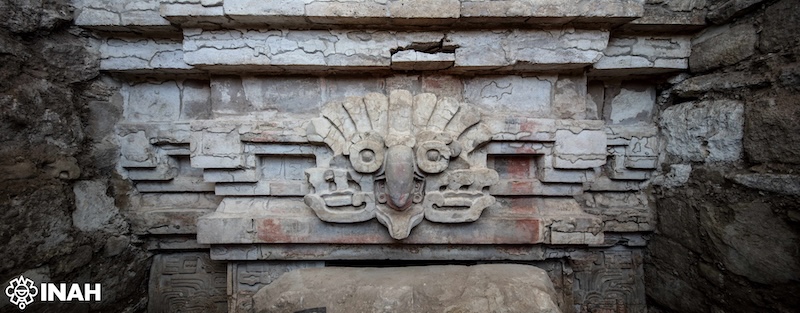
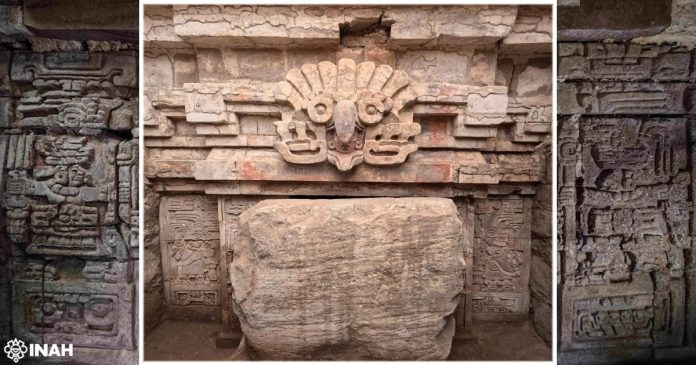
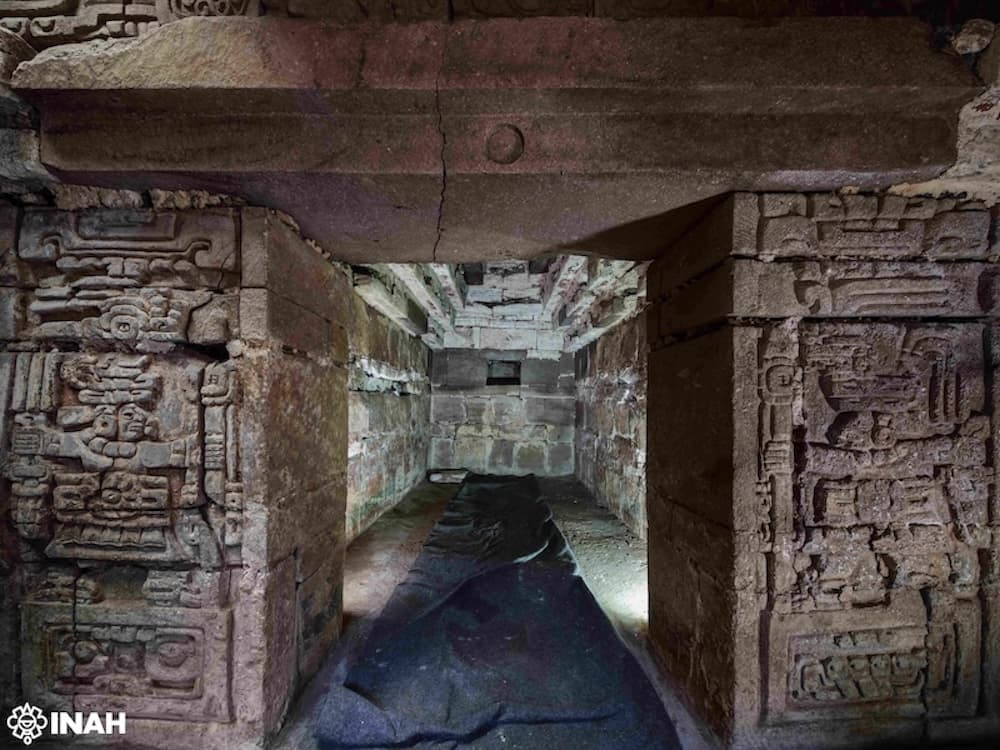
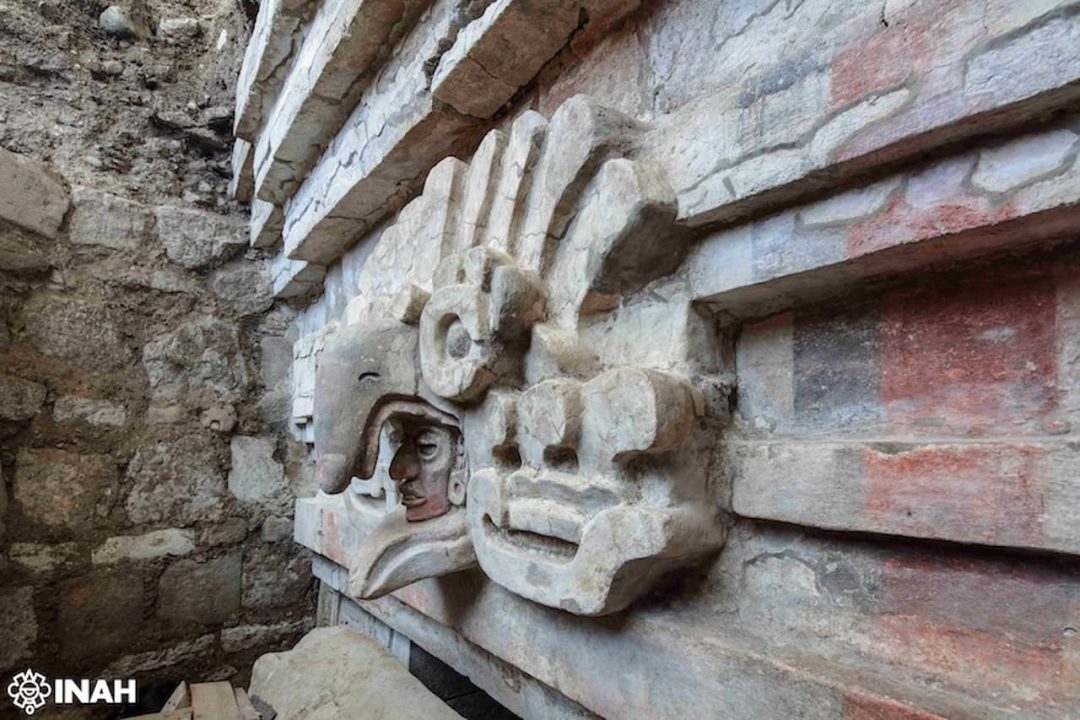
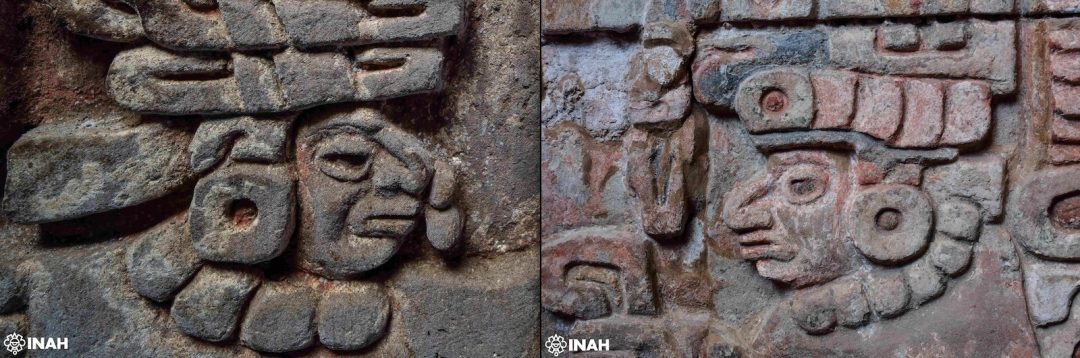
The tomb follows a classic Zapotec funerary layout consisting of an antechamber leading into a main burial chamber. The entrance is marked by a striking feature: a large sculpted owl whose open beak frames the painted face of a Zapotec lord. In Zapotec belief, the owl was tied to night, death, and supernatural power. Placing it above the threshold turned the doorway into a symbolic passage between the living and the dead. The beak resting over the face of the buried figure hints at protection or transformation, suggesting the individual held high status, possibly as an ancestor or ruler.
Flanking the entrance are carved stone jambs depicting a male and female figure, each adorned with elaborate headdresses and holding ritual objects. These figures may represent guardians of the tomb or ancestral attendants, reinforcing the sacredness of the space. Above the doorway sits a frieze made of stone slabs engraved with calendrical names. These inscriptions hint at the identity and lineage of the person buried inside. The names belong to a complex Zapotec system linked to birth dates and divine associations. With careful study, epigraphers may be able to reconstruct the genealogy of the tomb’s occupant.
Murals and Symbolic Imagery
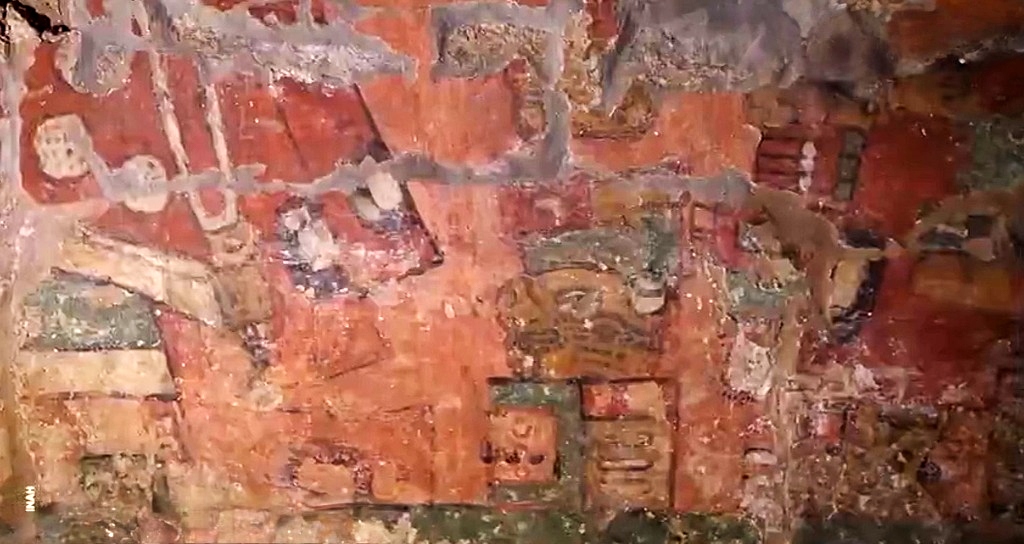
Inside the burial chamber, archaeologists encountered a vivid polychrome mural that has astonished researchers for its preservation and artistic sophistication. Painted in white, green, red, blue, and ochre, the mural shows a ceremonial procession of figures carrying bags of copal, the resin used as incense in pre‑Hispanic rituals. The scene points to a funerary ceremony meant to honor the dead. The participants move toward the tomb’s entrance, offering fragrance and smoke to guide the spirit into the afterlife.
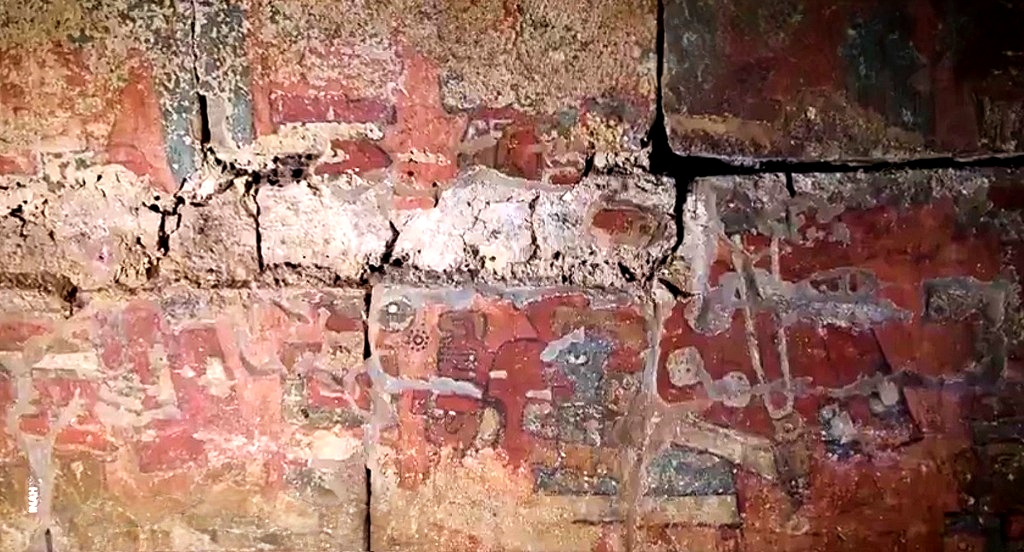
The murals encode elements of Zapotec cosmology, ritual practice, and social structure. The direction of the procession, the clothing of the figures, and the choice of pigments all point to established ceremonial practices that researchers are now studying closely. The use of copal, long tied to purification and communication with the divine, reinforces the idea that the tomb served as a sacred passage between the human world and the supernatural one.
Cultural Significance and Interpretation
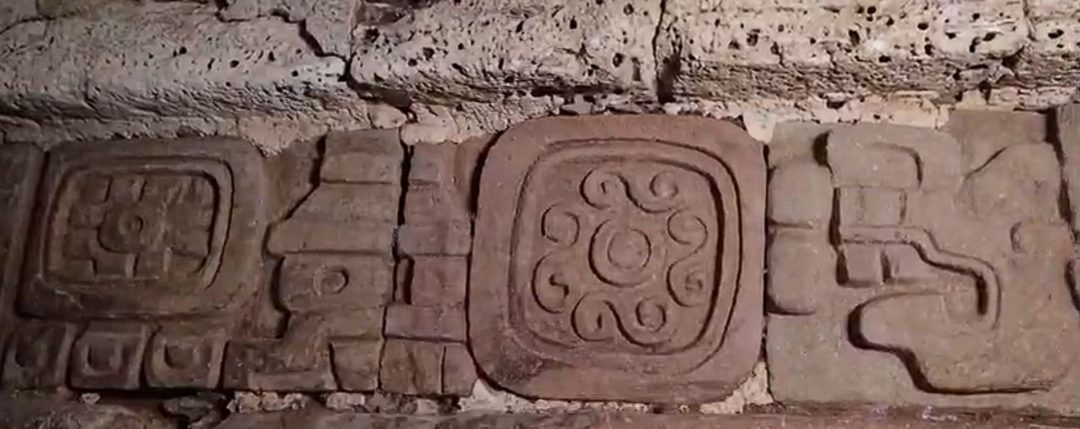
The discovery offers an unprecedented window into Zapotec funerary ideology. The sculptural reliefs, calendrical inscriptions, and mural paintings all point to a person of high status, possibly a ruler, priest, or honored ancestor. The owl motif strengthens this idea. It presents the deceased as someone with spiritual authority, a figure who could move between the human world and the realm of the gods.
President Sheinbaum emphasized that the tomb’s significance lies not only in its beauty but in the wealth of information it provides about Zapotec social organization, ritual life, and artistic traditions. The find has been described as a “time capsule,” preserving a moment of cultural expression with extraordinary clarity.
The tomb adds to our understanding of Zapotec life in the Classic period. This was the culture’s peak in population, politics, and artistic skill. Monte Albán is still the best‑known Zapotec center. Even so, the Huitzo tomb shows that elite rituals spread far beyond major cities. These traditions shaped smaller communities throughout the Central Valleys of Oaxaca.
Conservation Challenges and Ongoing Research
Despite its remarkable preservation, the tomb faces significant conservation challenges. Roots, insects, and fluctuations in temperature and humidity threaten the stability of the murals and stucco surfaces. INAH’s interdisciplinary team is currently stabilizing the paintings, documenting the iconography, and conducting ceramic and epigraphic analyses. Physical anthropologists are also studying the human remains, though only a handful of bones have been recovered so far.
The conservation process is delicate and time‑consuming. Painted surfaces must be cleaned and reinforced without altering their original pigments. Stone carvings require stabilization to prevent cracking. Even the soil surrounding the tomb must be carefully managed to avoid shifts that could damage the structure. These efforts reflect a broader commitment to preserving Mexico’s archaeological heritage, especially in regions where looting and environmental pressures pose ongoing threats.
Broader Implications for Zapotec Studies
The Huitzo tomb joins a growing list of Zapotec funerary sites discovered in recent years, but it stands apart for its completeness and clarity. Many earlier tombs were looted long before archaeologists arrived, leaving behind only fragments of their original contents. In contrast, the Huitzo tomb provides a nearly intact ritual context, allowing researchers to reconstruct ceremonial practices with far greater confidence.
The discovery also highlights the sophistication of Zapotec artistic and architectural traditions. The blend of sculpture, painting, and symbolic carving in one funerary space shows careful artistic and ritual planning. It also suggests that Zapotec elites invested heavily in these structures. Their tombs were not only places of burial but lasting monuments to lineage, power, and cosmological belief.
A Testament to Mexico’s Ancient Heritage
For many Mexicans, the discovery has become a source of national pride. Officials have emphasized that the tomb represents the “millennial greatness” of Mexico’s Indigenous civilizations and underscores the country’s central role in the cultural history of ancient Mesoamerica. The find has also sparked renewed interest in Zapotec culture among the public, encouraging further exploration of Oaxaca’s archaeological landscapes.
As research continues, the Huitzo tomb promises to reshape scholarly understanding of Zapotec ritual life and artistic expression. Its murals, carvings, and architectural details give a rare look at a world where death, ancestry, and divine power were closely linked. The tomb stands as a clear testament to the Zapotec legacy. It still inspires awe more than a thousand years after its creation.
For more ancient tombs check out: Lost Pharaoh Thutmose II’s Tomb Unearthed in Luxor
