
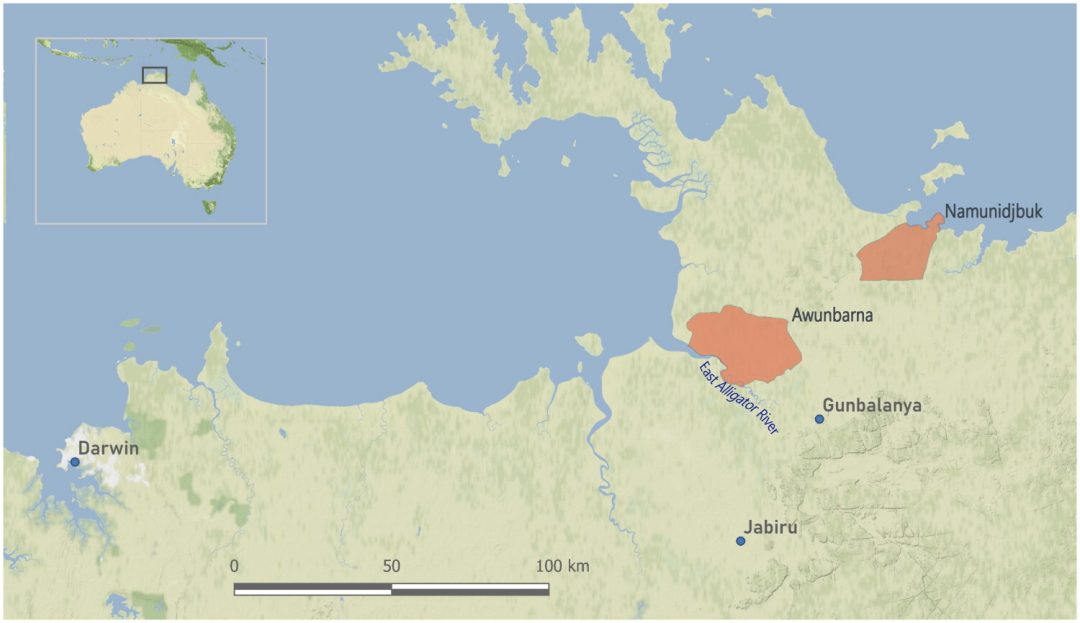
Awunbarna, known in English as Mount Borradaile, sits in north west Arnhem Land in Australia’s Northern Territory. It is Amurdak Country, south of the Cobourg Peninsula and a short distance from the East Alligator River. The sandstone shelters there hold paintings made across at least fifteen thousand years. Since 2018 a research team led by Paul S. C. Taçon, working with Sally K. May, Andrea Jalandoni and senior Amurdak Traditional Owner Charlie Mungulda, has recorded one hundred and sixty-five of those sites in detail. Their paper in Australian Archaeology, published online on 14 August 2026, turns to the most recent layer of that record.
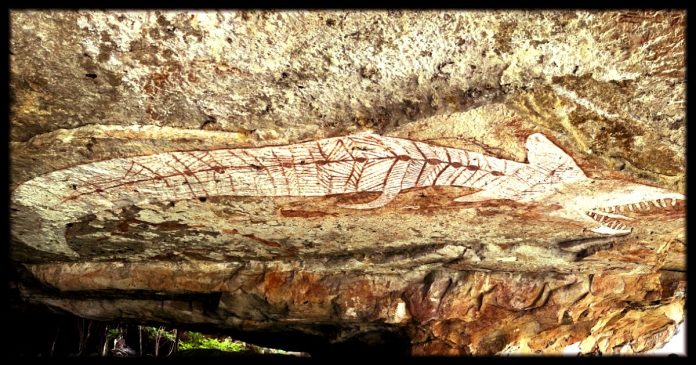
In the 1800s and early 1900s artists painted Rainbow Serpents, animals and human figures at a scale that dwarfs most earlier work. One serpent on a ceiling stretches 6.1 metres in a straight line and 6.88 metres if the curve of the body is followed. The same landscape holds Arnhem Land’s only known rock painting of a whale, a male giant more than two metres long, and a stone arrangement shaped as a Rainbow Serpent. The authors argue that these oversized images were made while Europeans were visiting and settling Aboriginal Country, and that they were a way of holding power over land and law when both were under pressure.
The Place and the Record
Western Arnhem Land has long produced large animal and human figures. George Chaloupka named an early phase the Large Naturalistic Style and placed it between about thirteen thousand and eighteen thousand years ago. Later styles usually favoured smaller figures, though occasional oversized Dynamic figures and life sized Maliwawa humans still appear. Very large kangaroos, fish and crocodiles were painted again in the last few centuries at Nawarla Gabarnmang, Deaf Adder Gorge, Injalak Hill, Djulirri, Malarrak and other sites. What stands out at Awunbarna is concentration rather than isolation.
Twenty nine Rainbow Serpent paintings occur at twenty one sites. That is 12.6 percent of the recorded shelters. Twenty of those twenty nine images belong to the most recent painting style. They sit in the uppermost layers of panels that already carried older work. Seven were made mainly with white pipe clay, a pigment that sits on the surface and weathers in decades or a few centuries rather than staining the rock as red ochre does. Colour combinations and infill match sequences dated between 1640 and 1930 at Nawarla Gabarnmang.
The contrast with neighbouring survey areas is sharp. Namunidjbuk, to the north east, yielded only two Rainbow Serpents among three hundred and fifty two sites. Injalak Hill, next to Gunbalanya, has two among two hundred and thirty two sites. Across the rest of western Arnhem Land the remaining recent Rainbow Serpents are scattered through seven large zones. Awunbarna packs twenty recent examples into about twenty seven square kilometres. That clustering is unusual. The only comparable older cluster is twenty two Yam style serpents along Twin Falls Creek on the plateau.
Rainbow Serpents Old and Recent
Yam style Rainbow Serpents at Awunbarna date to more than six thousand years ago. They have bodies like snakes, line infill and heads that resemble kangaroos or wallabies. Most have pointed tails. Some carry trailers from the head or a scalloped upper edge. One at site AW153 is unique among documented Yam examples. It has a row of scutes along the back and two legs with four toed feet, yet it still carries a large macropod head.
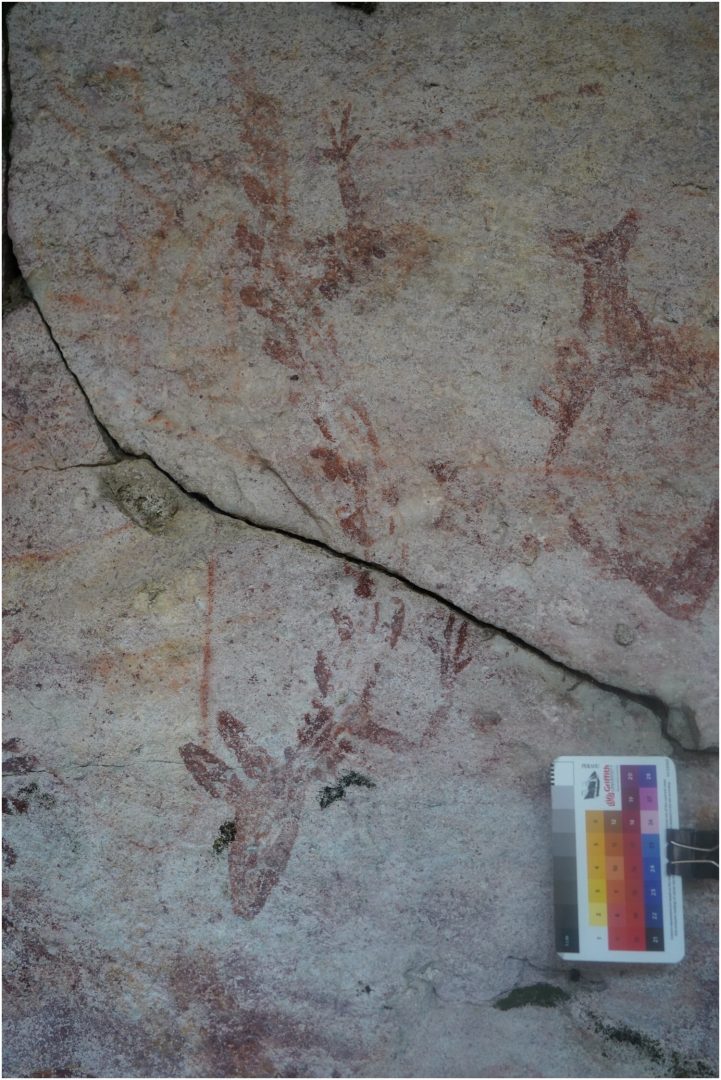
Yam images at the site range from 0.32 metres to two metres and average 1.14 metres. They are red, mulberry, or mixed red and mulberry, and they sit mainly on walls.Recent paintings are larger and more mixed in form. They average 2.4 metres and reach 6.1 metres. Colours include red, white with red outline, yellow with red outline, and one white figure with a purple outline. Infill includes solid colour, hatching, crossing hatch and internal bone markings. Eight have heads like kangaroos or wallabies, eight have snake heads, two have heads like crocodiles, one has a head like a goanna and one appears to have a double snake head. All end in pointed or slightly rounded tails.
Largest Serpent
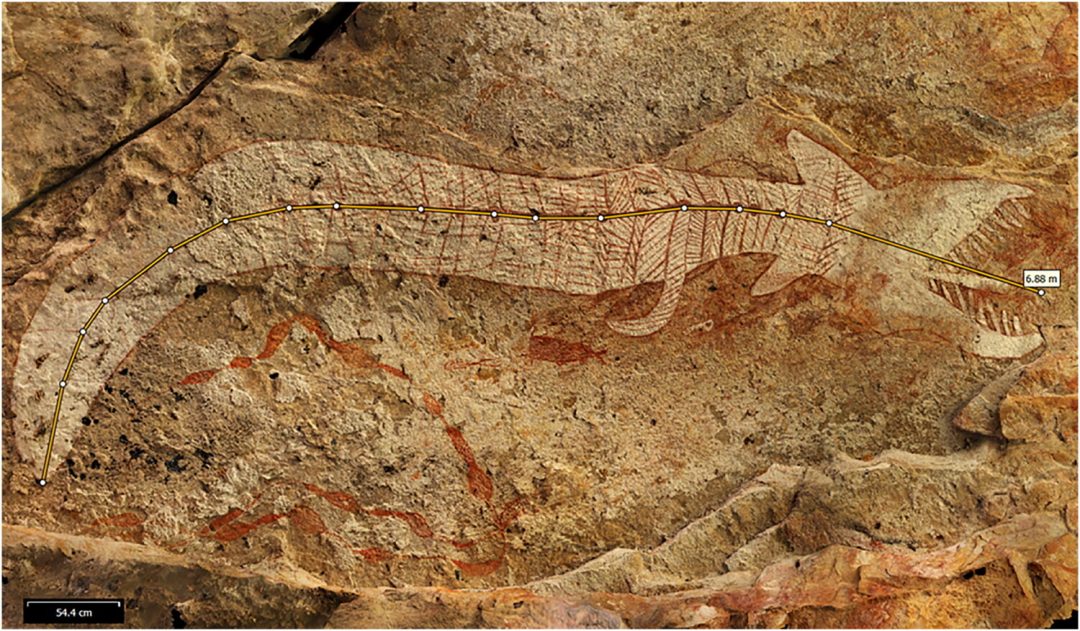
The ceiling painting at AW5 is the largest. It has a fierce head like a crocodile, a tongue between rows of teeth, fish fins behind the head and an appendage hanging from the body. A backbone with vertebrae and ribs runs through a white body marked with red hatching. A second large red and white serpent several kilometres west shows the same internal markings. At AW47 a snake body swells into the shape of a crocodile through its middle. White stick figures, a pair of large female figures, fish and a goanna were later painted across it. At AW40 a yellow serpent with red outline carries stick figures, women and fish on its body.
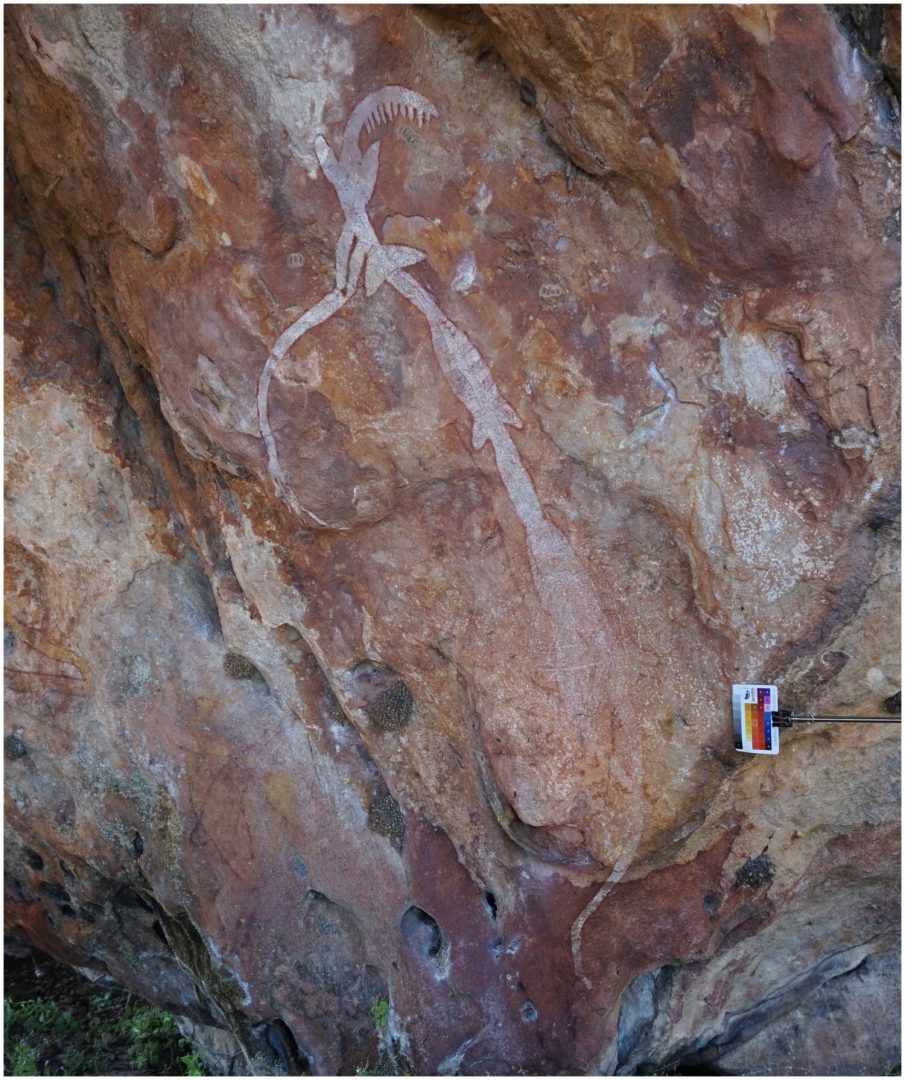
Directly below it a red serpent contains a white female figure placed as if swallowed. At AW45 a white serpent with red outline has breasts, an arm, fish fins and a long tongue lined with teeth. At AW164a three small animals like dogs sit on the tail of a solid red serpent.These images were not isolated decorations. Charlie Mungulda said that stories about Rainbow Serpent power and law were told to young people beneath the great ceiling serpent at AW5 and at other recent serpent sites.
A Whale, a Giant and Other Large Images
Site AW93 holds a white painting with red outline of a whale a little more than two metres by one metre. The body curves under the head. A design like baleen hangs from the mouth. Fins, an eye and a tail like a fluke are clear. The figure is placed so that it appears to swallow a woman. The authors identify it as a humpback. No other whale painting is known in western Arnhem Land rock art. Most Australian whale images are engraved, not painted, and none elsewhere shows baleen.
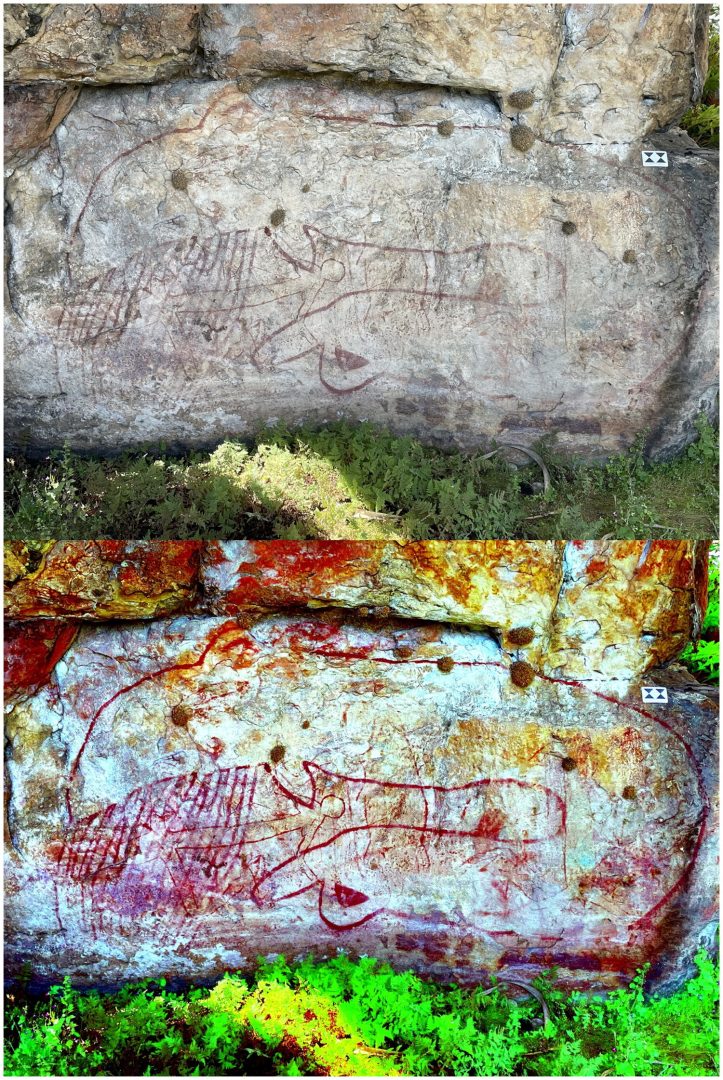
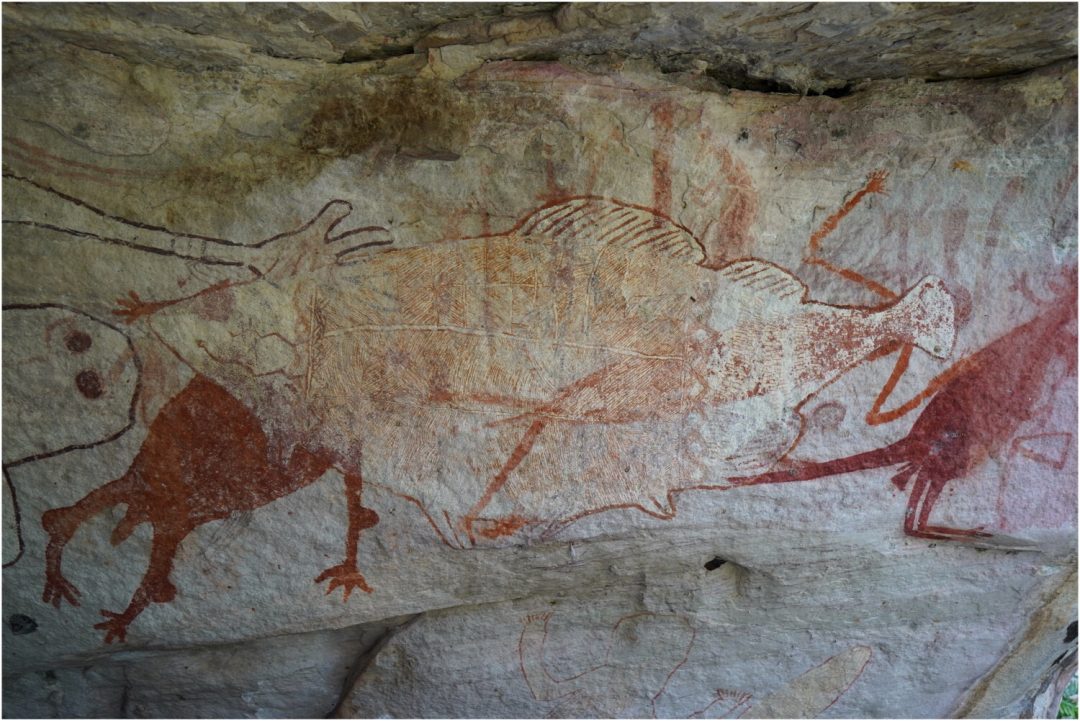
In November 2020 three humpbacks entered the East Alligator River only a few kilometres from the shelter, proving that the species can reach the area, though the painting itself is far older than that event. At AW47, the same shelter as the serpent with a crocodile midsection, artists painted a male giant 2.1 metres long. It is the largest human figure recorded at Awunbarna.
The body is white with a red outline and red internal markings. The figure lies on its side with one arm raised. Each hand has five fingers. One foot has four toes and the other has three. There are two eyes but no nose, mouth or neck. Fine hatched lines fill the torso in changing directions. The same hatch pattern appears on six very large fish at Awunbarna, including fish placed to the left of the giant’s feet and to the right of its raised hand. The authors note the same infill on large recent animals and people at sites to the north east.
The Serpent Laid in Stone and the Morak Ceremony
Beside the paintings stands a stone arrangement that traces a gigantic Rainbow Serpent. The main figure occupies an area 38.2 metres by 37.5 metres and uses 124 metres of placed stone. A winding neck 16 metres long runs from a circular body to a small boulder shaped like a crocodile head. The head points north west at 326 degrees. Nearby lies a larger oval arrangement 50.6 metres by 30.8 metres, open on one side and built from 117 metres of stone.
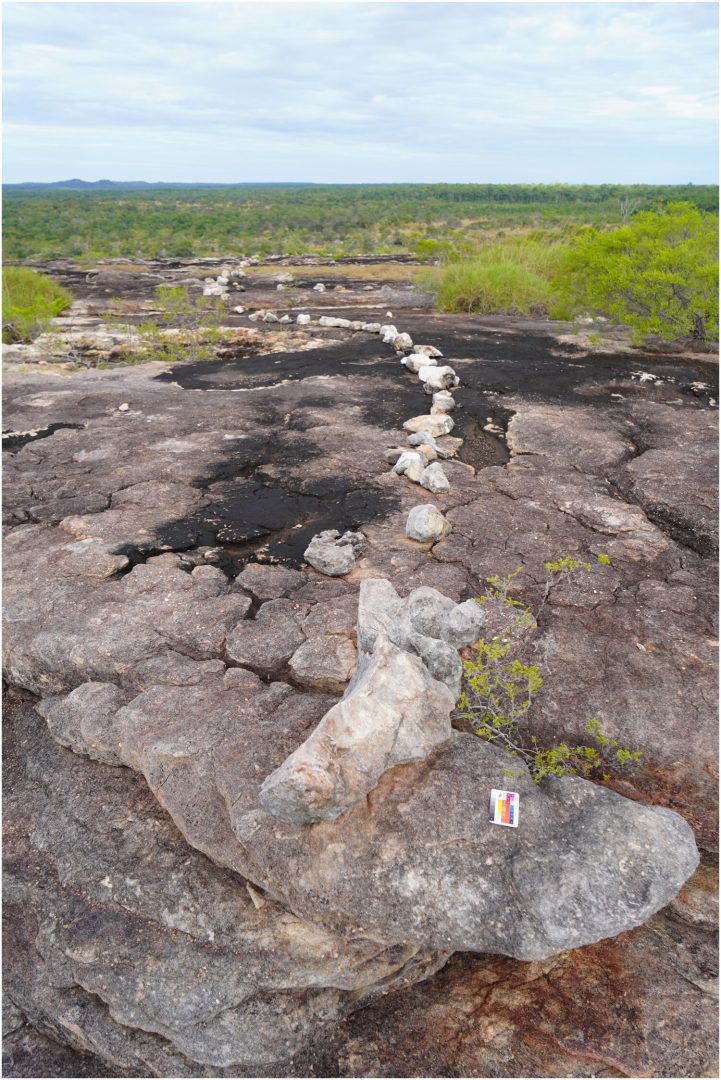
About forty metres to the south west a curving line of stone with a large head rock covers 21.3 metres by 14.1 metres. The Awunbarna serpent arrangement is one of only three of its kind reported in Australia. The others lie in western central Queensland and south east Queensland.Charlie Mungulda identified the arrangement as a ground for Morak, an initiation held for young men about eighteen years old or older in the late dry season.
People travelled from surrounding country to take part. Morak grounds occurred at wetland sites near the South and East Alligator Rivers. The Amurdak ground is the largest and the most north easterly. Some other grounds also used stone arrangements. A few were simply open earth. The ceremony ended in the 1970s. Charlie’s brother in law Big Bill Neidjie and their friend Iyanuk, also known as Felix Holmes, of the Limilngan clan, were among the last custodians. Iyanuk held the full song cycle. Songs were sung without the didgeridoo
The Morak
Accounts collected by the authors and earlier writers describe Morak as strict and physically hard. Young men completed tasks that people later described as dangerous and painful. At points in the rite, elders painted their bodies red and white. The men learned strict rules for sharing food, and senior custodians warned them that the Rainbow would punish anyone who broke Aboriginal law. A man had to master Morak knowledge before he could enter the Mardayin ceremony. Custodians taught that the female Rainbow Serpent (known as Warramurrunggundji, Imberombera, or Yingarna) set down the grounds as she left the first children of each language group in the landscape. The Awunbarna arrangement sits about nine kilometres southwest of the place where the first Amurdak speakers emerged. Stories told at the painted serpent sites prepared youths for what they would meet on the ceremonial ground.
Stories that Travel with the Paintings
Rainbow Serpents fold time. They belong to the oldest era and still act in the present. Kunwinjku speakers to the south distinguish Yingarna, the original mother, from her first born son Ngalyod, though the names sometimes interchange. Yingarna, also called Warramurrunggundji, came from the sea north west of the Cobourg Peninsula, crossed Croker Island and landed at Malay Bay. She created clans, gave languages and left children at places that include Cooper Creek in the heart of Amurdak Country, close to many of the painted serpents.
On part of that journey a giant named Wuraka travelled with her. Baldwin Spencer recorded the story at Gunbalanya in 1912, when the serpent was called Imberombera. Wuraka was so tall that his head stayed above water as he walked the sea. Inland he grew tired, sat down and became the stone tower now called Tor Rock on the north east edge of Amurdak Country.
The Whale
A second giant, Luma Luma, came from the sea to the east as a huge whale, became a man and walked into Kunwinjku Country. Ngalyod travelled with him underground. Luma Luma gave ceremonies, above all Mardayin. He was a fearsome ritual leader who sometimes ate men or children. He was speared, buried, and his spirit returned to the sea as a whale. In both cycles a giant arrives from salt water and travels with a Rainbow Serpent. The large fish painted on either side of the Awunbarna giant underline that water link.
Oral Traditions
A widespread story shared by Amurdak, Iwaidja, Mawng, Gagadju and Kunwinjku people tells of Ngalyod angered by a crying baby that adults ignored. The serpent swallowed the camp. Versions place the event near North Goulburn Island or Malay Bay, then follow the serpent inland to Cooper Creek, just north of the painted cluster.
Mardayin, which Morak prepared men to join, celebrated links between people, sites and Ancestral Beings. Estuarine Crocodile is spoken of as a leader in that rite. Painted and carved objects of crocodile, barramundi, emu, turtle and yam were carried in dance. Living creatures of unusual size were themselves called mardayin. Very large paintings could carry the same weight because of the labour, the paint and the way they dominate a panel when elders teach.
Why Size Mattered After Europeans Arrived
Buffalo shooting camps, new settlements, ships, firearms and trade goods changed daily life across Amurdak and neighbouring Country in the late 1800s. Artists at Awunbarna painted some of those new things, and they used Reckitt’s Blue more often than artists anywhere else in western Arnhem Land. They did not, however, enlarge the newcomers. They enlarged Rainbow Serpents and other beings already central to law. Many large traditional figures sit over or beside introduced subjects. The authors read that placement as a public statement. Senior painters, often ceremonial leaders, declared that Aboriginal tradition still governed the sites and the estates around them. They also showed that people could choose how far to enter the new order.
Rainbow Serpent stories already taught how to meet change. Landscapes, seas and climate had always transformed beings and people. Some Ancestors became stone and left raw material for tools and shelters. Painting those beings at great size during a new kind of disruption made the old lessons visible to anyone who entered the shelters. It also bound Amurdak people to neighbours who share Yingarna, Ngalyod and Mardayin. Awunbarna now holds 38.5 percent of all recorded recent Rainbow Serpent paintings in western Arnhem Land. That share is unlikely to be an accident of survival. It looks like a sustained choice to put the region’s most powerful Creation Being on the rock again and again.
Conclusion
The recent art of Awunbarna is not a fading echo of older styles. It is a dense, deliberate body of work made when outsiders were rewriting the map. Artists enlarged Rainbow Serpents until one filled a ceiling and made visitors look small. They painted a whale with baleen and a giant whose torso repeats the hatch of nearby fish. They laid a serpent in stone for Morak, a hard initiation that taught law, sharing and fear of the Rainbow, and that opened the road to Mardayin.
Charlie Mungulda’s knowledge ties those images to living story: Yingarna coming from the sea, Wuraka becoming Tor Rock, Luma Luma arriving as a whale, Ngalyod swallowing a camp because a baby cried. The paintings and the stone figure do not merely illustrate those accounts. They occupy the same country in which the accounts are still told. In a time of buffalo camps and foreign boats, size itself became a form of authority. The rock still carries that authority, and the people who speak for it still know what the big creatures were for.
