
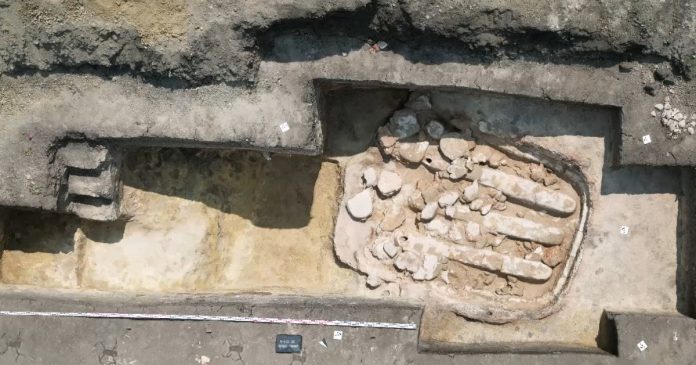
In 2025 a team working in Iași County in northeastern Romania opened a trench beside an ancient ditch and found a pottery kiln of unusual size. The site, Ursoaia, belongs to the Cucuteni Trypillia world of the fifth and fourth millennia BCE, a cultural complex that stretched across parts of present-day Romania, Moldova and Ukraine. That world is already famous for large, planned settlements and for painted vessels of high quality. The new kiln adds something more concrete. It is a two-chamber updraught installation with a working surface of about 7.5 square metres. That figure sits well above the cluster of known firing surfaces from the same tradition. The authors of the 2026 report in Antiquity treat the structure as a benchmark for specialised ceramic production in southeastern Europe.
The engineering, the capacity and the setting together point to output beyond the needs of a single household. Several other kilns appear on the same magnetometer map. However, the settlement itself is modest by the standards of the later Trypillia mega sites. The combination is what makes Ursoaia worth close attention.
A hilltop settlement beside two streams
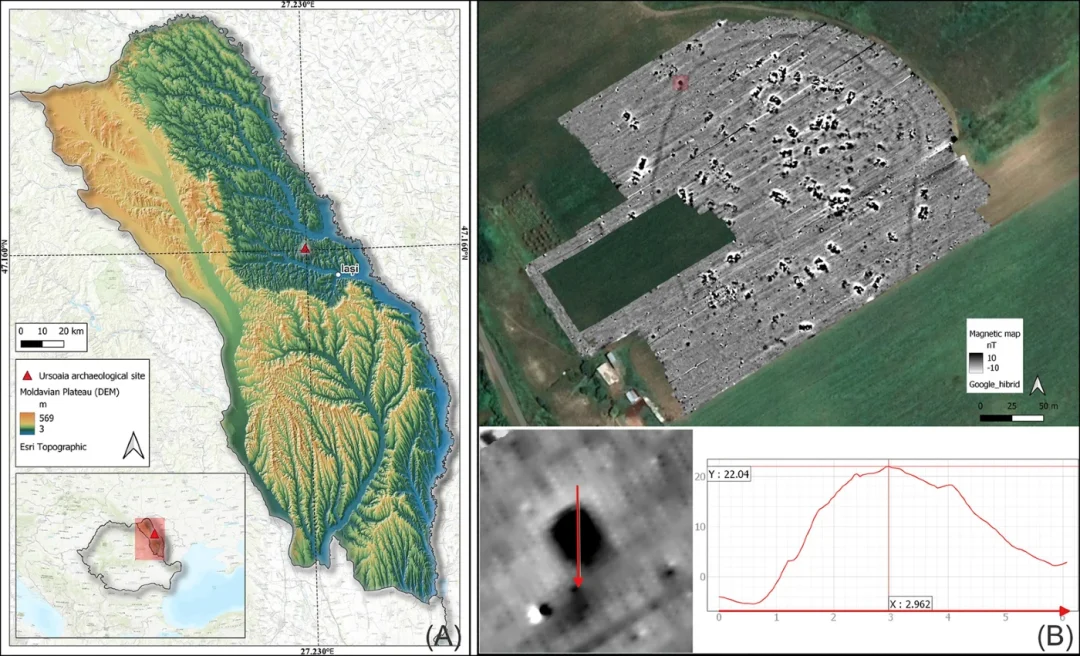
Ursoaia sits on a hilltop in the Moldavian Hilly Plain, at the meeting of the Ursoaia and Roșior streams. In 2024 a magnetometer survey mapped almost 8 hectares of occupation. A ditch enclosed the settlement. Inside it the survey recorded about 60 burnt dwellings in small clusters, many pits, and at least eight kilns. The layout and the decorated pottery belong, in the early fourth millennium BCE. Radiocarbon dates later confirmed that placement.
Burnt houses show clearly on magnetic maps because fire alters the magnetic properties of clay and soil. Kilns do the same, often more strongly. One dipolar anomaly next to the inner edge of a ditch spiked. The team chose that spot for excavation. What they uncovered was not a simple pit fire. Excavators uncovered a built installation set into the slope of the ditch, using the cut for stability, wind shelter and controlled access.
The choice of location was practical. Operators could tend the fire from the ditch rather than from the crowded interior of the settlement. Fire risk and smoke would have been easier to manage.
The architecture of the kiln
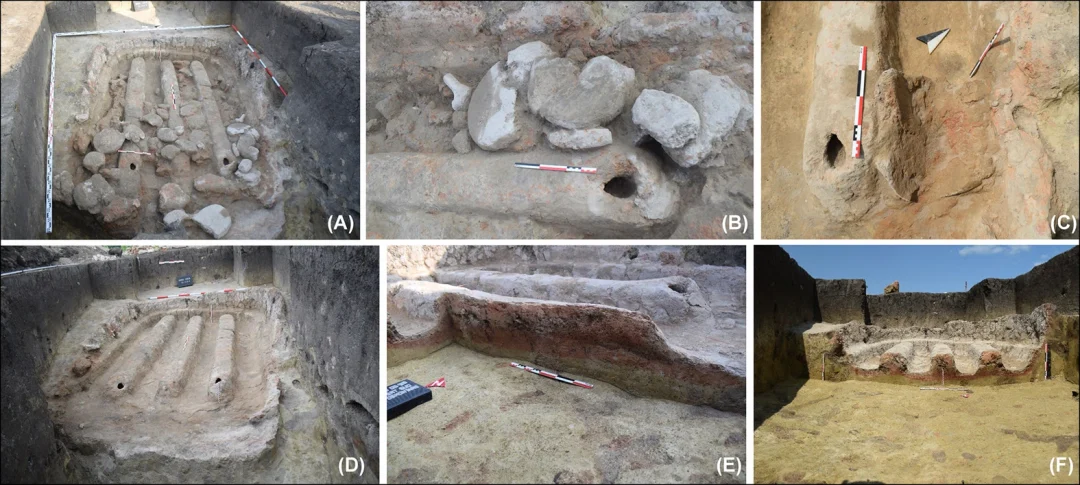
Image Source: https://doi.org/10.15184/aqy.2026.10428
The chamber measures about 3.10 by 2.40 meters. It held four long fire channels divided by three heavy supports. Those supports were first carved from the sterile clay of the pit, then shaped and levelled with an extra clay lining. A continuous ledge around the edge was reserved from the same primary clay and brought to the same height as the central supports.
On that frame sat a removable platform of modular slabs. Each slab was about 0.60 by 0.35 by 0.08 metres, with slightly rounded corners and a trapezoidal section. Together they formed a permeable grate. Hot gases moved along the channels beneath the slabs and then rose into the upper firing chamber. The joints between slabs also offered a way to regulate draught.
Height matters in an updraught kiln. The vertical distance between the fire mouth and the upper vent creates the stack effect that pulls air through the system. From the surviving structure and from vault fragments, the team estimates a total height of about 2.2 to 2.5 metres. That would give an upper chamber volume of around 12 cubic metres.
The design favoured even heat and reduced thermal stress. Wide channels, robust supports and replaceable slabs would have let potters load a large batch, fire it, and repair parts without rebuilding the whole installation. Patches of secondary luting and local thickening of floor, walls and supports show that the kiln was maintained through more than one firing cycle.
Heat, materials and the rhythm of use
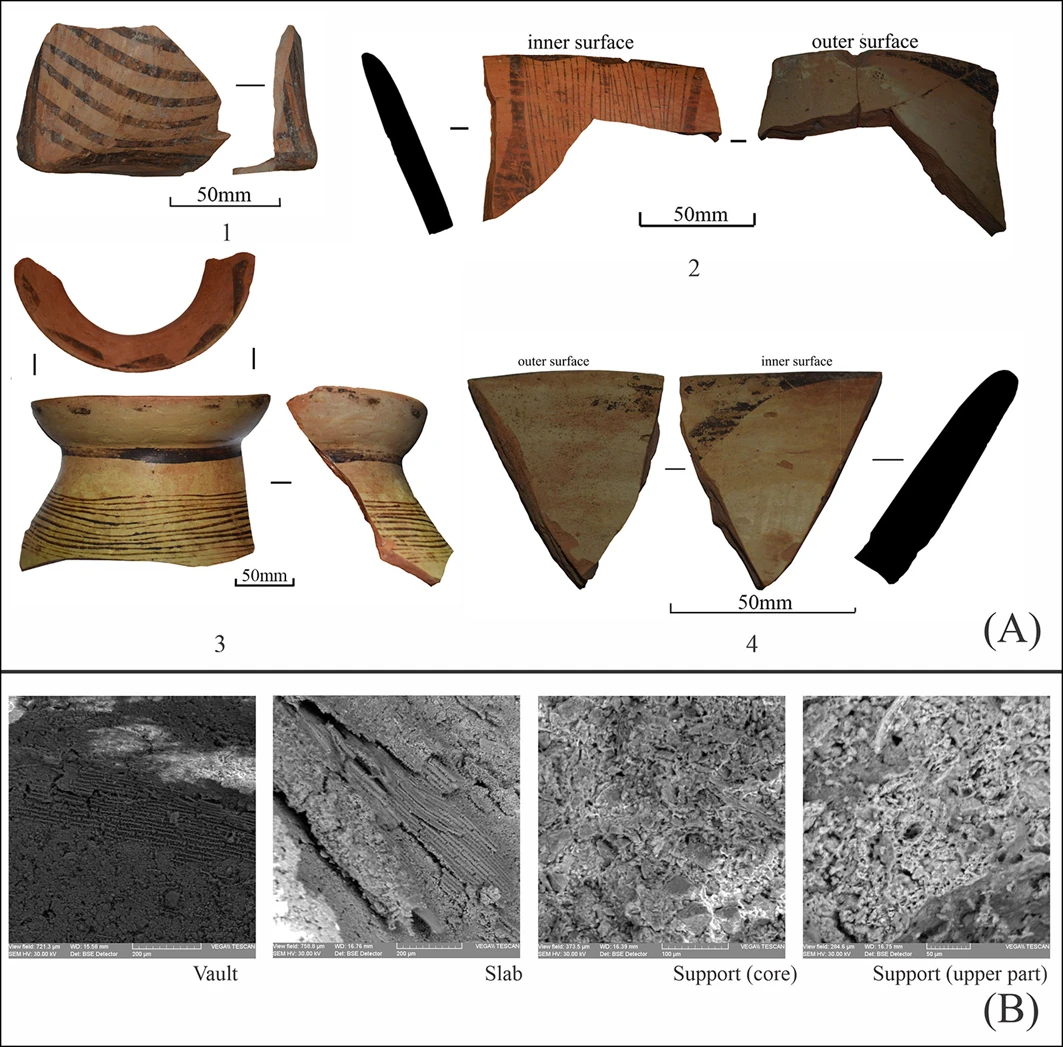
The team took small pieces of the lining, the floor slabs, the supports and a few sherds and looked at them under a laboratory microscope that can also read the chemistry of the clay. The results do not give one neat temperature. They show that the structure was used again and again at high heat.
The floor slabs were mixed with chopped plant matter. After firing they were fully burnt through in open air. The clay did not melt or turn glassy. That pattern fits a working heat of about 800 to 900 degrees Celsius. Pieces from the collapsed vault look different. They show the first signs of melting. Some spots on the heavy supports turned glassy. Those spots may have reached 950 to 1100 degrees Celsius for a time. The clay mix, how long the fire ran, and how much air reached each part all change the picture. Even so, the contrast is clear. The floor stayed cooler and more even. The roof and the supports took the hottest blasts. Heat moved through the kiln in a managed way, not as a wild blaze.
The potters had a steady routine. First they warmed the empty kiln. Then they loaded vessels in stages. The heat was held for a long time. Afterwords they let the kiln cool under control. Fine painted pots need that pace. A sudden rise or fall in heat cracks the walls and ruins the paint. A kiln this large only pays if the crew can keep temperature and airflow steady for many hours.
Dating the Kiln
Animal bone found with the kiln was dated by radiocarbon. Four samples were used. One came from the bottom of the ditch. One came from a ditch layer tied to the time the kiln was working. Two came from the fire channels after the kiln had gone out of use. The dates fall in the later 3900s BCE and reach into the 3800s BCE. They cluster around 3900 BCE. That places Ursoaia a little later than the kilns at Majdanetske and Stolniceni I and a little earlier than those at Taljanki and Dobrovody.
Pots found next to the kiln carry the same painted styles as the rest of the settlement in that phase. Shape and decoration match the dates. The kiln belongs with the painted ware of Cucuteni B1 and Trypillia BII to CI.
How large is large
Size is the point on which the study is most explicit. Published firing or working surfaces for Cucuteni Trypillia kilns usually fall between 2 and 4 square metres. Examples at Maidanetske, Talianki and Nebelivka sit in that band. Stolniceni I, previously among the largest, reaches about 4.6 to 4.8 square metres. Ursoaia at approximately 7.5 square metres stands apart inside that corpus.
A wider comparison uses a dataset of 238 Early and Middle Chalcolithic kilns from Southwest Asia compiled by Padovani. The mean firing chamber area there is about 1.5 to 1.8 square metres. Working areas above 7 square metres are rare. Four cases are cited: two installations at Tell Abada near 19.6 square metres, one at Tell Ziyada near 8.0 square metres, and one at Yunus at 7.1 square metres. Those sites date to the sixth and fifth millennia BCE and use a mix of vertical draught, horizontal draught and single chamber plans. Ursoaia is later and belongs to a different tradition, but it joins a very small group of oversized firing installations.
Conclusion
The find raises the ceiling of what can be shown for ceramic output in this part of Europe at this date. Further excavation at Ursoaia and comparison with the other magnetic anomalies will test whether the large kiln stood alone or formed part of a repeated pattern. Until then it remains the clearest single piece of built evidence that some Cucuteni Trypillia communities invested in firing installations designed for volume, control and long use.
