
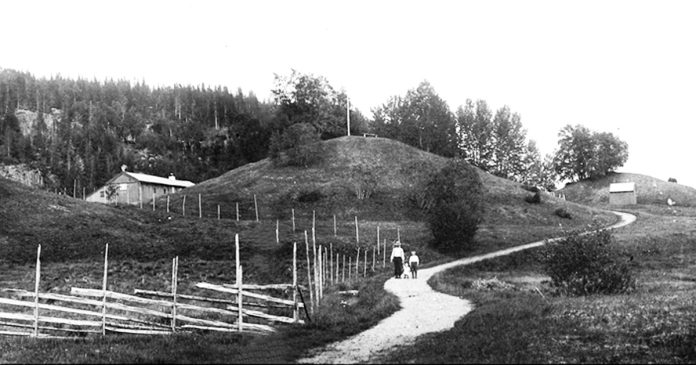
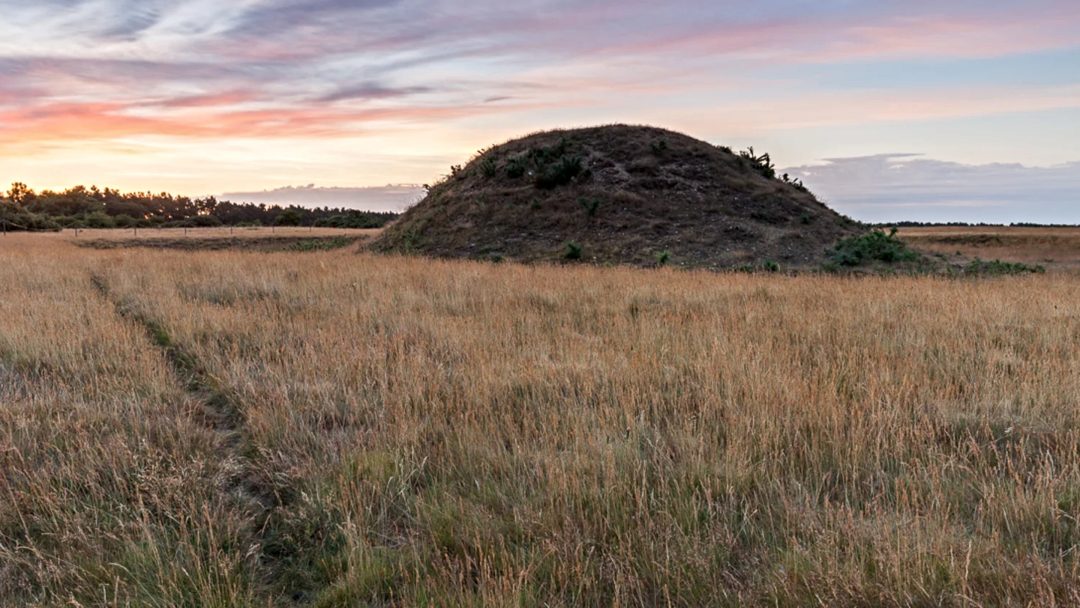
On the east side of Leka, a small island off the Namdalen coast of Norway, a grass covered mound still commands the harbor. Tradition named it Herlaugshaugen after a king who, in a thirteenth century saga, chose to seal himself inside rather than submit to Harald Fairhair. For centuries that story shaped how people read the hill. In 2023 a new excavation recovered iron clinker nails and scraps of wood. Radiocarbon dates place the burial near the year 700. The mound holds one of the earliest monumental ship graves yet identified in Scandinavia. The date sits between the early seventh century ship burials of East Anglia and the later royal ships of southern Norway.
The work does not restore a complete vessel. But it does fix a time, a size class, and a place on the coastal route that later ages called the way north.
A mound on the strait
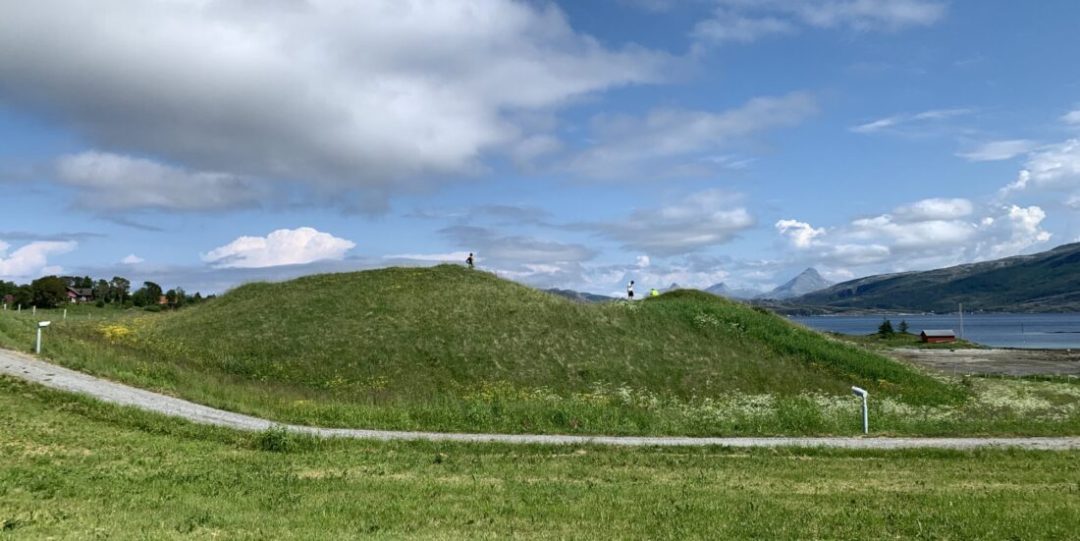
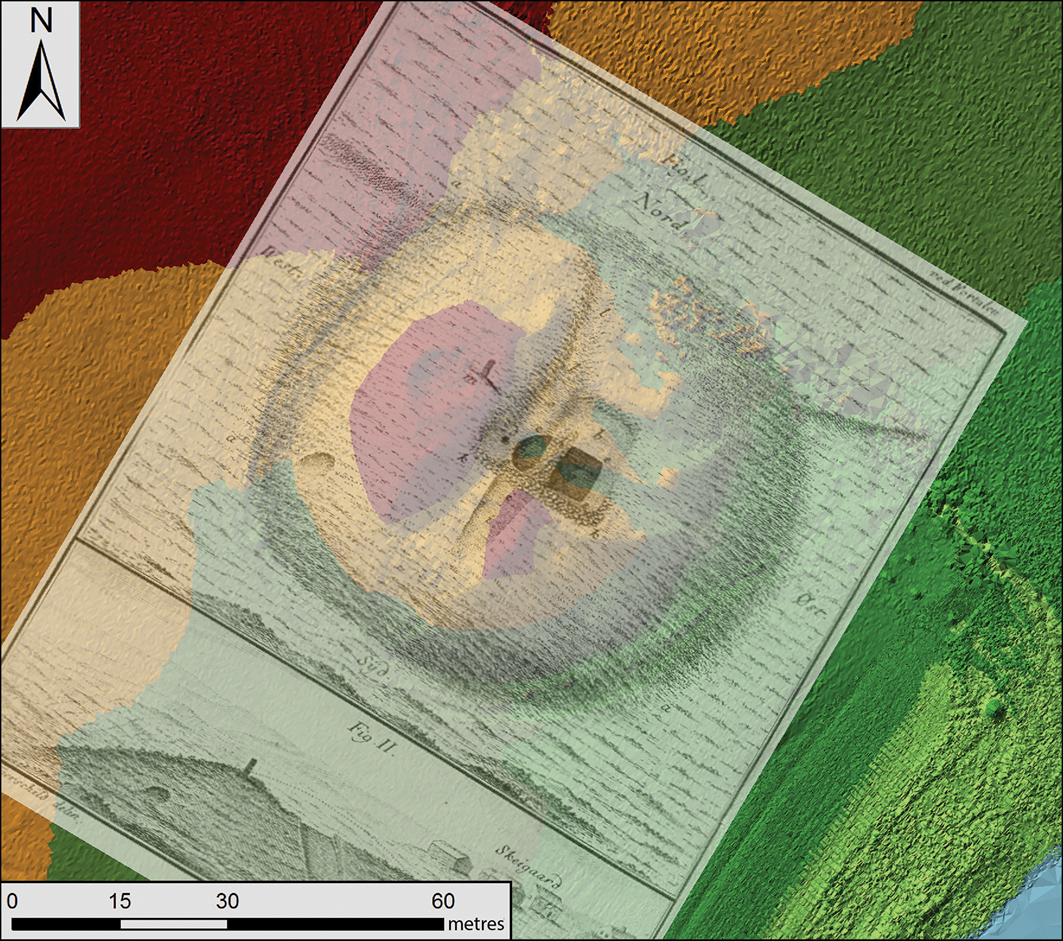
Leka sits where an east to west river and land route meets the long sea lane along the Norwegian coast. Namdalen has limited farmland. It is rich in fish, sea mammals, timber, game, and bog iron. Large burial mounds cluster here and around the inner Trondheim fjord. Many boat graves in the district fall between about 700 and 1050. Herlaugshaugen is among the largest of them. Surveys in 2012 measured a preserved diameter of 62 meters. Combined lidar, ground penetrating radar, and resistivity work suggested an original height near 12.5 meters and a surrounding ditch 5 to 8 meters wide
The mound stands on the farm Skei, by the harbor that faces the mainland. A visitor coming across the strait would have seen it first. That fact is not a small detail. Monumental graves were meant to be read from the water as well as from the land.
The saga of Harald Fairhair, written down by Snorri Sturluson in the thirteenth century, says that the brothers Herlaug and Rollaug ruled in Namdalen. They built a great mound. When Harald pressed them, Herlaug entered the mound with stores of food and closed it. Rollaug submitted. The tale belongs to the late ninth century in the saga’s own chronology. The new dates do not match that king. The mound is older than the story attached to it.
What earlier diggers found
The legend drew antiquarians. Farmers opened the center in 1755 and found a deep hole they took for an air vent. They also found pieces of an engraved brass cauldron, later melted down for shoe buckles. Lieutenants M. Lehne and P. H. Sommerschild directed further work in 1775 and 1780. .
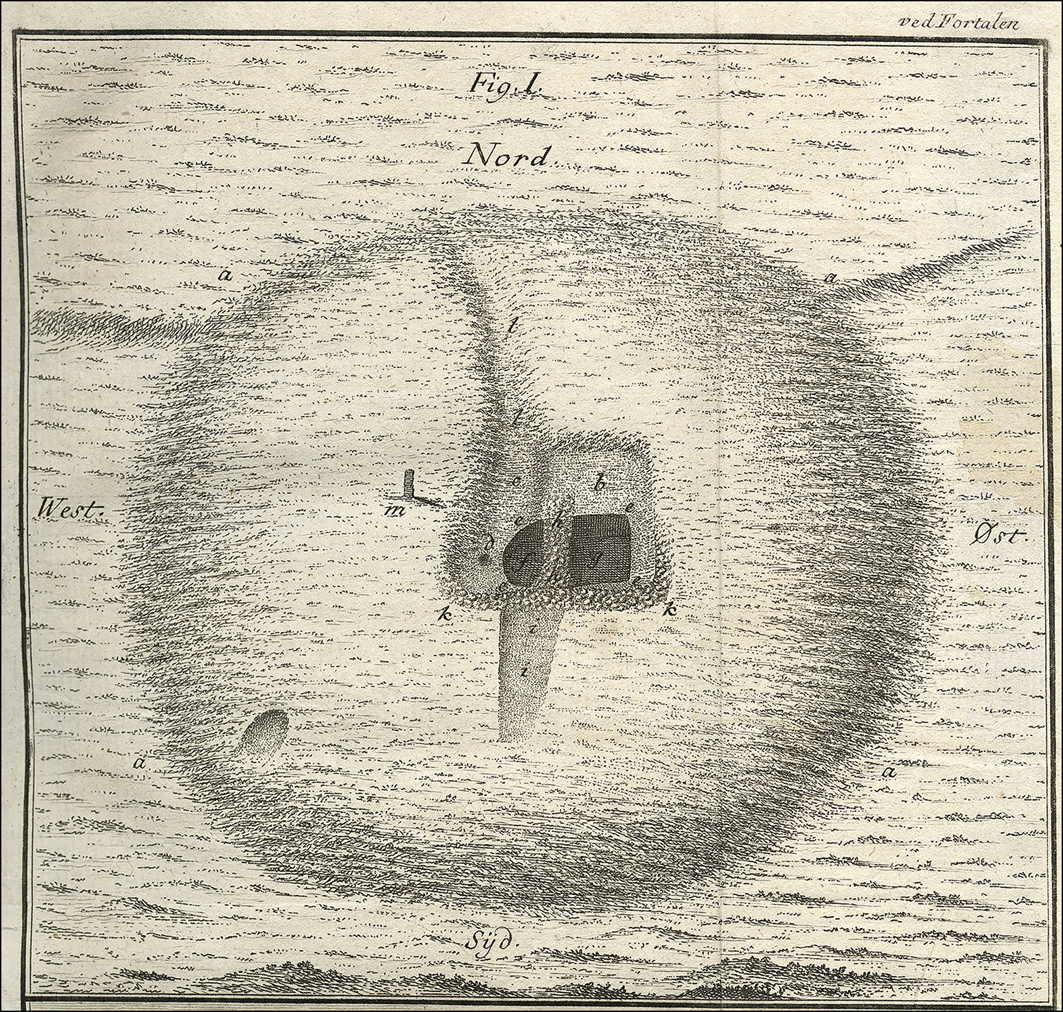
Sommerschild recorded a mound 63 meters across and 7 to 8 meters high. Near the surface they met two charcoal layers. Deeper they struck brown earth with iron nails and a wall of boulders. About 4 meters down a stone slab covered a skeleton. A sword lay beside it. Another skull and more human bone appeared a little to the south. Animal bone from cattle, pigs, and sheep was common. Wooden beams held iron nails
The finds were taken as proof that Herlaug’s storeroom and grave had been located. The sword and skeleton went to Trondheim and were later lost. In 1917 Theodor Petersen argued that the mound was a ship burial and that the so called vent was the imprint of a mast. That reading waited more than a century for confirmation by modern dating.
The 2023 fieldwork reported in 2026
A 2026 Antiquity research article published the findings from a 2023 dig. Archaeologists from the NTNU University Museum and Trøndelag County returned with two aims. They wanted artifacts that could prove a ship. They wanted samples that could date the mound. The Directorate for Cultural Heritage funded the fieldwork.
Three small openings were cut. Trench C, 2 by 1.2 meters, sat near the outer edge to record construction and the old ground surface. Test pit B, about a meter deep in an undisturbed upper zone, targeted the two charcoal layers noted in the eighteenth century. Trench A, 3 by 1.8 meters, ran east to west just east of the old stone wall in the center. A metal detector covered the trenches and the ground around them.
The fill is uniform shell sand from edge to core. The two charcoal layers still sit high in the mound, one about 70 millimeters thick, the other about 150 millimeters. Twenty nine iron rivets came from the central trench. The western part of that trench cut through soil already moved in 1775 and 1780. A cattle tooth from that disturbed fill dated to the modern era and confirmed the old disturbance. In the eastern part the rivets lay in shell sand just below the turf. Most were no longer in original position. Wood survived around a few of them, possibly elm or oak. Two rivets 0.2 meters apart still held wood with fibers running the same way. If those pieces had not been shifted, the ship would have lain southwest to northeast, parallel to the strait.
Nails, wood, and a date near 700
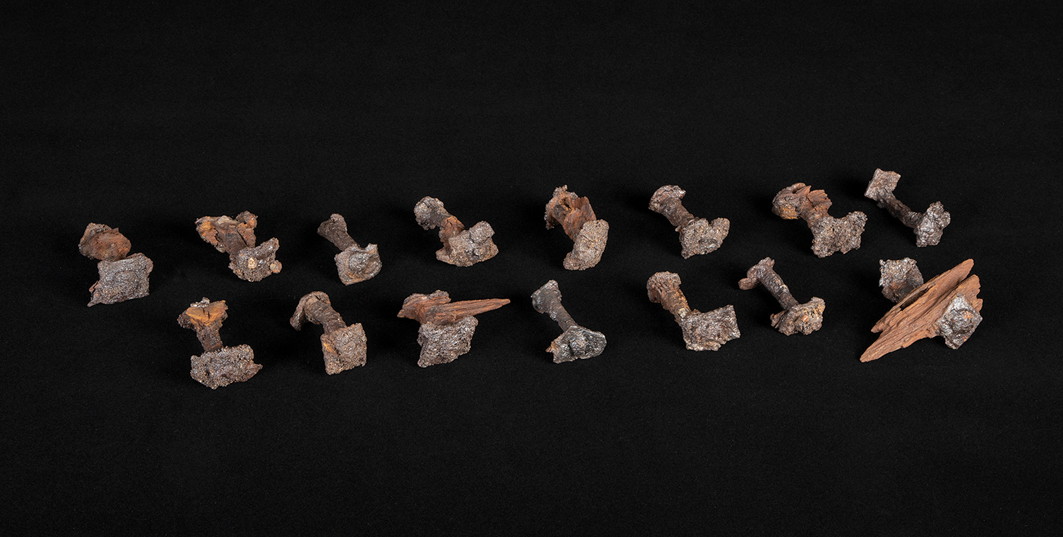
The rivets are large and consistent. Average shaft length is 50 millimeters. Heads reach 29 millimeters. Most roves are rectangular and up to 30 millimeters across. Size matches fastenings from the Gokstad, Oseberg, and Tune ships. Nearly all are clinker nails used to clench overlapping hull planks. One shorter nail is likely a scarfing nail for an end to end plank join. Another is probably a stem nail driven into stem or stern without a rove.
Because the recovered nails are similar in length, they likely come from the midship below the waterline. Higher strakes and the ends of a hull usually take shorter fastenings. The team concludes the vessel was a large ship, more than 20 meters long. That length places it in the same class as later seagoing ships rather than a small river boat.
Dating the artifacts
Unmodelled radiocarbon ages on wood and charcoal span calibrated AD 580 to 870. Outer rings on wood still attached to rivets fall in two ranges, about 656 to 703 and 741 to 774. Missing outer rings mean the true felling date could be later. Charcoal from the upper layers is pine and clusters in the late seventh and early eighth centuries. One older outlier may reflect a larger log. A Bayesian sequence model treats the charcoal layers as later than the ship but does not force a gap of any set length. The model places construction of the ship after AD 670. The mound itself belongs to the late seventh century or the start of the eighth. The team’s working date is around 700.
The two charcoal layers may mark later use. At Haugar in Tønsberg, burnt human bone has been found in charcoal inside a large mound. The Leka layers could record cremation deposits added at the same time as the ship or years afterward.
Closing a gap in the ship grave sequence
Burial in boats and ships is common across northern Europe from the first century to the eleventh. A vessel longer than about 12 to 15 meters is usually classed as a ship. The earliest boat graves in Scandinavia date from AD 1 to 550. Numbers rise in the Merovingian period, AD 550 to 800. Rich boat graves at Vendel and Valsgärde in Uppland belong to that span. The oldest known ship burials, as distinct from smaller boats, are in eastern England. Snape dates to about 550 to 600. Sutton Hoo dates to about 600 to 625. Until the Leka work, the oldest Scandinavian ship mounds were those on Karmøy in western Norway, assigned to the late eighth century. Two ships at Salme in Estonia, around 750, held crews who died by violence and were not regular mound burials. Ninth and tenth century ship graves concentrate around the Oslo fjord.
Herlaugshaugen therefore occupies a missing interval. It is later than Sutton Hoo and earlier than Oseberg and Gokstad. It also sits far north of the southern Norwegian cluster. The authors argue that monumental ship burial was already in use on the northern coast in the seventh and eighth centuries. They treat that fact as evidence of a shared North Sea custom rather than a late copy of an English template that arrived only with the Viking Age. Direct cargo from Britain in Norwegian graves becomes abundant in the ninth and tenth centuries. Contact in the seventh and eighth centuries is thinner but not absent. A seagoing ship of this date on Leka adds weight to the case for a continuous tradition.
Harbor, assembly, and the route north
Place names around the mound point to gathering. Skei is a name often tied to markets and recurring sports, including horse fights. The neighboring farm Leknes may preserve the island name or the Norse word for play and games. Until 1681 a church stood at Leknes. Nearby lies a site called Tinghaugen, the thing mound. No mound survives there now, and the age of the name is uncertain. Residents treat it as an old memory of assembly. If Leka drew people from a wider district, the first monument they met from the water was Herlaugshaugen.
The old name of Norway, Norvegr, means the way north or the route between the straits. Ships carried stockfish, skins, furs, antler, iron, marine oil, and whetstones south along that coast. Whetstones from Mostadmark in the Trondheim fjord moved in volume in the eighth century. Reindeer antler reached Ribe in Denmark by the mid eighth century. Continental objects in a seventh to eighth century cemetery on Ytre Kvarøy, farther north, show the same outward reach. Inland, scholars have long noted ties between Trøndelag and Uppland. In 1884 the traveler A. H. Cocks compared three large mounds at Bertnem, each about 50 meters across, with the royal mounds at Uppsala. Leka sits on both the sea lane and the valley road toward Sweden.
The island itself is geologically odd. Uplifted ocean floor from the Caledonian collision produced yellow and red rock rare in Norway. Combined with a safe harbor, fisheries, and pockets of good land, that landscape could draw people the way a dramatic rift later drew assemblies at Thingvellir in Iceland. The mound marks the entrance to a place that already had central functions.
What the monument claimed
Ship graves have been read as statements of rank, as origin stories for ruling houses, and as ritual craft for a voyage into death. Jan Bill has treated western Norwegian ship mounds as a political form borrowed from Anglo Saxon practice and used to pass authority from one ruler to the next. Other writers tie large mounds to rivalry over land and to assembly sites that advertised control of a territory. The Leka team is cautious about any direct line from this one grave to later royal power. They do place the mound inside longer processes of territorial claim and ranked authority in the Late Iron Age, from about 550 to 1050.
Most excavated ships from before the tenth century were built for both oar and sail. They carried warriors and cargo. Raiding and trade belonged to the same maritime economy. A leader buried in a ship of more than 20 meters had the means to move people and goods along the coast and, at least in principle, across open water. The mound made that capacity visible. In a period when Christianity already offered one model of kingship by divine grant, a great earthen ship offered another. Authority rested on ancestors, labor, and control of the sea road.
The occupant is unknown. The eighteenth century skeleton is gone. The dates rule out the saga’s Herlaug as the person first placed in the ship. Later generations could still reuse the hill and attach a new name to an old monument. That is a common fate of mounds. The charcoal layers hint that the site did not go quiet after the first burial.
Conclusion
Herlaugshaugen is a ship burial from around AD 700. The vessel was large, built with heavy clinker nails, and covered by one of Norway’s biggest mounds. The date pulls monumental ship burial north along the coast and backward in time by about a century relative to the Karmøy graves. It also sits between Sutton Hoo and the classic Norwegian ships of the ninth century.
Leka was not a backwater. It was a harbor on the coastal route, a likely meeting ground, and a point where sea traffic met the valley road inland. The mound faced the strait so that anyone who arrived by water would see it. That is the finding of the 2023 trenches and the laboratory dates. The legend of a king who walled himself in with food remains a story. The ship and the date are now part of the ground.
