
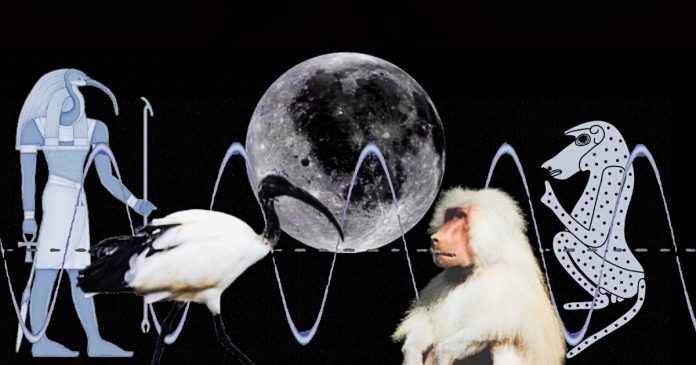
Thoth stood among the most complex deities of ancient Egypt. He governed wisdom, writing, magic, and the moon itself. Egyptians portrayed him in two animal forms: the sacred ibis and the sacred baboon. The choice of the ibis has long invited explanation through its curved beak and pied plumage. The choice of the baboon has remained far more obscure. A recent study by Nathaniel J. Dominy and Catherine Hobaiter examines both forms through the lens of color science and linguistic history. Their measurements show that the animals share a visual quality with moonlight itself.
The Dual Zoomorphic Forms of Thoth
Thoth appeared most often as a sacred ibis or as a baboon of the species Papio hamadryas. Natural populations of the ibis once ranged across Egypt. Baboons did not. Archaeological finds nevertheless include hundreds of mummified remains of both olive baboons and hamadryas baboons recovered from temples, tombs, and catacombs. Trade networks brought the animals into Egypt from regions farther south and east. Both species received ritual treatment. Only the hamadryas baboon, however, became an official embodiment of the god.
Physical Traits of the Sacred Ibis

Earlier scholars noted several features that might link the ibis to the moon. The beak curves in a shape that recalls a crescent. When the bird stands with wings tucked, its black and white banding can suggest the phases of a quarter moon. More recent attention has focused on the pure white plumage visible during landing. In that posture the bird presents a bright circular form. Cooper has connected this brilliance to the Egyptian name of Thoth, which carries the sense of a white or bright thing. The landing posture makes the argument especially persuasive.
The Puzzle of the Baboon
The selection of the baboon raises several difficulties. No evidence places wild baboons in Holocene Egypt. The animals therefore entered the religious system only through human transport and captivity. Both olive and hamadryas baboons reached Egypt and underwent mummification. Egyptian artists distinguished the two species accurately in sculpture and painting. Yet only the hamadryas received the status of Thoth. The study asks whether color supplies the missing criterion.
Linguistic Roots of the Name
Cooper’s analysis of the Egyptian theonym points toward an early Afroasiatic root tied to lunar luminosity. Epithets of Thoth include phrases such as the beautiful one of the night, the brightly shining, and silver sun. These titles emphasize brightness rather than shape alone. If the name itself encodes the quality of moonlight, then the animals chosen to represent the god should display that same quality in their appearance.
Spectroscopic Comparison of Moonlight and Animal Surfaces
The researchers obtained an irradiance spectrum of moonlight recorded when the moon stood at fifty-seven degrees elevation and ninety one percent full. The spectrum is relatively smooth and flat across visible wavelengths, with a peak between six hundred and seven hundred nanometers. They then measured reflectance spectra from museum specimens of olive baboons, hamadryas baboons, and sacred ibises held at the American Museum of Natural History. Hair samples came from standardized locations on the forehead and other regions. Plumage samples came from the white chest of the ibis.
Results of the Spectral Measurements
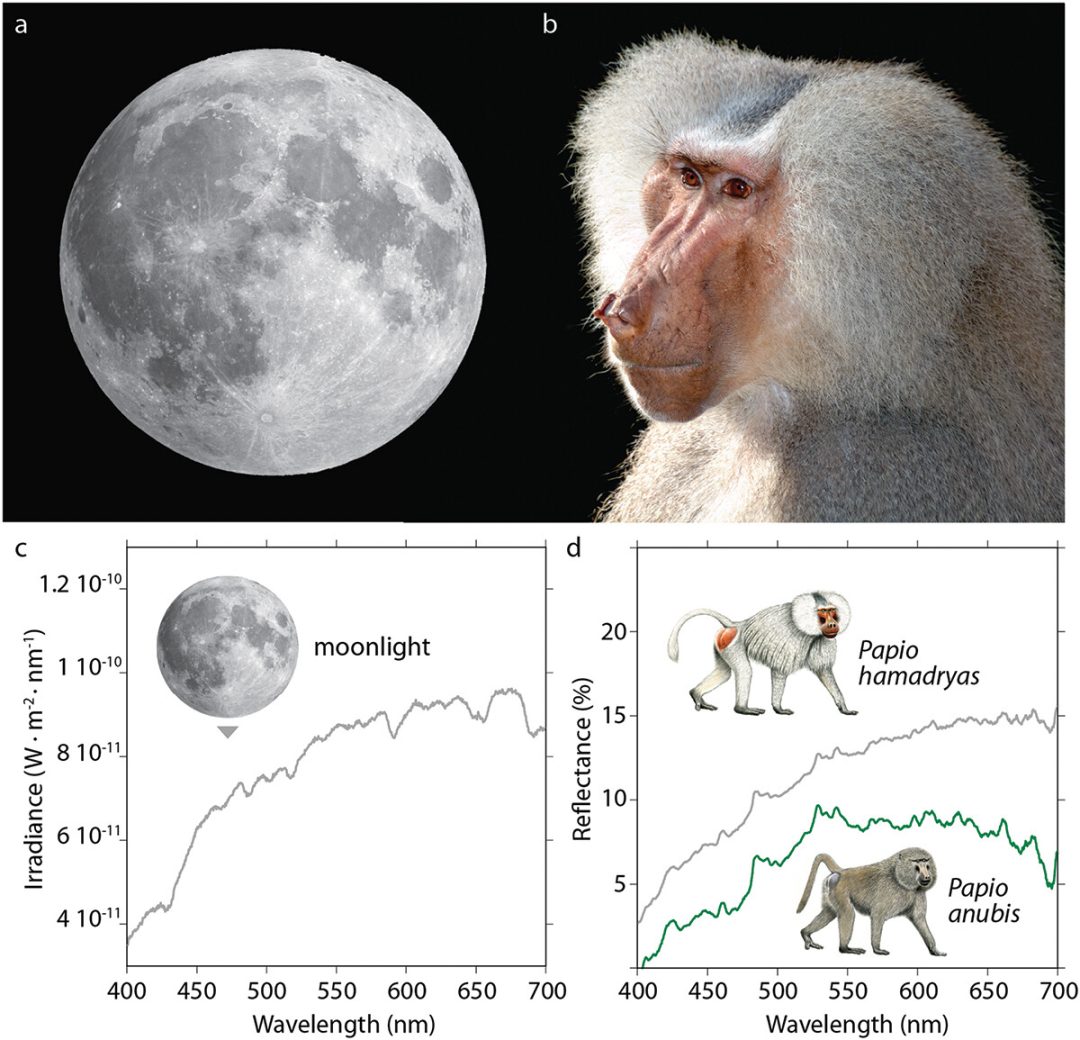
The reflectance spectrum of olive baboon hair shows a broad peak between five hundred twenty-five and six hundred fifty nanometers followed by a decline at longer wavelengths. Human observers perceive this profile as greenish, consistent with the common name olive baboon. The spectrum of hamadryas baboon hair is approximately sixty five percent more reflective. Its shape closely matches the moonlight irradiance curve and peaks in the same six hundred to seven hundred nanometer range. Human observers perceive this profile as gray or silver. German common names for the species include terms that translate as gray baboon and silver baboon.
Brightness of Male Secondary Features
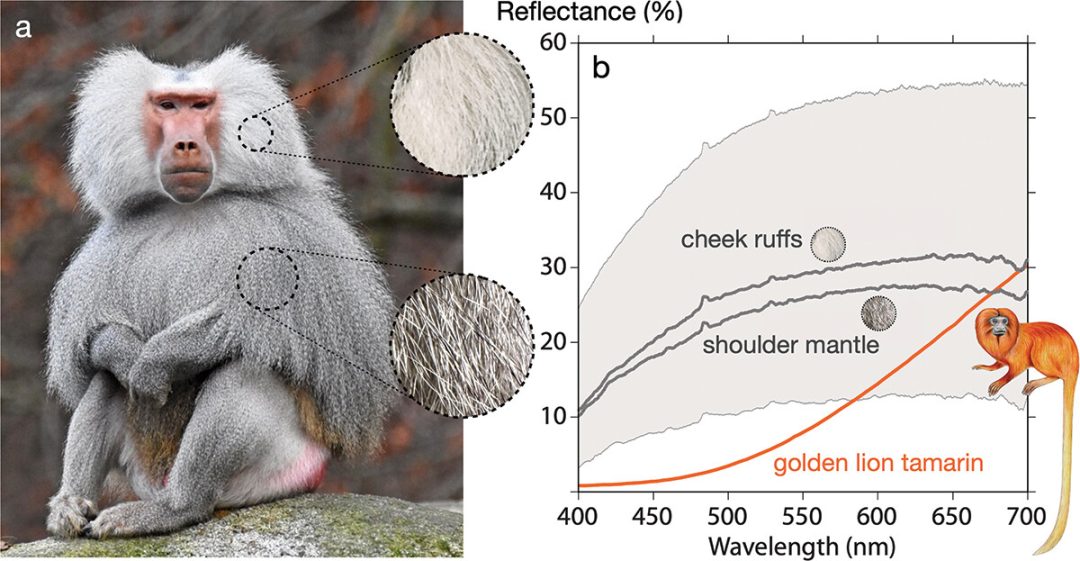
Adult male hamadryas baboons develop long shoulder mantles and prominent white cheek ruffs. The hairs in these regions display alternating bands of cinereous and gray shading. Reflectance measurements from the cheek ruffs and mantle show high and variable reflectivity. Average values exceed those recorded for other monkeys familiar to ancient Egyptians, including grivet and patas monkeys, by a factor of two. Maximum reflectivity surpasses even that of the golden lion tamarin, a species noted for exceptional luminance. The silver white quality of mature males therefore stands out with particular intensity.
Ancient Accounts of Baboon Behavior
Classical sources describe behavioral responses of baboons to lunar events. A fifth century text attributed to Horapollo states that Egyptians painted the baboon to represent the moon because the animal shows sympathy at the time of conjunction. When the moon darkens, the male neither looks up nor eats but bows to the ground as if in grief. Temple keepers continued to maintain baboons so that the moment of conjunction could be observed from their conduct.
Modern observations of captive hamadryas groups during solar eclipses record abrupt reductions in activity, increased vigilance, and huddling. Sporadic vocalizations also occur. Egyptian texts speak of the jubilating language of baboons directed toward the sun, a speech that included shouting, singing, and dancing. One animal in the Saqqara catacomb carried the name meaning the Hearing Ear, suggesting a role as intermediary.
Implications for Egyptian Religious Practice
Egyptian artists paid close attention to the distinguishing traits of birds and mammals. They differentiated three species of ibis and two species of baboon. Among all available candidates they selected the animals whose coloration and brightness most closely resembled moonlight. The same principle extends to both zoomorphic forms of Thoth. Behavioral sensitivity to celestial events further reinforced the association. Keepers who lived in close proximity to the animals could observe and interpret these responses within a religious framework.
The dual embodiment of Thoth therefore rests on a shared visual property. Both the sacred ibis and the sacred baboon display surface colors whose spectral profiles align with the irradiance of moonlight. Linguistic evidence that the god’s name itself refers to brightness supplies an independent line of support. The measurements confirm that the choice of animals was consistent with that meaning.
