
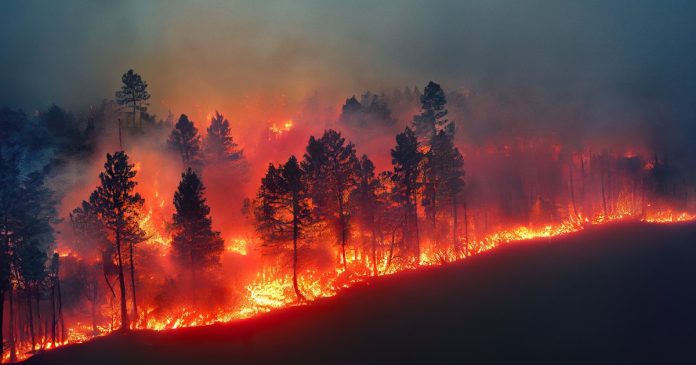
Pottery changed daily life in the Neolithic Near East, held grain, water, and stews. It made fermentation and storage easier. Decorated vessels also carried meaning beyond use. Most explanations for its origin point to social demand, population growth, or slow experiments with clay linings in baskets and hearths. A 2026 paper in the journal Geomorphology puts forward a different starting point. People in the Jordan Valley may have first seen clay harden because wildfires baked it in place. The same fires had stripped soil from the hills and laid that soil down where villages later stood. The study calls this the “natural kiln hypothesis”.
The claim applies to the southern Levant, the hill country of present-day Israel and the Jordan and Dead Sea valleys. It does not replace every other account of pottery. This perspective adds an environmental trigger that lines up with the moment and the place where ceramic vessels first appear in that region.
Two warm intervals and two fire peaks
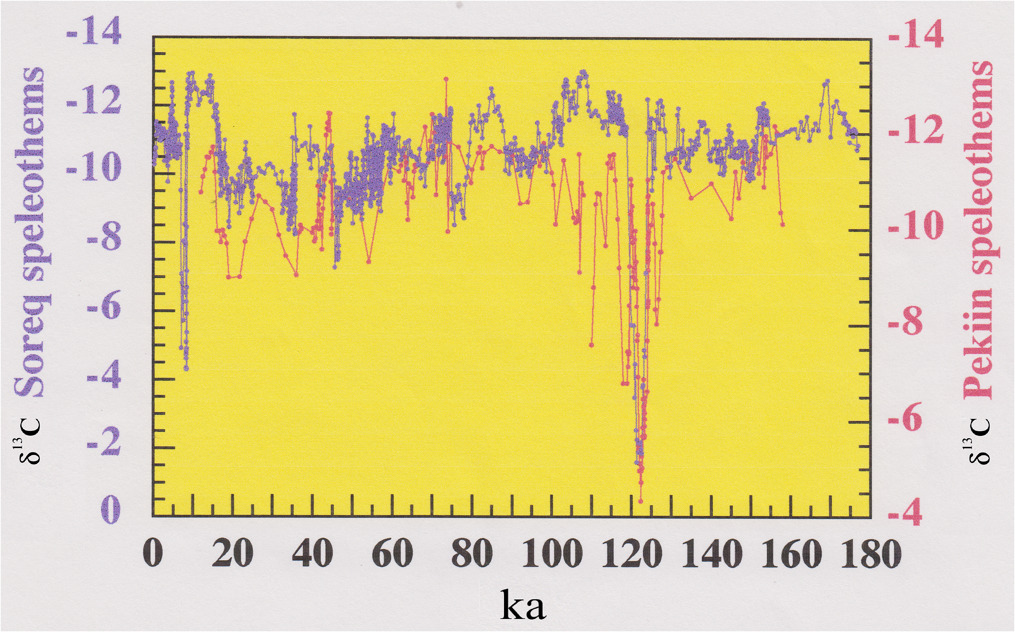
The study compares two stretches of time. One is Marine Isotope Stage 5e, from about 129,000 to 116,000 years ago. The other is the early part of the Holocene, from about 11,700 to 7,000 years ago, with a sharp pulse near 9,500 years ago. Both intervals were warm and unstable. Summer sunlight was strong because of the tilt and orbit of Earth. As Weather systems shifted, dry thunderstorms could deliver lightning onto dead grass and shrubs at the end of a dry season.
The fire signal was extracted from lake mud via core drilling. A long core from the Dead Sea shows a jump in tiny charcoal particles between about 124,000 and 122,000 years ago. Another core from Hula Lake in the northern Jordan Valley shows another jump near 9,500 years ago. In the Ghab Valley a core from northwest Syria shows charcoal peaks near 9,600 years ago. The two Holocene peaks line up across a wide area. That pattern is hard to explain by campfires alone. People lived in small pockets. They did not occupy every hillside at once.
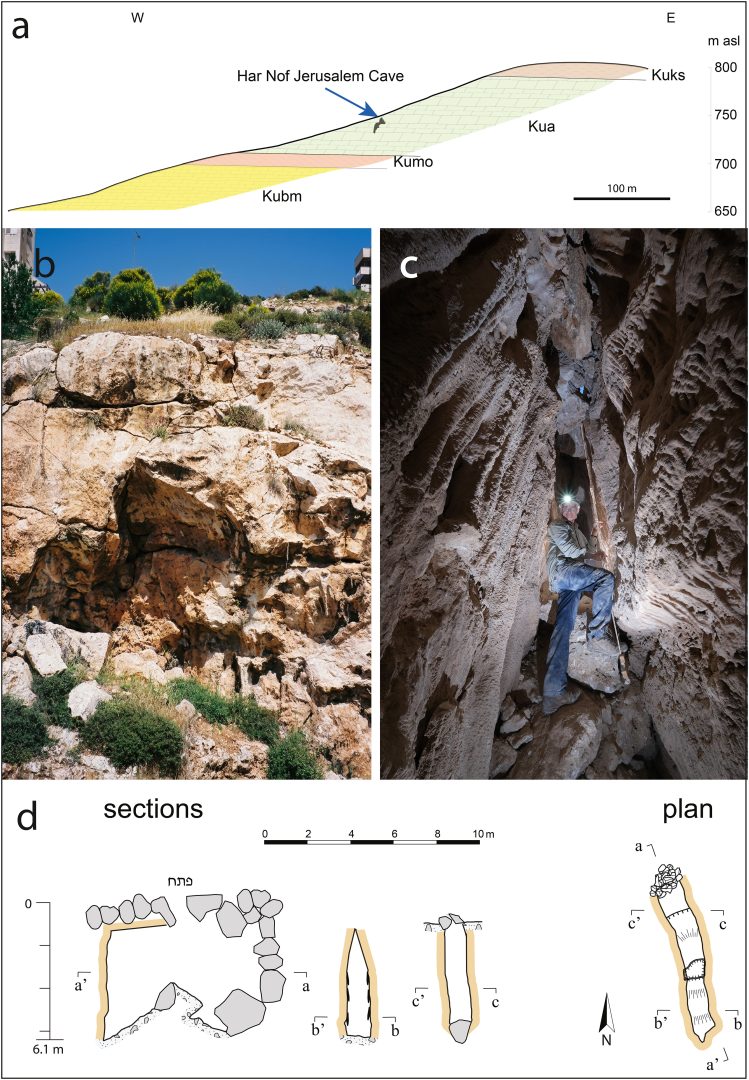
Caves on the western hills add a second line of evidence. Stalagmites from Soreq Cave and Har Nof Cave near Jerusalem record carbon and strontium isotopes. During both fire peaks the carbon isotope values rise. That rise matches the loss of C3 plants, the trees and woody shrubs that dominate Mediterranean slopes today. Strontium ratios shift at the same time and even a little earlier. Those ratios track the washout of soil from the rock above the caves. Temperature estimates from the same stones show heat and swings in heat.
What fire does to a hillside
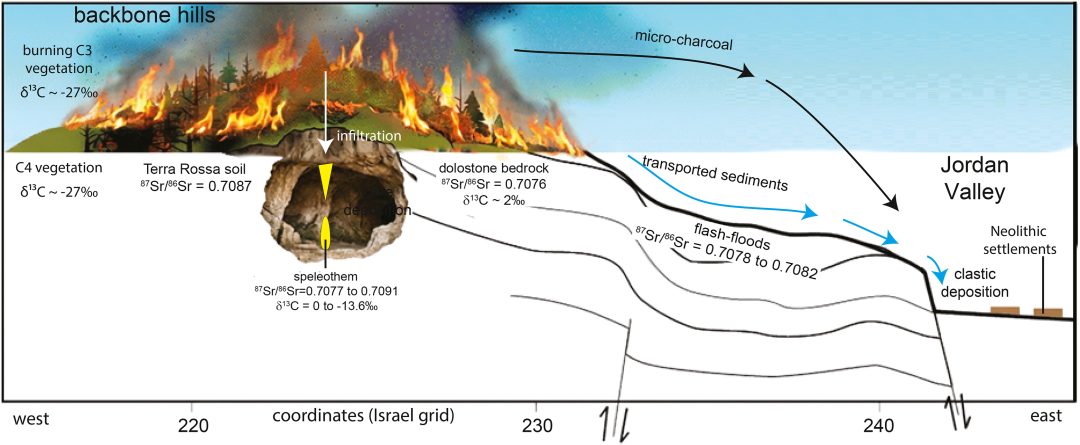
Modern burns in the same region show why the ancient signal is so strong. After a severe fire on Mount Carmel, runoff and sediment can rise by tens or hundreds of times in the first year. Plants no longer hold the ground. A layer of fine charcoal can sit on the soil and send water sideways along the contact. Steep south facing slopes dry faster and recover slower. Heavy winter rain then moves the loose material. The soil on the Judean and Samarian hills is terra rossa. It is a red mix of clay, silt, quartz dust from the Sahara, and residue from dissolved limestone. Once it leaves the slope it does not vanish. Flash floods carry it into the rift valley. There it settles as fans and floodplain fills.
In Stage 5e those fills form part of the Samra Formation in the Dead Sea basin. In the Holocene they form the Ze’elim Formation along the Dead Sea and the Fazael Formation in the lower Jordan Valley. Some of the Holocene bodies are tens of meters thick. Dates on fans and cores cluster between about 12,000 and 7,000 years ago, with major pulses near 9,500 to 8,200 years ago. Soil on the Golan Heights tells the same story from the opposite direction. Almost no surface soil there is older than about 7,500 years. Older soil was stripped away.
New ground under new villages
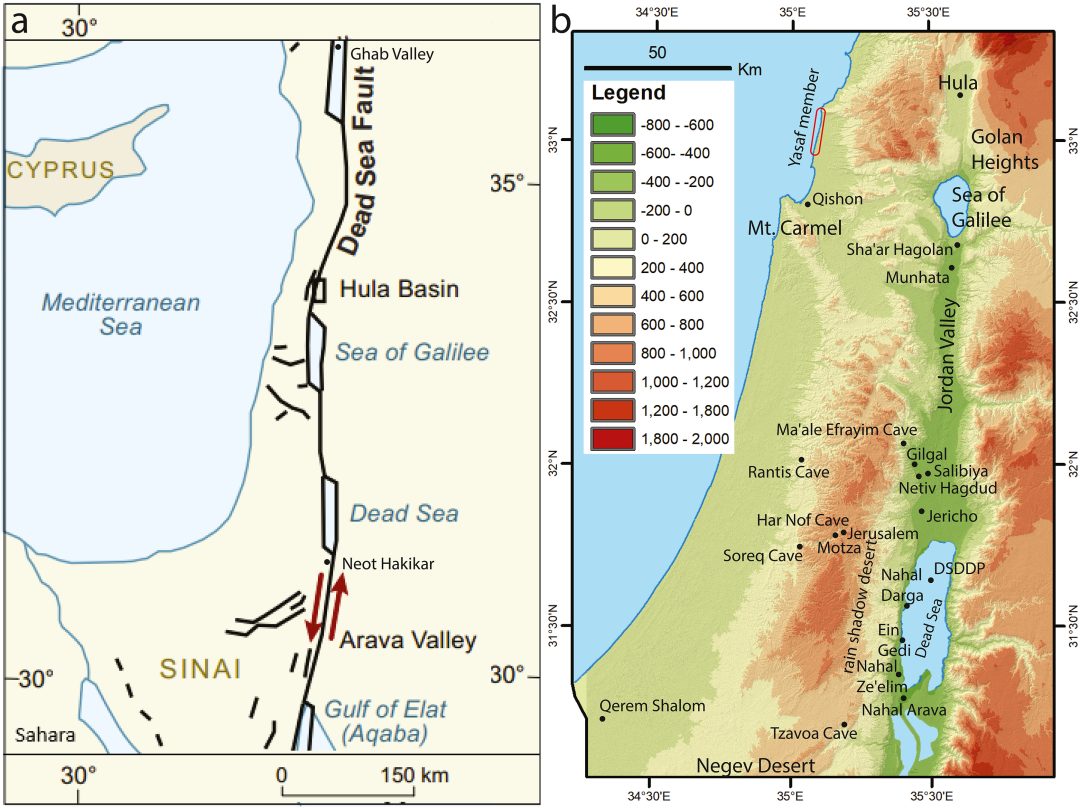
Large Pre Pottery Neolithic sites sit on the fresh valley fills. Jericho, Gilgal, and Netiv Hagdud occupy ground that had only recently arrived from the hills. Later, Pottery Neolithic towns such as Sha’ar Hagolan grew on the same kind of surface. A well at Sha’ar Hagolan, dated to about 8,400 to 8,200 years ago, was cut through reworked soil and gravel into older lake beds beneath. The village stood on the new deposit.
Upland sites moved in the opposite direction. Motza, a large settlement in a highland valley west of Jerusalem, was abandoned near the fire and erosion peak, before pottery became common. Hills that had lost their soil offered less for farming and less for grazing. Valleys that had gained soil, and that still held springs and seasonal water, offered more.
The Jordan Valley was already a center of plant domestication. Wheat and barley had wild ancestors that could tolerate low intensity fire. People who settled on the new clay rich ground had water, soil that floods could renew, and time. Those conditions favored fields and storage. Pottery arrived in that setting.
Clay that fire had already touched
This hypothesis turns on a simple observation. The fires that cleared the hills also burned across the valley floors. Clay that had just been dumped there sat in the open. People who already used fire every day would have seen patches of ground that heat had changed. Soft red clay became hard. The change was visible and lasting.
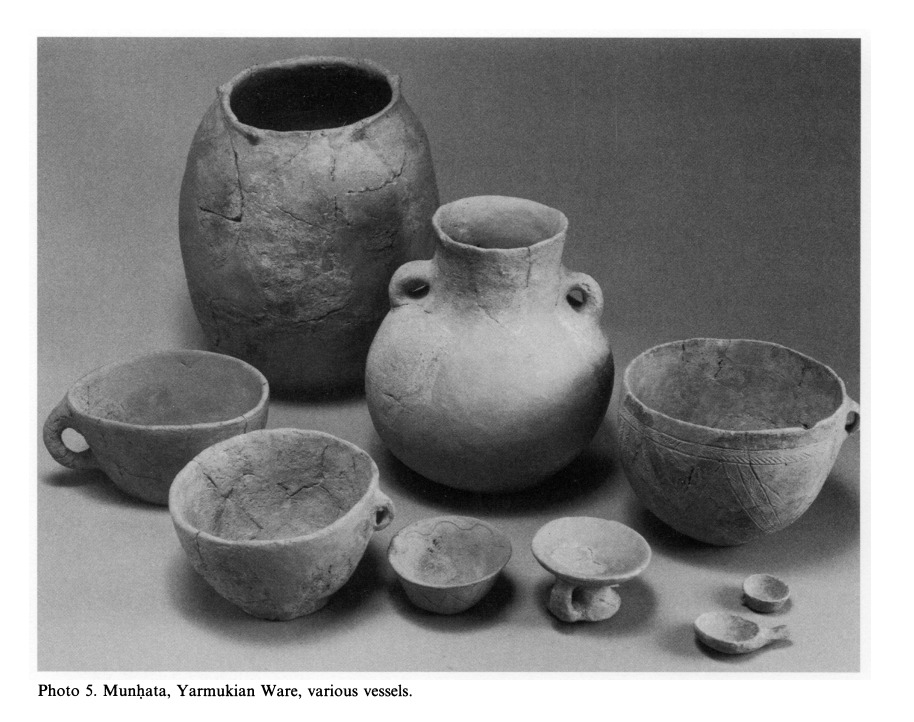
Work by Yuval Goren in 1992 showed that early Yarmukian pottery from Munhata and related sites was made from local reworked terra rossa. That is the same clay the floods had delivered. The match does not prove that potters first learned the trick from a wildfire. It does show they used the material that nature had placed at their feet.
Yarmukian vessels and figurines are already skilled. But the new study argues that such skill does not require a long age of blind tests if the basic fact was already known. Fire transforms clay. Once that fact was grasped, people who managed fire for cooking and land clearing could raise the temperature on purpose.
Several local conditions made the lesson cheap to learn. Clay was abundant after the erosion pulse. Water was close. Settlements were permanent. Surplus food gave time to try and fail. Small hearths had been used in the region for hundreds of thousands of years. What had been missing, in this account, was a large natural example at the same moment that villages stood on fresh clay.
The older fire that produced no pots
Stage 5e was the stronger of the two events. Charcoal counts, isotope swings, and valley fills were all larger. Three hominin groups appear to have lived in the southern Levant at that time. Neanderthals, Early Homo sapiens & according to the paper an archaic “Nesher Ramla Homo”. They used fire but did not farm and They did not live in large, settled villages on aggrading fans. They left no pottery.
The paper treats that interval as a natural control. The landscape did the same work. Hills burned. Soil moved. Clay collected in low ground. The human setting was different. Without sedentism, fields, and a need for storage vessels, the baked clay remained a curiosity rather than a craft. The contrast matters. Environment alone did not invent pottery. Environment plus a particular way of life may have.
What the dates can and cannot show
The hypothesis rests on coincidence in time and place. Coincidence is not proof of cause. The charcoal peak, the cave isotope peaks, and the valley sediment dates all fall inside a window of a few thousand years. They do not yet line up year by year. A gap in the Hula Lake charcoal record after about 9,000 years ago hides the close of the Holocene fire pulse. Scholars still argue about the exact start of the Pottery Neolithic.
Tests that could strengthen or break the idea; Excavators at Sha’ar Hagolan or a similar site could look for a layer of naturally baked clay under the oldest pots. That layer should match the local terra rossa in chemistry and texture. Experiments could show whether a valley floor wildfire can reach 500 to 700 degrees Celsius, the range where clay begins to harden in a lasting way. If pottery in the southern Levant is shown to be much older than about 9,500 years ago, the timing fails.
The hypothesis does not shut out other paths. People may still have lined baskets or hearths. Feasts and storage needs may still have created demand. Clay from other sources may still have been tried. The fires may only have shortened the route from observation to craft.
Conclusion
The early Holocene fire pulse did two things at once. It damaged the hills. It built new ground in the valleys. People followed the soil. They farmed it. They may also have watched fire work on that soil and then copied the result. Pottery then helped those valley towns grow. Vessels stored harvests. They cooked food. They carried decoration that marked group and ritual. A harsh interval on the slopes became, in the lowlands, a setting for invention.
The natural kiln idea is a proposal, not a finished proof. It grows from the match between fire records, washed clay, village locations, and the clay used in the first local pots. It asks field teams to search for baked sediment that no potter made. If that sediment is found in the right place and at the right time, a wildfire on a newly filled valley floor will belong in the story of how soft earth became ceramic.
