
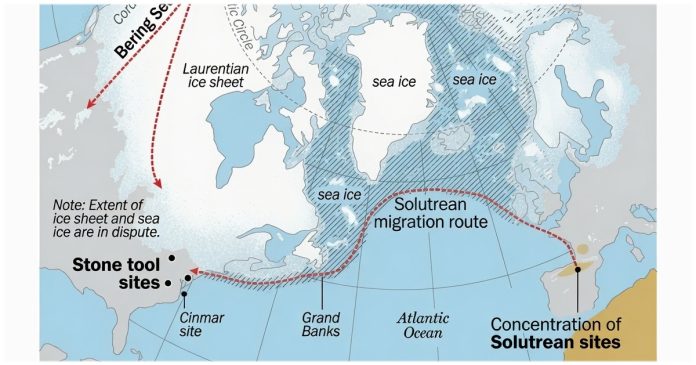
Few questions in American prehistory have generated as much heat and as little light as the Solutrean Hypothesis. The dominant model, migration from northeast Asia via the Bering land bridge, rests on substantial evidence and commands broad consensus. That consensus, however, has hardened in places into something closer to doctrine, and one consequence of that hardening is the treatment of the Solutrean hypothesis: a proposal, grounded in real archaeological data, that a Paleolithic European population may have reached North America via the North Atlantic ice edge some 20,000 years ago. What follows is an argument that the scientific community has not dealt with it honestly and that the reasons for that failure are worth examining with clear eyes.
The People the Ice Age Almost Erased from the Story
Roughly 22,000 years ago, in the southwestern corner of what is now Spain and Portugal, a Paleolithic culture was doing something remarkable with stone. The “Solutreans” named after Solutré (a site in eastern France where their tools were first identified) were producing bifacially flaked points of a precision that had not been seen before in the human record. Thin, symmetrical, elegantly formed. Archaeologists call these laurel-leaf blades, and the name is apt: they are almost impossibly delicate for objects shaped entirely by percussion and pressure. An accumulated technical tradition refined across generations.
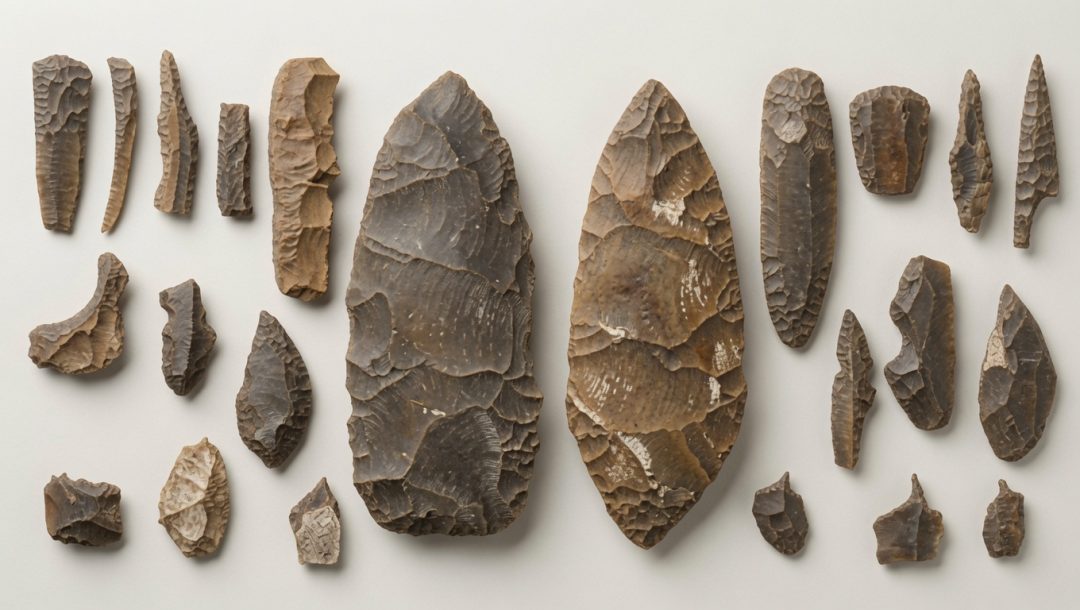
Dennis Stanford, former chair of the Smithsonian’s anthropology department, and Bruce Bradley, a lithic specialist at the University of Exeter, spent years looking at those Solutrean tools and then looking at something else: Clovis points from North America, dated to roughly 13,000–11,000 years BP. Their 2004 publication presented their case. Which is that the technological family resemblance between these two traditions was not coincidental. The hypothesis they advanced was pointed: Solutrean people, or their cultural descendants, crossed the North Atlantic during the Last Glacial Maximum, arrived on the eastern seaboard of North America, and seeded what became the Clovis culture. This is not a fringe idea invented for popular consumption. Stanford worked at one of the world’s preeminent scientific institutions. Bradley is a practicing flint knapper with decades of hands-on experimental archaeology behind him.
Ice Was the Road, Not the Obstacle
One of the most persistent mischaracterizations of the Solutrean hypothesis is that it requires ancient humans to have paddled across open Atlantic Ocean. Which is a feat so obviously implausible that dismissal seems warranted on its face. But, that is not the argument. During the Last Glacial Maximum, approximately 20,000 years ago, sea ice extended dramatically further south and west than it does today. Paleoclimate reconstructions, derived from ocean sediment cores, ice cores, and foraminifera assemblage data, allow scientists to model the extent of sea ice coverage with reasonable confidence. What those models show is a continuous zone of pack ice. Along with seasonal polynyas, and navigable leads extending across the North Atlantic from Iberia to eastern North America. That is not open ocean. That is an ice-edge habitat.
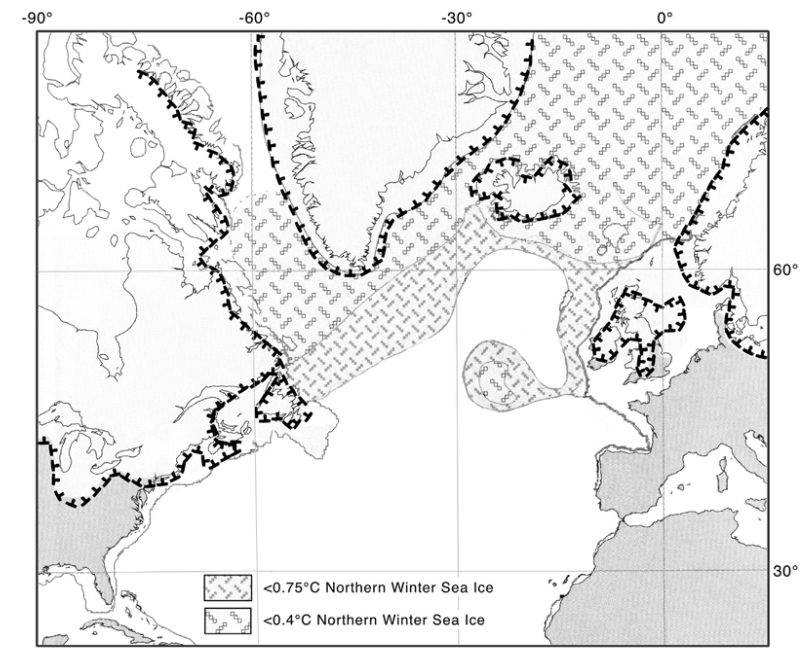
Inuit and their predecessors navigated analogous environments across the Arctic for thousands of years. They hunted marine mammals from skin boats, reading ice conditions, and moving laterally along pack ice margins. This can astonish anyone who has not studied the archaeology of circumpolar cultures. The cognitive and technological requirements of ice-edge coasting are demanding, but they are demonstrably within the range of Paleolithic humans. Pointedly they are the same species that crossed open water to reach Australia at least 50,000 years ago. Asking whether Solutreans could have followed an ice shelf is a different question, and a far less daunting one, than asking whether they could have rowed across open Atlantic. The hypothesis, properly understood, is about ice-edge coasting. Critics who argue against open-water crossing are creating a straw man.
When One Side Has to Prove the Boat
The objection that the Solutrean hypothesis requires boats and produces no direct boat evidence sounds scientific until you apply it consistently. The Kelp Highway model, which is now a mainstream and widely entertained companion to the overland Beringia route, also requires watercraft. Pacific coastal migration along the kelp forest margin from northeast Asia to the Americas demands ice-edge and open-water navigation at least as demanding as anything proposed for the North Atlantic route. No Paleolithic boats have been recovered for the Kelp Highway either. No dugout canoes, no skin vessels, no paddles. The assumption of boat capability is simply granted. The Solutrean hypothesis asks for the same assumption and receives none. That is a preferential distinction. One the field should be honest about when when it applies the boat-evidence demand to one Atlantic hypothesis while waving it past an equally boat-dependent Pacific one.
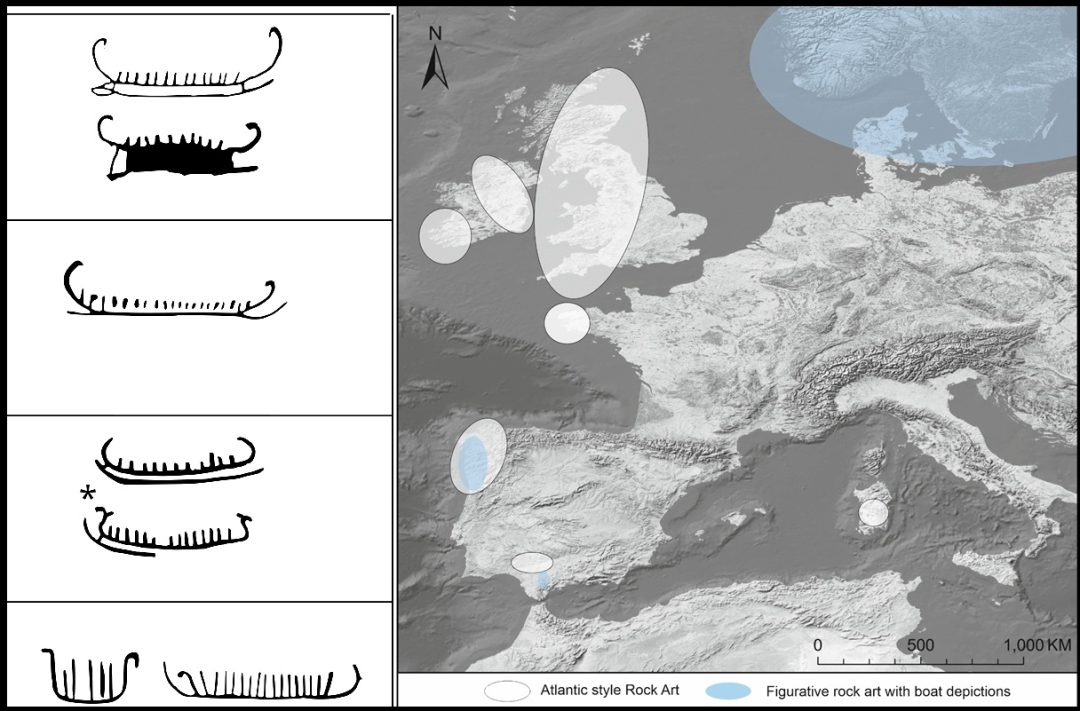
What the archaeological record of northwest Iberia does offer, not as proof, but as meaningful cultural context, is a deep and structurally persistent maritime tradition. The region spanning northern Portugal into Galicia contains a dense concentration of prehistoric boat petroglyphs, documented at sites. A 2026 study in PLOS One analyzed these carvings using high-resolution 3D scanning and GIS landscape analysis, confirming significant typological parallels with Bronze Age Scandinavian nautical iconography, vessels rendered with masts, steering oars, rigging, and crew positions, dated broadly to c. 1300–800 BCE.
Contextualizing the Boat Petroglyphs
The Atlantic Rock Art tradition in this region extends back through the Bronze Age into the Neolithic. These carvings postdate the Solutrean by millennia and prove nothing directly about Paleolithic seafaring. What they do show is that the culture occupying this exact stretch of Atlantic coastline maintained an orientation toward the ocean across thousands of years. A civilization carving technically detailed oceangoing vessels at the end of the Bronze Age was not a culture that discovered the sea recently. Holding the Solutrean hypothesis to a boat-evidence standard that is waived for the Kelp Highway, is not neutral skepticism. It is selective application of a rule that only runs in one direction.
When Two Traditions Invent the Same Mechanics
The lithic evidence is where the hypothesis earns its most serious attention. This is where the dismissals feel most strained. Solutrean and Clovis stone-tool traditions share a cluster of techniques that are, to put it plainly, globally rare. Overshot flaking. This is when a percussion strike travels all the way across the face of a biface and removes a flake from the opposite edge. A feature that appears in Solutrean assemblages and in Clovis assemblages. Channel flake removal, a step involved in producing the distinctive fluted base of Clovis points. Which importantly, has no known Old World parallel except in Solutrean work. Thin biface production of the kind both traditions achieved requires years of apprenticeship-level skill acquisition. Not a technique that emerges spontaneously or frequently. The combination of these traits is not common. It is, in the global lithic record, almost singular.
The standard rebuttal is convergent evolution. An idea that two cultures, independently and in isolation, arrived at the same complex, difficult, multi-step technical solution. Convergence is real; it explains a great deal in biology and in human material culture. But it carries an explanatory burden proportional to the complexity of the trait in question. Independent cultures developing scrapers? Plausible. Discovering ceramic firing? Documented. But cultures independently arriving at overshot flaking, channel flaking, and thin bifacial production as a coherent package does real work on the odds. In addition, separated by an ocean and several thousand years? That asks convergence to do a lot of work. The critics have rarely grappled with this problem at the level of specificity it demands, preferring instead to invoke convergence as a category and move on.
Genome Studies Close the Case, Not so Fast.
The genomic case against the Solutrean hypothesis is presented as decisive. Ancient DNA studies show strong northeast Asian ancestry across sampled Native American populations, and no detectable Pleistocene European signal has emerged from the sequenced genomes. That result is real, and it carries weight. But the samples driving that conclusion are concentrated in Mexico, Central America, and South America. Clovis sites are not there. Clovis culture clusters in the North American east: the Great Plains, the American Southeast, the mid-Atlantic seaboard. That is precisely the region the ancient genomic record is almost entirely silent on. Anzick-1, a burial from Montana dating to roughly 12,600 years ago, remains among the only directly Clovis-associated ancient genomes ever sequenced. Citing Mesoamerican and South American genomes to make definitive claims about the people who produced Clovis technology is a geographic mismatch the field underplays to a remarkable degree.
The sample concentration in Mesoamerica and South America is consistent with a Beringian crossing. But the implication that follows from their own model rarely gets pressed. If Beringia was the sole entry point, the migratory path ran from the northwest corner of the continent. Clovis culture, however, flourishes in the east and southeast. That’s thousands of miles in the opposite direction. A people entering from the northwest would have had to traverse the full breadth of an unfamiliar landmass, over mountain ranges etc, to eventually coalesce into a distinct culture concentrated at the far end of the continent. That journey is possible. But It is not simple, and the conventional model asks us to assume it without much scrutiny. An Atlantic coastal arrival places people directly on the eastern seaboard. Precisely where Clovis culture is densest. The Solutrean hypothesis doesn’t ask to displace Beringia model. It offers an additional route.
The Sites That Were Not Supposed to Exist
Meadowcroft Rockshelter in southwestern Pennsylvania has produced stratified cultural material dated, at its lowest levels, to somewhere between 16,000 and 19,000 years ago. Cactus Hill in Virginia has yielded stone tools beneath a Clovis layer, in deposits dated to 15,000–17,000 years BP. Buttermilk Creek in Texas produced a lithic assemblage the (Debra L. Friedkin site) with credible dates pushing past 15,500 years ago, predating Clovis by several millennia. Each of these sites has been subjected to sustained institutional skepticism: the dating is questioned, the stratigraphy is disputed, the site formation is interrogated. Some of that scrutiny is legitimate science. But a pattern emerges when you survey the literature carefully. Pre-Clovis claims are held to an evidentiary standard that, applied consistently, would cast doubt on many well-accepted Beringian-model sites. The bar moves depending on which direction the result points.
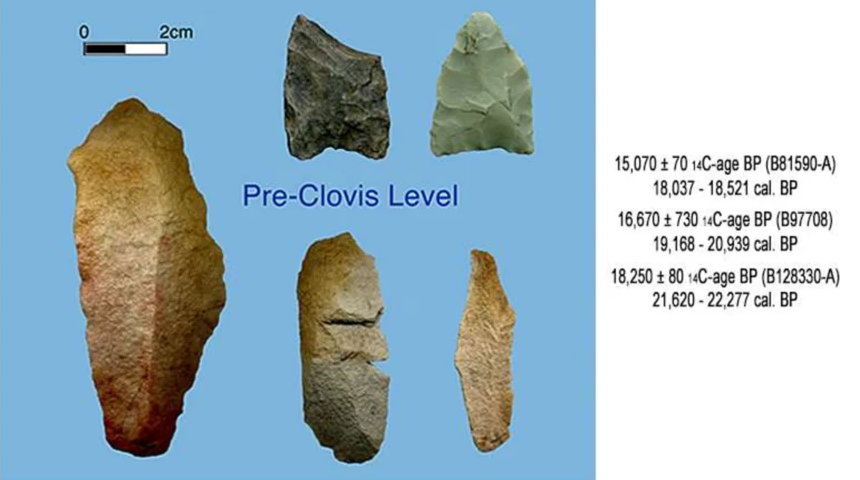
Geoarchaeological Investigations, 2013-2020
Archaeologists who have worked these sites, James Adovasio at Meadowcroft, Michael Johnson at Cactus Hill, Michael Waters at Buttermilk Creek, are not credulous amateurs. They are professionals who have navigated the peer review process and defended their work in print, repeatedly, against concerted opposition. The reception their findings received speaks less to scientific rigor than to the sociology of a field defending a consensus. Pre-Clovis evidence keeps accumulating. Monte Verde in Chile, firmly accepted now, pushed the clock back by 1,500 years and was dismissed for over a decade before the evidence became undeniable. Then came the refutation again. The pattern has a history.
The Evidence That Is Underwater and Cannot Speak
Here is the problem no one who dismisses Atlantic-coastal migration can argue their way past: the coastlines that any Solutrean-derived population would have inhabited are gone. Post-glacial sea level rise since the Last Glacial Maximum has inundated roughly 120 meters of vertical relief along the Atlantic margin. Coastal camp sites, shell middens, lithic scatters, hearths, burials (everything that a maritime people would have left behind on a productive coastline) now lies beneath the continental shelf. The seafloor off the eastern seaboard of North America is an archaeological terra incognita. The technology to systematically survey it, let alone excavate it, is expensive, underfunded, and only beginning to be applied.
When critics of the Solutrean hypothesis point to the lack of Atlantic coastal evidence for the migration, they are pointing to a gap that the physical geography of the Last Glacial Maximum makes structurally inevitable. The evidence cannot be found because we cannot look where it is. Submerged landscape archaeology is a genuine and growing discipline. Work in the North Sea, the Gulf of Mexico shelf, and off the coast of Florida has already recovered meaningful Pleistocene material. But the scale of funding directed at submerged Atlantic coastal sites is vanishingly small compared to what a rigorous test of the Solutrean hypothesis would require. Refuting a hypothesis by pointing to missing evidence in an area you have not searched is a logical move that should not survive peer review. Yet it recurs in the literature without apparent embarrassment.
The Politics That Dare Not Speak Its Name
Stanford and Bradley have addressed this directly, and it deserves honest acknowledgment: the Solutrean hypothesis has been enthusiastically adopted by white nationalist groups and fringe writers eager to argue that Europeans arrived in the Americas before Native Americans and therefore have a prior or equal claim to the land. This is a grotesque misreading of the hypothesis. One that posits migration, not conquest, predating any concept of European identity by fifteen thousand years. But the misrepresentation is real and persistent. Researchers working in this area are aware that their publications can be strip-mined for political ammunition. The discomfort is understandable.
Understandable, and nonetheless insufficient as a reason to suppress inquiry. Science has faced this problem before and will face it again. The genetics of intelligence, the evolution of sex differences, the archaeology of population replacement, each of these areas carries the risk that findings will be weaponized by bad actors. The answer to that risk is not to stop asking questions; it is to ask them carefully, publish honestly, contextualize findings rigorously, and refuse to cede legitimate inquiry to people who would distort it. When a field decides that a hypothesis is too politically inconvenient to investigate fairly, it has substituted optics management for epistemology. That is a failure of science, regardless of how well-intentioned the motives behind it are.
Proportionate Skepticism as the Actual Standard
The Solutrean hypothesis may be wrong. Say that plainly, because it is true. The genomic evidence is weighty. The time gap between Solutrean and Clovis (several thousand years) requires explanation. The absence of confirmed Solutrean maritime technology is a real lacuna, though not a fatal one for a coastal-adaptation model. A complete and definitive case for Atlantic migration has not been made. Acknowledging all of this is compatible with the position that “probably wrong” and “not worth serious investigation” are categorically different conclusions and that the field has too often conflated them.
What rigor actually demands is proportionate engagement. Clovis-first is not settled science when pre-Clovis sites keep producing credible dates, when the toolmaking parallels between two widely separated cultures remain unexplained by any mechanism more specific than a shrug at convergent evolution, and when the coastal margin where Atlantic migration evidence would reside sits under 120 meters of seawater. The Solutrean hypothesis deserves real funding for submerged site archaeology along the Atlantic shelf. It deserves honest comparison of lithic assemblages without predetermined conclusions. It deserves the same threshold of evidence applied to it as to the models it challenges. That is not a radical demand. It is the minimum that scientific integrity requires. But it is, at present, largely being refused.
For more deep dives on alternative theories read The Silurian Hypothesis Reexamined
