
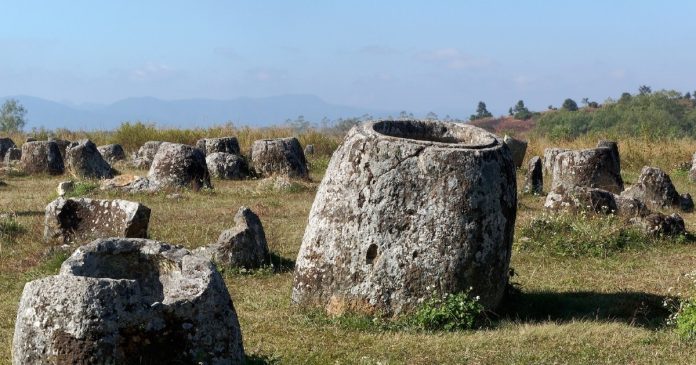
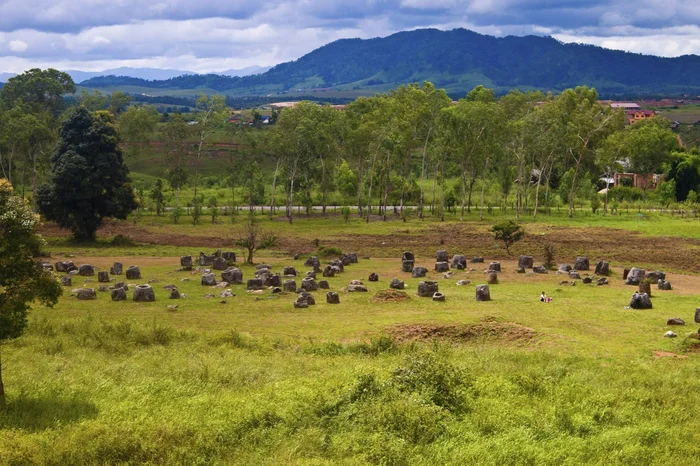
Recent headlines have suggested that a new archaeological excavation in northern Laos has finally resolved the long-standing puzzle of the Plain of Jars. A large stone vessel at Site 75 was found to contain the remains of at least thirty-seven individuals. Carefully arranged over several centuries. The findings add important detail to one chapter in the story of these megalithic features. But, they fall short of solving the broader mystery. The data illuminate how certain jars were used in later periods. But, leave open fundamental questions about when and why the jars were originally created.
The Excavation at Site 75 and What Was Found
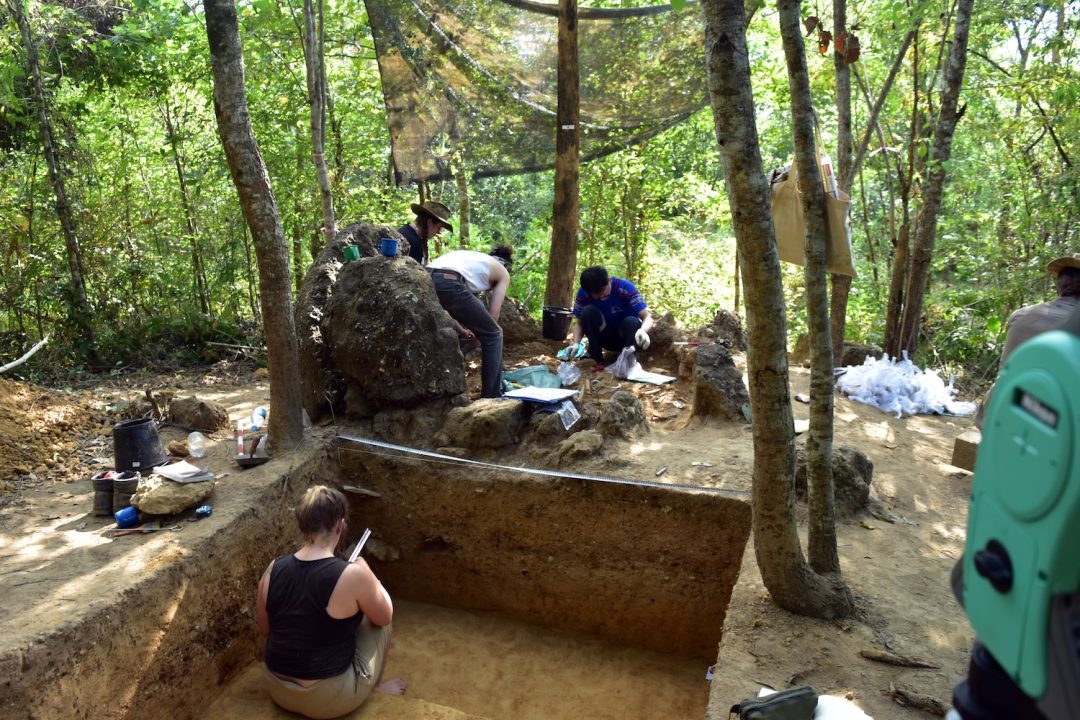
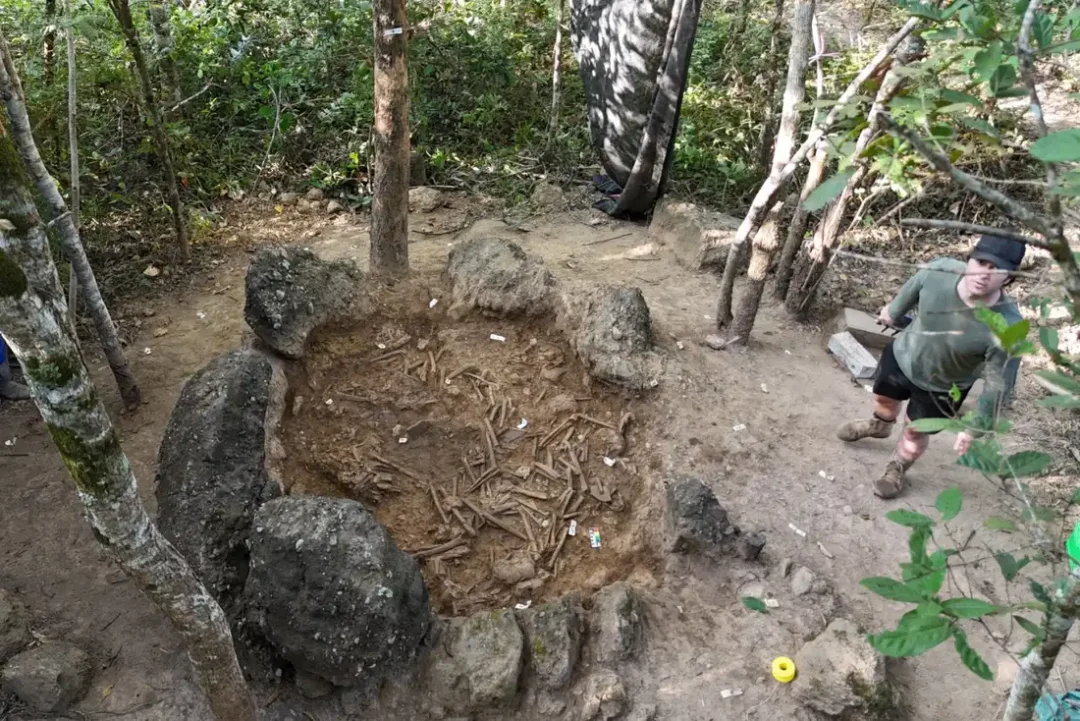
Archaeologists working at Site 75, located on the Xieng Khouang Plateau northeast of Phonsavan, focused on an exceptionally large stone vessel known as Jar 1. The jar measured roughly 1.3 meters in preserved height with a base diameter of about 2.05 meters. It was already in poor condition when work began, with partially collapsed sides and an interior open to the elements. Inside and around the vessel, excavators recovered densely packed, disarticulated human bones representing a minimum of thirty-seven individuals based on dental remains. Skulls and long bones showed deliberate arrangement, particularly around the edges of the feature.
Radiocarbon dating of bone, tooth, and charcoal samples placed the episodes of deposition between approximately 890 and 1160 CE. A span of up to 270 years with multiple distinct phases. The pattern is consistent with secondary burial practices in which bodies decomposed elsewhere before selected bones were gathered and placed inside the jar. Associated artifacts included iron tools, earthenware sherds, a copper based bell, stone slabs, and glass beads. Whose chemical composition points to production centers in South India and Mesopotamia. These goods suggest participation in wider trade networks during a time of increasing regional connectivity.
Lead researcher Nicholas Skopal described the collapsed vessel as resembling a giant stone cauldron that had caved in on itself. The team used photogrammetry to document the spatial relationships between the bones and the remaining jar fragments. Data confirmed that the remains filled the original interior space rather than accumulating around an external structure.
Funerary Interpretations Have Deep Roots in the Research
The notion that the Plain of Jars monuments served a mortuary purpose is far from novel. French archaeologist Madeleine Colani reached similar conclusions in the 1930s. She recovered burnt bone fragments, teeth, and glass beads from several jars during her pioneering surveys. Colani linked the sites to Iron Age burial practices. Rejecting earlier ideas that the vessels functioned simply as storage containers for food or water.
Subsequent work by Lao and Japanese teams expanded the picture. Excavations led by Eiji Nitta in the 1990s identified secondary pit burials. They also documented ceramic jar burials near the megalithic vessels at Site 1 and at other locations. More recent Australian Lao collaborative projects documented additional human remains. Both cremated and unburned, around and occasionally within jars at multiple locations. These earlier findings already supported the view that at least some jars played a role in complex funerary sequences involving secondary treatment of the dead.
The 2026 study therefore builds directly on this established line of interpretation rather than introducing an entirely new framework. Its primary contribution lies in the quality and context of the new evidence: the first well recorded instance of undisturbed, multigenerational secondary interments inside one of the largest stone vessels, accompanied by precise dating and trade artifacts.
The Dating Gap and the Question of Original Purpose
A critical limitation must be kept in view. The radiocarbon dates obtained from Jar 1 apply to the human remains and associated materials deposited inside the vessel. They establish when people used the jar as a repository for ancestral bones during the ninth through twelfth centuries CE. They do not date the carving of the stone itself or the moment when the jar was first positioned on the landscape.
Previous optically stimulated luminescence dating from sediments beneath jars at other sites has indicated that some vessels were already in place as early as the late second millennium BCE. This chronological separation means the ninth to twelfth century activity represents one documented phase of use. Not necessarily the period of original construction. The jar at Site 75 was already damaged and partially collapsed when the later burials occurred, consistent with a monument that had stood for centuries before being adopted for this specific mortuary function.
Repurposing as a Plausible Explanation
Monuments frequently acquire new meanings and uses long after their initial creation. The Plain of Jars sites show clear signs of extended histories of ritual engagement. Some jars contain later cremated remains associated with Buddhist traditions that arrived in the region centuries after the probable Iron Age horizon. Jar 1 deposit contained trade goods from distant sources. Their presence shows that ninth‑ to twelfth‑century communities continued to interact with these ancient features. Those interactions linked them to broader networks.
Nothing in the new excavation rules out the possibility that many of the jars were created earlier. Perhaps during the Iron Age or before, and were later repurposed as ossuaries or family crypts by subsequent groups. The careful arrangement of bones spanning multiple generations and the interpretation of the jar as a place for ongoing ancestral rites fit comfortably within a model of reuse. A megalithic vessel already carried significance because of its age and scale. It offered a ready‑made container for these practices. This symbolic potency made it an obvious choice.
This perspective matches patterns seen at megalithic sites worldwide. Later societies often reactivated or reinterpreted much older constructions for their own ritual purposes. The Plain of Jars may reflect the same dynamic. Its monuments appear to have accumulated layered biographies over time. They did not serve a single, fixed function from the moment they were created.
What the Discovery Adds and What It Leaves Unresolved
The excavation at Site 75 supplies valuable new texture to our understanding of mortuary practices in mainland Southeast Asia during the late first and early second millennia CE. It demonstrates that at least one large jar functioned as a communal repository for the remains of dozens of individuals over an extended period, likely organized at the scale of family or extended kin groups. The associated trade artifacts hint at connections reaching far beyond the Laotian highlands.
At the same time, the study does not resolve several core questions that have defined research on the Plain of Jars for nearly a century. We still lack direct evidence for when and how the majority of the jars were carved from stone, transported across the landscape, and initially erected. The engineering and organizational capacity required to move multiton vessels remains poorly understood. Whether the jars originally served primarily funerary roles, or whether their earliest purposes included other ritual, territorial, or social functions, continues to be debated. Most jars have not been excavated internally in the manner of Jar 1. So, variability across the hundreds of known examples is still largely unexplored.
The new data therefore refine rather than replace earlier models. They strengthen the case that certain jars held significance as places of ancestral commemoration during specific historical windows. While leaving open the possibility that their original creation belonged to an earlier cultural context.
Conclusion
Headlines proclaiming that the mystery of the Stone Jars of Laos has been solved overstate what the evidence from Site 75 actually delivers. The excavation provides the clearest picture yet of how one vessel was used as a multigenerational ossuary between the ninth and twelfth centuries CE. Complete with direct dating and contextual artifacts. This constitutes meaningful progress in documenting the later ritual life of the Plain of Jars landscape.
Yet the chronological gap between the dated bone deposits and the probable age of the jar itself, combined with a long scholarly tradition of funerary interpretations, means the findings are best understood as evidence of reuse rather than proof of original purpose. The monuments of the Plain of Jars appear to have participated in shifting cultural practices over many centuries. Their story is one of continuity and adaptation more than of a single decisive revelation.
