
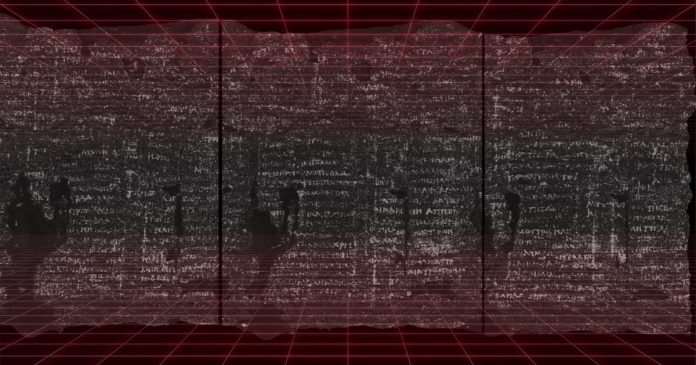
Researchers announced on June 25, 2026, that they had virtually unrolled and read an entire carbonized papyrus scroll from Herculaneum from beginning to end. The scroll, designated PHerc. 1667 and known in the project as Scroll 4, had remained sealed since the eruption of Mount Vesuvius in 79 AD. This marks the first complete end to end virtual reading of one such document. The achievement relied on high resolution X ray imaging, computational reconstruction, and machine learning. It opens a path to recover texts from the hundreds of scrolls that still sit unopened in collections.
Historical Context of the Herculaneum Papyri

Workers discovered the scrolls in the eighteenth century inside the Villa of the Papyri at Herculaneum. The villa formed part of a larger Roman town buried by volcanic debris. Early excavators recovered roughly eight hundred rolls or fragments. Many contained works by the Epicurean philosopher Philodemus and other Greek authors.
Physical unrolling attempts during the nineteenth and twentieth centuries frequently destroyed the brittle material. Some scrolls were reduced to fragments. Others received a readability score of zero after damage in the nineteen eighties. Conservationists then stored the surviving items without further invasive work.
Condition and Background of PHerc. 1667
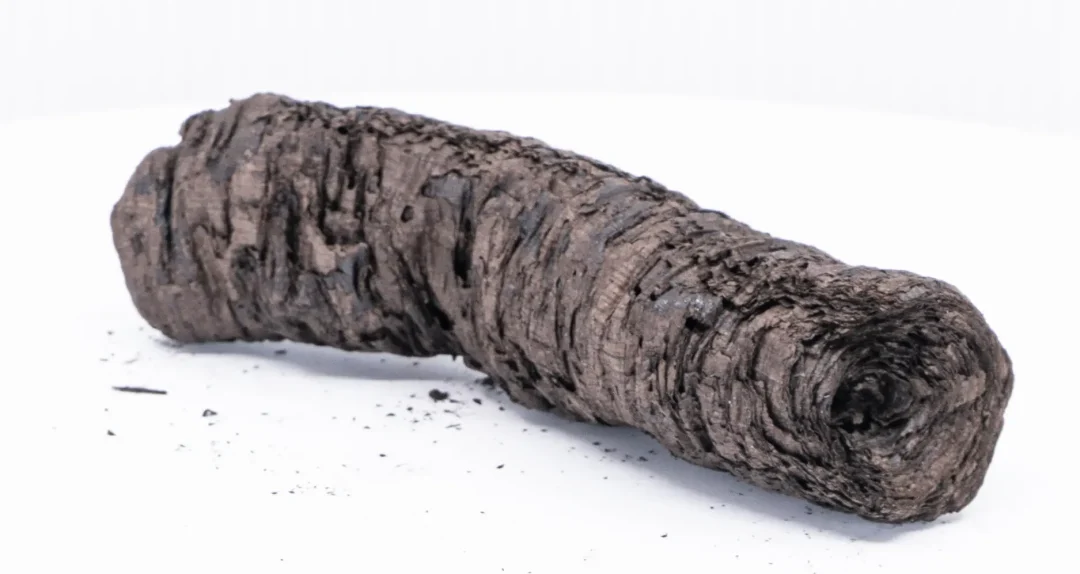
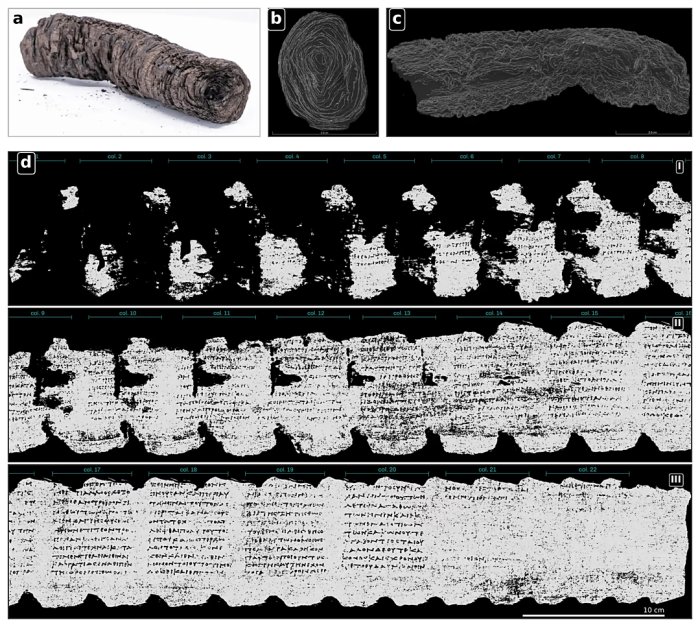
PHerc. 1667 belongs to the collection in the National Library of Naples. Previous interventions had stripped away outer layers and left a compact inner core roughly eight centimeters high. The surviving portion measured about one point five meters in length when virtually flattened. It contained approximately twenty-two columns of Greek text written in a formal hand. Papyrologists had long considered the item unreadable. The new project recovered continuous text across the lower parts of the columns despite gaps caused by surface loss.
High Resolution X Ray Scanning
Teams transported the scroll to synchrotron facilities for nondestructive imaging. They used phase contrast X ray microtomography on the BM18 beamline at the European Synchrotron Radiation Facility in Grenoble. Additional scans occurred at the Diamond Light Source in the United Kingdom.
These instruments produced three dimensional volumetric data at resolutions of a few micrometers. The phase contrast technique highlighted subtle density variations between the papyrus fibers and any applied ink. No physical contact occurred during data collection.
Virtual Unwrapping and Layer Segmentation
Software first reconstructed the three-dimensional geometry of the rolled papyrus. Algorithms then traced the path of each tightly wound layer through the volume. The process isolated individual sheets and projected them onto flat two-dimensional surfaces.
This virtual unwrapping pipeline avoided the distortions common in earlier manual methods. Open source code for the full workflow now resides in public repositories. The same pipeline later confirmed earlier partial readings on other scrolls through direct comparison of ink signals.
Machine Learning Detection of Ink
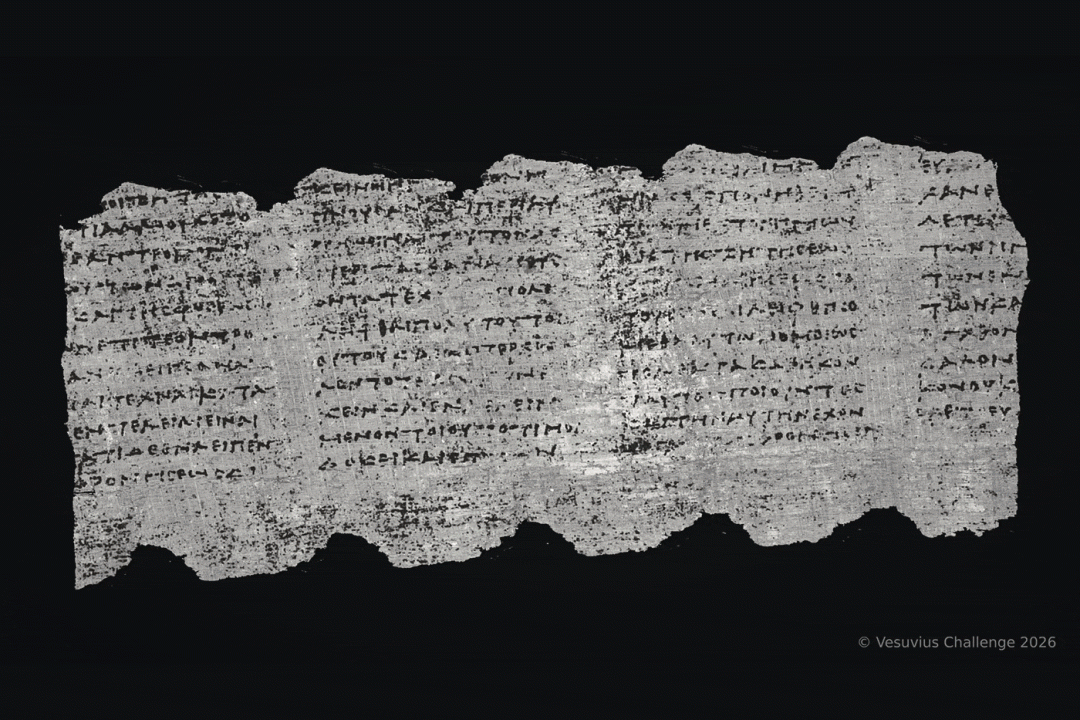
The carbon ink on carbonized papyrus creates only faint texture and density differences in the X ray volumes. Researchers trained neural networks on verified examples of ancient writing to locate these signals automatically. The models flagged potential letters across the flattened surfaces.
Papyrologists examined every flagged region. They produced a verified transcription of the surviving text. The combination of automated detection and expert review allowed sustained reading across multiple columns for the first time.
Content of the Recovered Philosophical Text
The transcribed text forms a continuous philosophical discussion roughly one point five meters long. It addresses ethics, human impulse, practical wisdom, and moral progress. Scholars identify the work as a Stoic treatise composed around the second century before the common era.
A reference to Aristocreon, nephew and disciple of the Stoic philosopher Chrysippus, appears near the end. This detail supports attribution to Chrysippus or a member of his school. Passages explore how departure from human nature impedes understanding and how disciplined inquiry builds practical wisdom. One translated excerpt reads: “We will inquire into something, but we will not grasp it, if in some way we depart from ourselves and from our own nature.”
The full Greek text and translation appear in the project preprint.
Impact on Ancient Studies and Remaining Scrolls
The successful reading of PHerc. 1667 demonstrates a scalable, nondestructive workflow. Parallel work on PHerc. 172 has already yielded more than seventy columns, including the title “On Vices, Book 1” by Philodemus. Additional titles and authors have emerged from other items.
All tomographic data, reconstructed surfaces, and transcriptions now appear openly on the Vesuvius Challenge site under a Creative Commons license. The associated preprint and code support further refinement by the global research community. Scholars anticipate recovery of many additional lost works from the ancient world in the coming years. The emphasis now moves to careful editing and historical interpretation of the newly accessible texts.
This development transforms a long-standing technical barrier into an active field of study. The remaining sealed scrolls in Naples and elsewhere can now receive systematic attention through the same methods.
