
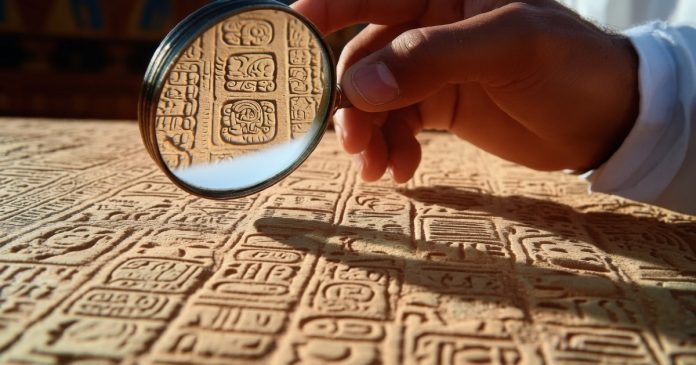
In early 2026 researchers published the identification of the first known Classic period Maya mathematician by name. The announcement centers on a painted microtext from the site of Xultun, Guatemala. Although archaeologists first uncovered the chamber containing the text in 2010, detailed imaging, conservation, and epigraphic analysis only recently allowed full reconstruction and decipherment of this particular inscription. Designated Text 19, it records an original astronomical formula and ends with an explicit attribution to an individual named Sak Tahn Waax (White chested Fox). This represents the only surviving example of a Classic Maya scholar claiming direct credit for mathematical and astronomical work.
The Structure at Xultun
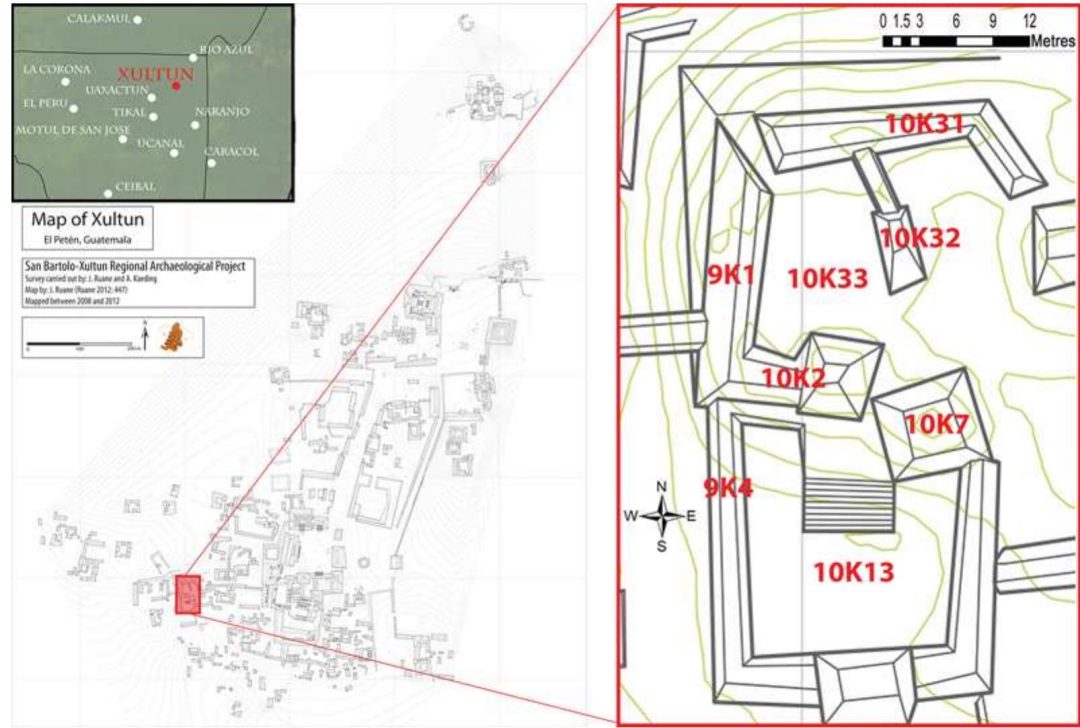
Excavations at Xultun in 2010 revealed Structure 10K2, a small masonry building in a residential area. The single chamber inside features painted portraits of seated and kneeling men on all four walls. Each figure bears the title taaj (obsidian), indicating a class of specialists. Among them appears the eighth century Xultun ruler Yax Wen Chan Kinich, shown dressed as a Maize Wind deity with a scorpion tail.
The east wall and the northeast corner contain the densest concentration of texts. Approximately fifty two separate inscriptions occur in this area. Many were painted over existing figures or on patches of newly applied lime plaster. Their content focuses on lunar tables, ring numbers, and nested cycles that reconcile planetary motions with the various Maya calendars. The physical character of the texts and the presence of papermaking tools in and near the chamber indicate that the room served as a workspace where specialists prepared bark paper books during the mid eighth century.
Documentation and Challenges
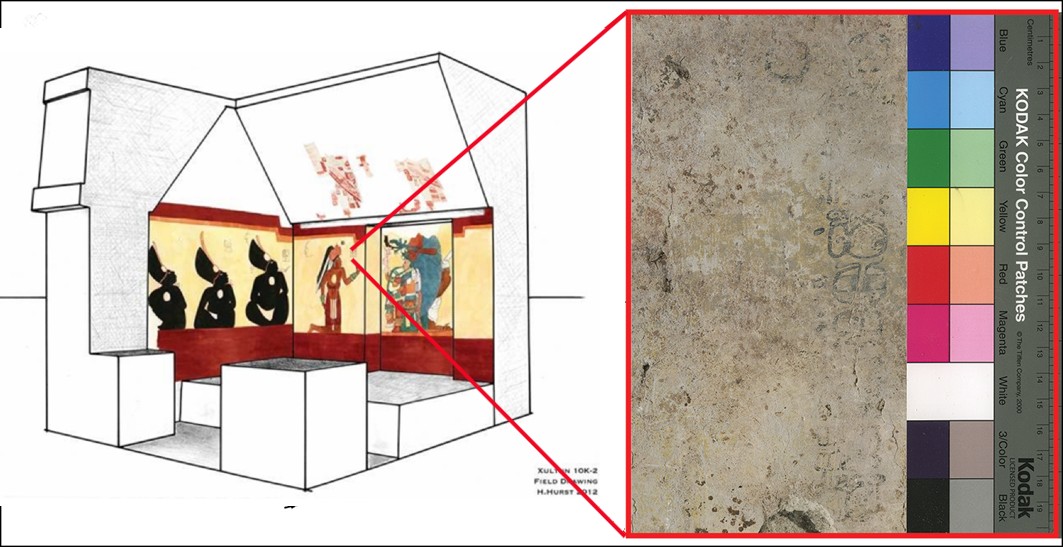
Preservation of the painted surfaces varies due to root growth, water infiltration, and the chamber’s proximity to modern ground level. After excavation, conservators cleaned the walls while specialists documented them using high resolution flatbed scans at four hundred dots per inch, conventional photography, infrared imaging, and digital enhancement tools such as dStretch. These combined techniques gradually revealed the faint glyphs of Text 19.
The inscription consists of eleven glyph blocks arranged in an inverted L shape. It measures one hundred ninety two millimeters high and occupies a central position on the east wall. Multispectral imaging and careful comparison of image sets enabled epigraphers to reconstruct eroded sections and produce a reliable drawing.
The Formula Itself
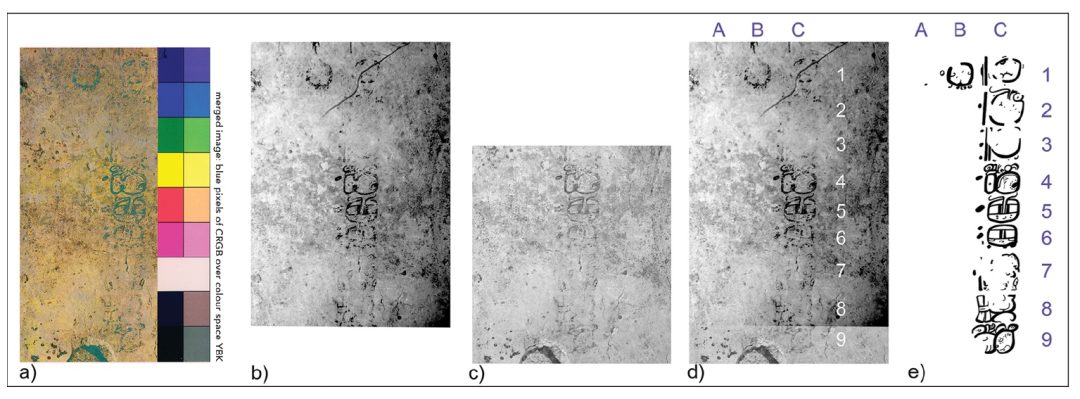
of Text 19; c) multispectral image of lower portion of Text 19; d) merged multispectral images of complete text with column and row numbers indicated;
e) reconstruction drawing of Text 19 (photographs by G. Ware; processed images by H. Hurst; drawing by F.D. Rossi). Image Source: https://doi.org/10.15184/aqy.2026.10378
Text 19 opens with a sequence of five calendar stations linked by precise intervals. The total span equals two thousand nine hundred twenty days. That number is the lowest common multiple of the Venus synodic period of five hundred eighty-four days and the solar year of three hundred sixty-five days. In other words, the relative position of Venus and the sun repeat after eight solar years or five Venus cycles.
The first date is reconstructed as four Akbal six Muan. Twenty days later the text reaches eleven Akbal six Pax. A further two hundred sixty days, equal to one Tzolkin cycle, brings the count to eleven Akbal one Zac. The next interval is one thousand five hundred sixty days, corresponding to two synodic periods of Mars. This lands on eleven Akbal one Pax. A final distance of one thousand eighty days, or three tuns of three hundred sixty days each, closes the sequence on twelve Akbal six Muan. The ending date falls on the same Haab day with which the formula began, exactly two thousand nine hundred twenty days later.
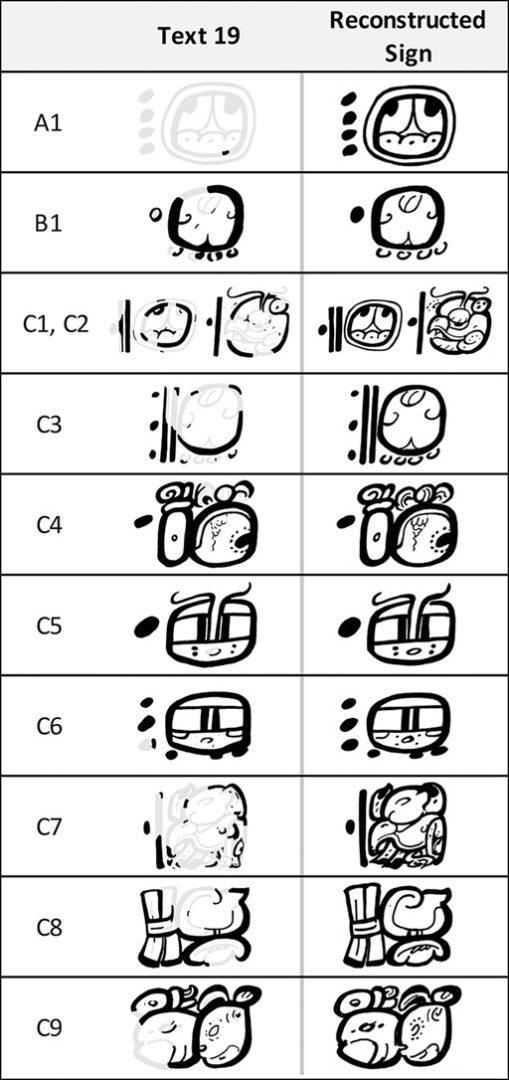
The intervals increase in a regular pattern: twenty days, two hundred sixty days, one thousand five hundred sixty days, and one thousand eighty days. The overall length is five Venus periods. Within this single count the scribe embedded the uinal of twenty days. The Tzolkin of two hundred sixty days. tun of three hundred sixty days. Haab of three hundred sixty-five days. The Venus year of five hundred eighty-four days, and the Mars year of seven hundred eighty days.
The Signature
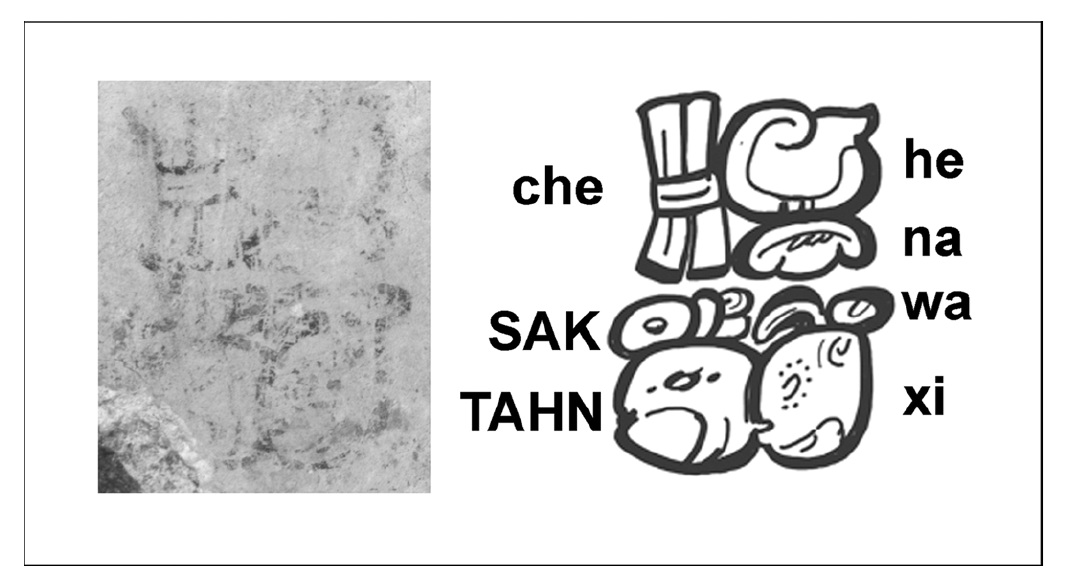
The final two glyphs of the text are not calendrical. The first reads che he na, a quotative particle that means so says. The second spells the personal name Sak Tahn Waax. The closing statement therefore attributes the preceding calculations directly to this individual. Whether Sak Tahn Waax painted the text with his own hand or whether another scribe recorded his work cannot be determined. In either case the formula carries an explicit claim of authorship. No other Classic period Maya text makes a comparable statement about mathematical or astronomical labor.
Context and Comparisons
The chamber contains many other calculations that deal with the same planetary cycles. One set of columns on the north wall consists of numbers evenly divisible by the seven hundred eighty day Mars period. A lunar table nearby spans roughly thirteen years of one hundred seventy seven or one hundred seventy eight day semesters. Certain texts appear to link lunar eclipses with the motions of Mars and particular star groups. Text 19 stands out because it presents a self contained formula rather than a partial table or a large super number. Its organization is unusual even by the standards of the room. The signature may reflect that novelty.
Later Maya books such as the Dresden Codex contain extensive Venus and Mars tables. Those tables treat each planet largely in isolation or in relation to seasonal markers. Text 19 instead interleaves the two planets inside a single continuous count that also respects the Tzolkin and the Haab. The structure has no close parallel among the surviving codices, yet the shared interest in reconciling Venus and Mars suggests continuity between the Classic period workshop at Xultun and the later manuscript tradition.
Chronological Placement
Paleographic details and the reconstructed Long Count position of the opening date place the formula in the year seven hundred eighty one of the Common Era. That date falls well within the occupation span of Structure 10K2, which ceramic and radiocarbon evidence place between approximately six hundred fifty and nine hundred fifty. The chamber was deliberately filled and buried in the mid to late eighth century, preserving its contents until modern excavation.
Significance of the Attribution
Although the chamber and its texts have been known since 2010, the full decipherment of Text 19 and recognition of its unique authorship claim are new. Previous studies documented the astronomical content of the room but did not isolate this signed formula or connect it to a named individual. The 2026 publication therefore marks the first identification of a specific Classic period Maya mathematician astronomer.
This discovery adds a personal dimension to our understanding of Indigenous Maya science. It shows that eighth century specialists not only performed sophisticated calculations but, in at least one case, claimed intellectual ownership of an original pattern of cycles. The work connects the Xultun workshop to later codex traditions while highlighting the creativity possible within established calendrical frameworks. Sak Tahn Waax now stands as the earliest known Maya scholar credited by name for contributions to mathematics and observational astronomy.
