

Göbekli Tepe’s reputation has been shaped by its pillars. The T‑shaped monoliths, the carved predators, and the circular enclosures dominate public imagination, creating a narrative of ritual architecture suspended above the practical realities of Neolithic subsistence. Yet the most consequential dataset from the site does not come from the pillars at all. It comes from the grinding stones. More than seven thousand cereal‑processing artifacts came out of the excavation areas, creating the largest and most standardized plant‑processing toolkit of the Early Neolithic. When analysts place these tools alongside phytolith evidence, architectural layout, and the newly uncovered hearths in the peripheral sectors excavated by Erdem Barın, Göbekli Tepe’s operational logic sharpens. The site functioned as a multi‑functional upland hub: a monumental ritual core at the center, ringed by domestic and activity zones where people cooked, processed, and consumed food. The pillars were the stage, but the grain was the engine.
The Grinding Tools and What They Reveal
A study by Dietrich and colleagues remains the most detailed analysis of Göbekli Tepe’s grinding equipment. The scale of the toolkit is extraordinary. Researchers documented thousands of handstones, grinding slabs, bowls, plates, mortars, and pestles, and they modeled each piece and ran macro‑ and microscopic use‑wear analysis on the entire toolkit.
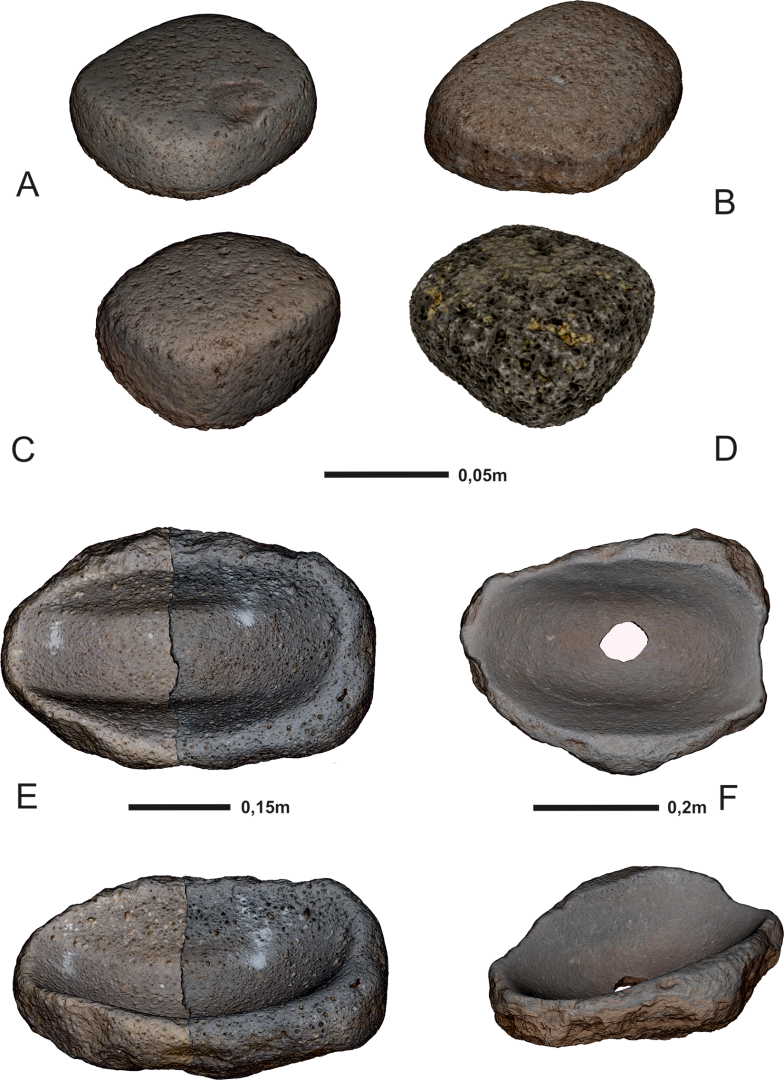
The results show that the tools were standardized in shape and size, indicating intentional mass production rather than casual or opportunistic use. The wear patterns match repeated grinding of cereals, not occasional processing of mixed materials. Experimental replication demonstrated that the tools could produce fine flour efficiently, with a half kilogram of einkorn processed in under an hour. Phytoliths recovered from tool surfaces and sediments confirm the massive presence of cereals, including wild einkorn and barley. The authors conclude that Neolithic groups at Göbekli Tepe produced standardized and efficient grinding tools, most of which were used for the processing of cereals.
This dataset reveals a community deeply engaged in plant processing, producing flour, meal, and malt in quantities far beyond household needs. Malt‑crushing wear patterns show that workers softened and crushed grain for fermentation, and this activity aligns with earlier evidence for beer‑like beverages in Late Natufian contexts. Bread is possible, but the archaeological signature fits porridge, mash, and malt‑based drink more securely than baked loaves. The grinding toolkit is the most direct evidence of what people actually did at Göbekli Tepe, and it shows that plant processing was not peripheral. It was central.
The Spatial Logic of Food Processing
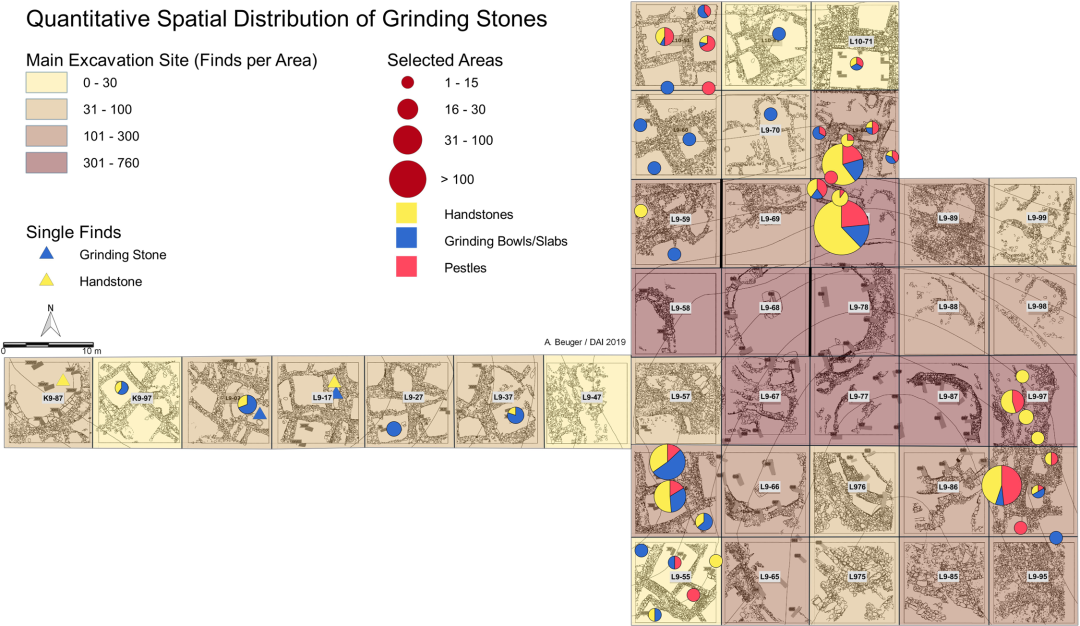
Göbekli Tepe contains two architectural systems that operate in tandem. The monumental circular enclosures of Layer III are the most visually striking. They contain smoothed bedrock floors, T‑pillars up to five and a half meters tall, carved reliefs of animals and abstract symbols, and benches carved into the walls. These buildings show no domestic debris, no storage installations, and no evidence of fire. They were cleaned during use and intentionally backfilled at the end of their operational life. They are not food‑processing spaces.
The rectangular buildings of Layer II tell a different story. These structures, often overlooked in popular narratives, contain grinding bowls set into floors, benches and platforms used as work surfaces, storage niches, and cell‑like rooms dedicated to processing tasks. Dense clusters of handstones and grinding slabs appear inside these buildings, not in the monumental enclosures. Dietrich and colleagues emphasize that plant‑food preparation links directly to the rectangular buildings, and they show that the distribution of grinding equipment marks out specific working zones dedicated to food production. These buildings function as Neolithic kitchens and workshops, even though they lack hearths. They are the operational centers of cereal processing.
The spatial separation is deliberate. The rectangular buildings form terraces around the monumental enclosures, creating a ring of workspaces surrounding the ritual core. The architecture itself encodes the workflow: processing in the rectangular buildings, gathering in the circular enclosures, and cooking outside.
The Hearth Evidence and the Expansion of the Site
For years, the absence of hearths in the main excavation area led researchers to conclude that cooking occurred outdoors. This interpretation was accurate for the limited footprint excavated by the German Archaeological Institute. However, recent excavations by Erdem Barın have expanded the known functional map of Göbekli Tepe. Barın’s team opened new trenches in sectors the German team never touched, including small circular enclosures, domestic clusters, peripheral habitation zones, and activity areas on the limestone plateau. In these new areas, Barın identified hearths, fire pits, burned floors, ash lenses, and charcoal concentrations. These features appear in domestic or mixed‑use contexts, not in the monumental enclosures.
This discovery does not overturn the original findings. It expands them. The monumental enclosures and their adjacent rectangular buildings still show no hearths. They were not cooking spaces. But other parts of Göbekli Tepe, newly excavated by Barın, do contain hearths and fire pits. These represent domestic or activity areas that were not part of the original excavation footprint. Göbekli Tepe was not a single‑purpose ritual sanctuary. It was a multi‑functional upland hub with distinct zones for ritual, processing, cooking, and habitation.
Integrating Processing, Cooking, and Consumption
The updated evidence allows a more complete reconstruction of Göbekli Tepe’s operational sequence. Grain processing happened inside the rectangular buildings, where grinding tools cluster and where benches and platforms provided stable work surfaces. Cooking happened in the domestic and activity zones identified by Barın, where hearths and fire pits appear. Consumption happened during seasonal gatherings, likely in or around the monumental enclosures, which served as communal focal points rather than domestic spaces.
This integrated model resolves the earlier contradiction created by the absence of hearths in the main excavation area. The monumental core was not designed for cooking. It was designed for gathering. The rectangular buildings were not designed for fire. They were designed for processing. The newly discovered domestic zones were designed for heat. Together, these zones form a coherent operational landscape.
Seasonal Work Feasts and Organized Labor
The grinding toolkit, the spatial layout, and the new hearth evidence converge on a single interpretation. Göbekli Tepe hosted large seasonal gatherings where people produced, cooked, and consumed food immediately. Dietrich and colleagues point out that the main excavation area shows no large storage facilities, so the community generated food for direct use. They also note that seasonal spikes in activity signal organized work feasts that mobilized labor at scale. Archaeozoological data support this model. Gazelle hunting peaks between midsummer and autumn, matching the seasonal availability of wild cereals. The grinding tools show heavy, repeated use, not occasional household activity. The rectangular buildings form terraces around the enclosures, functioning as work zones. The domestic clusters excavated by Barın provide the missing fire infrastructure
Göbekli Tepe did not operate as a temple cut off from subsistence. It ran as a labor‑intensive construction hub powered by seasonal feasting, and its workers processed plant and animal foods at scale to keep the operation moving. People did not gather because of the pillars. They carved the pillars because gatherings—driven by food production—created the conditions for that work.
In Closing
Göbekli Tepe’s carved pillars dominate public imagination, but the grinding stones and hearths tell the real story. They reveal a community capable of organizing labor, producing food at scale, and sustaining seasonal gatherings that fueled monumental construction. They show a site where subsistence and symbolism were intertwined, not a sanctuary floating above the practical realities of Neolithic life. The newly excavated domestic zones demonstrate that Göbekli Tepe included cooking spaces beyond the ritual core. The site was a work‑feast engine powered by grain, labor, fire, and seasonal celebrations. The pillars may be the most visible artifacts, but the grinding stones and hearths are the most honest. They show what people actually did at Göbekli Tepe and why they gathered.
For more big picture Tas Tepeler insights check out Megaliths and Metallurgy: A Lost Civilization Takes Shape
