

The Great Pyramid of Khufu has endured for more than 4500 years as one of the most remarkable engineering achievements in human history. Standing on the Giza Plateau, it has survived countless earthquakes, heavy rainstorms, and the immense compressive forces of its own massive structure without collapsing. While its iconic shape and precise alignment have long fascinated observers, recent analysis reveals a deeper layer of intentional design. Ancient Egyptian builders incorporated subtle geometric features, including the famous concavity of its faces, that actively enhanced its seismic resilience. This article explores how these architectural choices transformed potential vulnerabilities into sources of long term stability.
Concavity of the Great Pyramid

Each of the four faces of the Great Pyramid is slightly indented along its central line, creating a subtle concave octagonal form rather than a perfect square pyramid. This concavity is barely visible from the ground but becomes evident from the air, especially during equinox conditions when shadows highlight the division of each face into two right triangles. Early observers such as Flinders Petrie noted the hollowing of the core masonry, estimating an indent of about 0.94 meters on the north face. Later infrared photography and satellite imagery confirmed a maximum indent near 0.92 meters. For centuries this feature puzzled researchers, yet it now appears as a deliberate outcome of the pyramid’s internal construction rather than an accidental byproduct.
Inward Sloping Courses
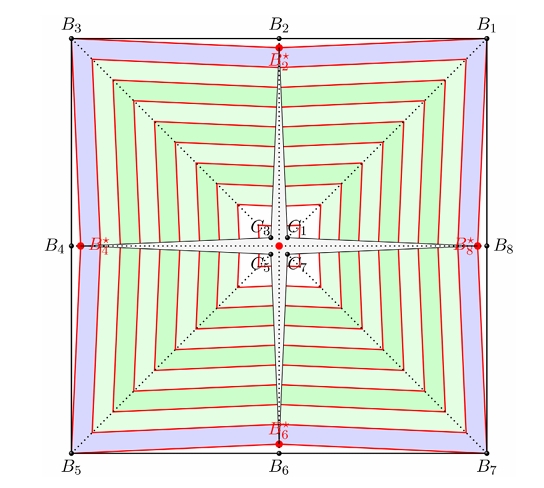
Geometric analysis demonstrates that the concavity arises from courses of blocks laid on gently inclined planes sloping inward toward the center at approximately 11 degrees to the horizontal, corresponding to a rise over run ratio of 1 to 5. When builders added uniform height blocks to these inclined triangular surfaces during construction, the outermost edges indented slightly along the midlines of each face.
This indentation was not imposed afterward but emerged directly from the practical method of laying stones while measuring angles rather than long distances on sloping planes. The slope itself is elegantly simple, consistent with ancient Egyptian surveying practices that relied on unit fractions. In this way the concavity served as a visible record of the pyramid’s internal structure of inward sloping layers.
Stability Against Gravity and Long Term Forces
The inward sloping courses provided critical advantages under the pyramid’s enormous gravitational load. Vertical forces from the weight of overlying stones generated lateral components that would normally push blocks outward in a structure of purely level courses. In contrast, the inclined layers directed these forces inward, tightening the masonry over time instead of allowing it to loosen. A reinforced base further enhanced stability. Builders incorporated a natural bedrock outcrop, estimated at 20 percent of the monument’s volume, into a cross shaped substructure bonded with precisely fitted limestone blocks and mortar. Corner sockets at the base prevented diagonal extension, while the concavity itself produced reaction forces that continuously compressed the structure toward its central axis. This design countered the rheological tendency of irregular stones to flow laterally and flatten under sustained pressure, a phenomenon that would have destabilized a purely level course system.
Protection from Earthquakes and Rainstorms
Earthquakes and rainstorms posed repeated threats over millennia. Historical records indicate the region experienced severe seismic events, including a major earthquake in 1303 AD that dislodged most casing stones. The inward sloping courses responded differently to ground shaking than level courses would have. During peak ground acceleration, blocks might shift outward temporarily, yet subsequent tremors allowed them to settle back into their inclined positions, restoring tightness. Rainstorms, occurring more frequently than modern observers might assume (accumulating over 500 significant events in 4500 years), also affected the structure differently. Water flowing through gaps in level courses would erode vertical faces and separate blocks laterally. On inclined courses, however, erosion combined with gravity to drive blocks inward, further compacting the masonry. An internal drainage system of chamfered stones forming vertical wells and vents, including a central well along the axis, helped manage moisture without compromising integrity.
Modern Validation Through Ambient Noise Analysis
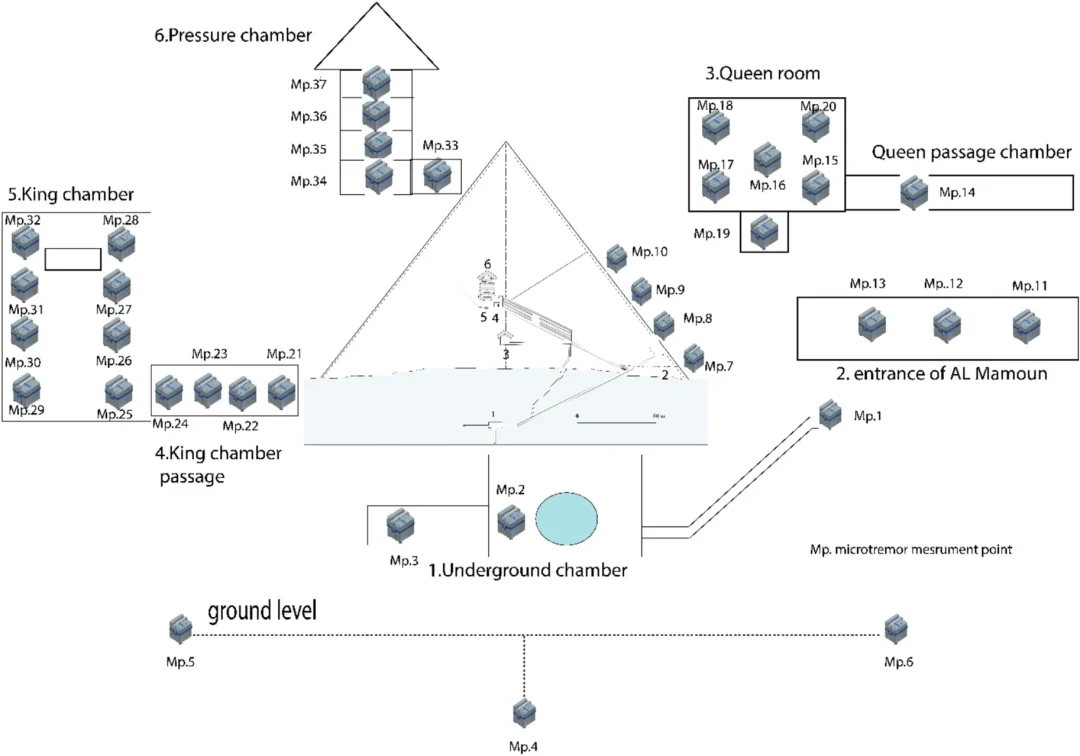
Amplification increased with elevation up to the level of the King’s Chamber but decreased noticeably within the pressure relieving chambers, demonstrating how their geometry actively mitigated seismic response. The foundation soils showed a low seismic vulnerability index of 8.2, confirming excellent bearing capacity. Together these measurements provide quantitative evidence that the ancient architects achieved homogeneous dynamic behavior precisely through the structural features, including inward sloping courses, that enhance overall earthquake resilience.
These theoretical insights from geometric and rheological modeling find strong empirical support in a comprehensive 2026 geophysical study that employed horizontal to vertical spectral ratio analysis at 37 measurement points inside the pyramid and on surrounding soil. The survey revealed remarkably uniform fundamental frequencies across all structural elements of the pyramid, averaging approximately 2.3 hertz, while the Giza Plateau soil exhibited a distinctly lower frequency near 0.6 hertz. This deliberate mismatch prevented resonance amplification during seismic events, a key factor in the monument’s survival.
Conclusion
The Great Pyramid stands not merely as a monumental tomb but as a sophisticated engineered system optimized for seismic and environmental endurance. Its subtle concavity, far from decorative, emerged as a natural consequence of inward sloping courses that actively tightened the structure under gravity, earthquakes, and erosion. Reinforced foundations, strategic mass distribution, and internal drainage complemented these choices, creating a resilient whole greater than the sum of its parts. Modern ambient noise surveys confirm what the geometry implies: the pyramid’s dynamic properties were deliberately tuned to avoid destructive resonance with the ground. In this light, the ancient Egyptians demonstrated profound geotechnical insight, embedding long term earthquake resistance into one of humanity’s most enduring creations. Their achievement continues to offer valuable lessons for contemporary engineering in seismic zones.
